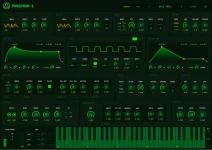
OA-Phosphor-1 uses a Lorenz strange attractor as a modulation source, while two conventional LFOs remain available elsewhere in the synth. The split matters because Lorenz chaos does not behave like another oddly shaped LFO hiding behind a different label.
A normal LFO follows a cycle. Give it a sine, triangle, saw, or another repeating shape, and the same contour comes around again, which is exactly what you want for tremolo, rhythmic filter movement, vibrato, and other jobs that benefit from a predictable pulse.
Lorenz modulation takes a different route. Its movement comes from a deterministic nonlinear system, so the next value follows from the system's current state rather than being picked randomly, yet the resulting path can remain nonperiodic instead of settling into a short repeating loop.
Edward Lorenz's deterministic nonperiodic flow research established the useful distinction decades before software synths started borrowing strange attractors. Small differences in a chaotic system's starting state can grow into very different trajectories, even though no dice roll is required to decide each new value.
For sound design, continuity is the interesting part. Smooth chaotic movement can wander without sounding like stepped sample-and-hold randomness, and it can keep developing after a normal periodic LFO would have exposed its cycle several times.
OA Labs describes its Lorenz source as deterministic motion that never quite repeats. The OA-Phosphor-1 v1.2 synth update keeps that chaos engine alongside dual LFOs that include random shapes and tempo synchronization, so you do not have to force one modulation method into every job.
The same logic applies to classic vibrato or a pumping amplitude pattern. Predictability is useful when the modulation itself is part of the rhythm, because listeners can lock onto the cycle instead of following a contour that keeps changing.
Lorenz modulation earns its place on sounds where repetition becomes a weakness. Long pads, drones, restrained pitch movement, slowly shifting filter color, and evolving textures can reveal a short LFO cycle quickly, especially once the same note is held across several bars.
Rate and amount then become more important than choosing a familiar waveform. Rate controls how quickly the chaotic motion develops, while amount decides how strongly its movement reaches the sound, letting you keep the source busy internally without making the destination lurch around.
Low amounts are often more convincing than dramatic settings. A little nonrepeating motion can stop a sustained patch from sitting perfectly still, while large amounts push the modulation itself to the front and make the instability an obvious part of the performance.
The distinction becomes especially clear when several modulators are already active. A repeating LFO can create a recognizable pulse against an envelope or arpeggiator, while Lorenz motion can add a slower layer whose timing does not keep landing in the same relationship to those events. You get movement without another obvious rhythmic grid competing for attention.
Pitch is also a revealing destination, but it is easy to overdo. Small continuous deviations can add unease or life, while heavy movement makes tuning instability the main event and can blur harmony faster than similar motion on timbre or filter position.
A useful comparison is to program one sustained patch with a slow sine LFO, another with smooth random modulation, and another with Lorenz chaos at a restrained depth. The sine eventually declares its period, the random source can feel less connected from moment to moment, and the chaotic source occupies the useful middle ground of structured motion without a simple loop.
OA-Phosphor-1 does not replace its LFOs with chaos because the two tools solve different problems. Use an LFO when you want recurrence you can predict; use random modulation when genuine unpredictability suits the patch, and reach for Lorenz motion when you want evolving behavior that remains governed rather than periodic.
A normal LFO follows a cycle. Give it a sine, triangle, saw, or another repeating shape, and the same contour comes around again, which is exactly what you want for tremolo, rhythmic filter movement, vibrato, and other jobs that benefit from a predictable pulse.
Lorenz modulation takes a different route. Its movement comes from a deterministic nonlinear system, so the next value follows from the system's current state rather than being picked randomly, yet the resulting path can remain nonperiodic instead of settling into a short repeating loop.
Deterministic chaos is not the same as random modulation
Random modulation and chaotic modulation can both sound unpredictable, but they arrive there differently. A random source may generate new values without a fixed underlying trajectory, while a Lorenz system follows equations whose state evolves continuously from what came before.Edward Lorenz's deterministic nonperiodic flow research established the useful distinction decades before software synths started borrowing strange attractors. Small differences in a chaotic system's starting state can grow into very different trajectories, even though no dice roll is required to decide each new value.
For sound design, continuity is the interesting part. Smooth chaotic movement can wander without sounding like stepped sample-and-hold randomness, and it can keep developing after a normal periodic LFO would have exposed its cycle several times.
OA Labs describes its Lorenz source as deterministic motion that never quite repeats. The OA-Phosphor-1 v1.2 synth update keeps that chaos engine alongside dual LFOs that include random shapes and tempo synchronization, so you do not have to force one modulation method into every job.
An LFO is still better when timing must be obvious
Chaos is not automatically the more sophisticated choice. If a filter needs to open on every quarter note, a tempo-synced LFO gives you repeatable timing that is easy to hear, edit, and line up with the groove.The same logic applies to classic vibrato or a pumping amplitude pattern. Predictability is useful when the modulation itself is part of the rhythm, because listeners can lock onto the cycle instead of following a contour that keeps changing.
Lorenz modulation earns its place on sounds where repetition becomes a weakness. Long pads, drones, restrained pitch movement, slowly shifting filter color, and evolving textures can reveal a short LFO cycle quickly, especially once the same note is held across several bars.
Rate and amount then become more important than choosing a familiar waveform. Rate controls how quickly the chaotic motion develops, while amount decides how strongly its movement reaches the sound, letting you keep the source busy internally without making the destination lurch around.
Low amounts are often more convincing than dramatic settings. A little nonrepeating motion can stop a sustained patch from sitting perfectly still, while large amounts push the modulation itself to the front and make the instability an obvious part of the performance.
The distinction becomes especially clear when several modulators are already active. A repeating LFO can create a recognizable pulse against an envelope or arpeggiator, while Lorenz motion can add a slower layer whose timing does not keep landing in the same relationship to those events. You get movement without another obvious rhythmic grid competing for attention.
Lorenz motion works best when you leave it room
Short plucks may end before a chaotic trajectory has time to show why it is different. Longer notes expose the payoff because the modulation can keep moving without announcing a four-beat or eight-beat return point.Pitch is also a revealing destination, but it is easy to overdo. Small continuous deviations can add unease or life, while heavy movement makes tuning instability the main event and can blur harmony faster than similar motion on timbre or filter position.
A useful comparison is to program one sustained patch with a slow sine LFO, another with smooth random modulation, and another with Lorenz chaos at a restrained depth. The sine eventually declares its period, the random source can feel less connected from moment to moment, and the chaotic source occupies the useful middle ground of structured motion without a simple loop.
OA-Phosphor-1 does not replace its LFOs with chaos because the two tools solve different problems. Use an LFO when you want recurrence you can predict; use random modulation when genuine unpredictability suits the patch, and reach for Lorenz motion when you want evolving behavior that remains governed rather than periodic.