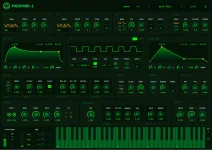
OA-Phosphor-1’s current arpeggiator gives every step control over pitch degree, octave, probability, timing, ties, rests, and glitch behavior. It is closer to a compact phrase generator than the usual up, down, or random note repeater.
The difference shows up once you stop feeding it simple triads and expecting a fixed pattern back. Each step can decide more than which note plays, so one held chord can produce phrases that change shape, skip events, stretch across octaves, and lean away from the grid without rebuilding the MIDI clip underneath it.
Per-step octave movement gives the pattern another axis. A chord can stay harmonically familiar while individual events jump above or below the played voicing, which is often enough to turn a plain repeated figure into something that feels composed rather than mechanically cycled.
The glitch engine pushes further with jump, stutter, and skip actions on individual steps. Those operations can redirect or repeat parts of the sequence without forcing the whole arp into one global glitch mode, so a disruption can happen at one point while the rest of the phrase keeps its identity.
Trig phase adds another layer for patterns that should behave differently across repeated cycles. Instead of treating every pass as an identical run through the same steps, the arp can create conditional-feeling movement across cycles, which is useful when four bars need to feel related without being carbon copies.
The OA-Phosphor-1 v1.2 arpeggiator changes also make timing movement visible. Off-time steps are drawn against the grid, so groove stops being an invisible amount knob and becomes something you can inspect while the pattern runs.
Visual feedback matters because timing changes are easy to overcook. A few displaced steps can loosen a phrase, while large offsets can make the arp feel late, rushed, or detached from the drums even when the note choices are perfectly sensible.
Research on performed rhythm is more cautious than the usual claim that humanized timing automatically creates better groove. Microtiming and groove research found strong groove ratings for both quantized performances and performances retaining natural microtiming, while exaggerated timing deviations generally reduced ratings.
OA-Phosphor-1 gives you a practical way to hear that boundary. Start straight, add groove gradually, and watch where the steps land before deciding whether a looser setting actually helps the part or merely makes the timing less precise.
Custom seeding is useful when you want variation with some repeatability. Instead of accepting a completely different result every time, a seeded groove can give the pattern its own recognizable timing fingerprint, which makes experimentation easier when you are comparing versions inside an arrangement.
The expanded octave range gives those held patterns more room to travel. Five octaves is enough for a restrained chord to turn into a much wider melodic figure, especially when per-step octave motion is already deciding which events climb or drop.
Eleven pattern modes keep the basic note-order behavior available when you want it. The useful part is being able to combine a recognizable ordering rule with probability, timing, octave changes, rests, ties, and glitches rather than expecting the pattern mode itself to provide all the variation.
A good patch does not need every arp feature active. One or two probability changes, a single octave jump, and restrained groove can carry more personality than a sequence where every step is trying to surprise you.
Use glitch actions where the ear can remember the normal pattern first. Keep the groove close enough to the beat that the drums still own the pocket, then let octave motion and probability handle longer-term variation. The arpeggiator becomes most convincing when its generative behavior sounds intentional rather than busy.
The difference shows up once you stop feeding it simple triads and expecting a fixed pattern back. Each step can decide more than which note plays, so one held chord can produce phrases that change shape, skip events, stretch across octaves, and lean away from the grid without rebuilding the MIDI clip underneath it.
Per-step probability keeps repetition from becoming rigid
Probability is useful because repetition and variation do not need separate patterns. Lowering the chance of a step firing can create occasional gaps inside an otherwise stable phrase, while ties and rests let you control whether the rhythm breathes, sustains, or simply stays silent.Per-step octave movement gives the pattern another axis. A chord can stay harmonically familiar while individual events jump above or below the played voicing, which is often enough to turn a plain repeated figure into something that feels composed rather than mechanically cycled.
The glitch engine pushes further with jump, stutter, and skip actions on individual steps. Those operations can redirect or repeat parts of the sequence without forcing the whole arp into one global glitch mode, so a disruption can happen at one point while the rest of the phrase keeps its identity.
Trig phase adds another layer for patterns that should behave differently across repeated cycles. Instead of treating every pass as an identical run through the same steps, the arp can create conditional-feeling movement across cycles, which is useful when four bars need to feel related without being carbon copies.
The OA-Phosphor-1 v1.2 arpeggiator changes also make timing movement visible. Off-time steps are drawn against the grid, so groove stops being an invisible amount knob and becomes something you can inspect while the pattern runs.
Groove works better when you can see the displacement
OA Labs describes the groove section as more than a single swing control. Pattern, resolution, amount, and feel work together, while a groove preview and custom seeding give you a way to shape timing behavior without manually dragging every MIDI note in the DAW.Visual feedback matters because timing changes are easy to overcook. A few displaced steps can loosen a phrase, while large offsets can make the arp feel late, rushed, or detached from the drums even when the note choices are perfectly sensible.
Research on performed rhythm is more cautious than the usual claim that humanized timing automatically creates better groove. Microtiming and groove research found strong groove ratings for both quantized performances and performances retaining natural microtiming, while exaggerated timing deviations generally reduced ratings.
OA-Phosphor-1 gives you a practical way to hear that boundary. Start straight, add groove gradually, and watch where the steps land before deciding whether a looser setting actually helps the part or merely makes the timing less precise.
Custom seeding is useful when you want variation with some repeatability. Instead of accepting a completely different result every time, a seeded groove can give the pattern its own recognizable timing fingerprint, which makes experimentation easier when you are comparing versions inside an arrangement.
Hold and octave range turn the arp into a performance tool
Hold or latch changes how you play the instrument because your hands no longer need to keep every source note pressed. You can feed the arp a chord, let the pattern continue, then use the freed hand for filter movement, AGE, modulation, or another controller while the phrase keeps running.The expanded octave range gives those held patterns more room to travel. Five octaves is enough for a restrained chord to turn into a much wider melodic figure, especially when per-step octave motion is already deciding which events climb or drop.
Eleven pattern modes keep the basic note-order behavior available when you want it. The useful part is being able to combine a recognizable ordering rule with probability, timing, octave changes, rests, ties, and glitches rather than expecting the pattern mode itself to provide all the variation.
A good patch does not need every arp feature active. One or two probability changes, a single octave jump, and restrained groove can carry more personality than a sequence where every step is trying to surprise you.
Use glitch actions where the ear can remember the normal pattern first. Keep the groove close enough to the beat that the drums still own the pocket, then let octave motion and probability handle longer-term variation. The arpeggiator becomes most convincing when its generative behavior sounds intentional rather than busy.