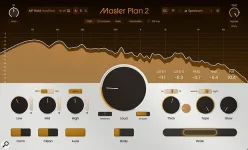
Musik Hack has rebuilt Master Plan 2 from scratch, giving its mastering plug-in a new limiter, more sound controls, and a fresh interface. The update keeps the all-in-one setup of the first version but gives producers far more ways to shape a finished track without a long chain of separate effects.
Much of the design draws from co-founder Stan Greene's work in mixing and mastering. The first Master Plan had already gained fans among Grammy-winning audio pros with credits tied to Post Malone, Drake, Doja Cat, Shaboozey, SZA, Ludacris, and Usher. That's quite a user base for a plug-in built around ease of use.
Limiter 2.0 gets a major upgrade. Musik Hack says its new design can push volume higher while keeping drums, bass, and mix detail intact. The Presence control offers two release styles, while Body lifts softer parts of a track. Glue compression and true-peak limiting also get finer control, which may help users push loudness without wrecking the mix.
Tone shaping gets more options as well. Producers can blend four types of saturation, with the familiar Thick mode still in place. Glow aims to bind the mix, Aura adjusts the plug-in's color, and Silk adds smooth high-end harmonics. Auto-input leveling handles gain setup, while a low-latency mode makes live use more practical.
Underneath, the EQ has new phase and frequency tuning, while the multiband compressor uses a revised crossover meant to avoid pre-ringing. Dynamic Calm helps reduce harsh peaks and unwanted resonances. Tape saturation gets separate flavor and intensity controls, giving users more say over how much grit reaches the master.
There's also a hybrid anti-aliasing system that pairs oversampling with Antiderivative Antialiasing, or ADAA. Its job is to cut unwanted artifacts from nonlinear effects. Latency-aware bypass and automatic LUFS matching help make before-and-after checks fairer, without a louder signal getting an unfair edge.
The metering side has had a major refresh. An intelligent loudness guide checks the music as it plays and shows when limiting may be getting out of hand. New views cover gain, frequency balance, EQ, and stereo image, while a difference display tracks the extra gain and saturation. All those visuals can be hidden if users prefer a clean screen.
Reference tracks can be loaded right into the plug-in, with beat detection making it easy to loop matching parts. Three snapshots let users swap settings across song sections or run blind comparisons. Fresh themes, dark and light modes, and deeper options round out the interface changes.
And for anyone who likes the old sound, Legacy Mode keeps the full Master Plan 1 processing chain ready for use. Co-founder Sam Fischmann says the goal was to give engineers more control while keeping mastering quick and easy.
Windows 10 and newer systems can run Master Plan 2, along with Macs on macOS 11 or later. It comes in VST3, AU, and AAX formats.
New buyers can grab it at an intro rate of $179 instead of $249, or pay $15 across 12 monthly payments through Rent-to-Own. Existing users have a $60 upgrade path, with a $5 monthly payment choice as well.