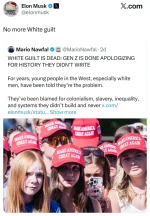
Elon Musk has been pushing back hard against the concept of white guilt on X, and people are pointing out his apartheid-era upbringing in South Africa as relevant context. The billionaire keeps boosting posts about white people being tired of apologizing for historical stuff they personally had nothing to do with, plus he regularly shares content worrying about demographic shifts and declining white birth rates.
Critics say his background matters because he grew up benefiting from a system literally built on racial hierarchy, then moved to North America and became insanely wealthy. The timing of his anti-guilt posting also lines up suspiciously with whenever reparations conversations gain momentum, even though Japanese Americans and Holocaust survivors actually got compensated, while Black Americans never received the land or resources promised after slavery.
The argument goes that Musk controls a massive platform and uses it to reframe accountability as some kind of attack on white people, which conveniently dodges actual conversations about material inequality. For communities already dealing with wealth gaps and systemic issues, watching someone with his specific history amplify grievance narratives feels less like free speech and more like power protecting itself.
Critics say his background matters because he grew up benefiting from a system literally built on racial hierarchy, then moved to North America and became insanely wealthy. The timing of his anti-guilt posting also lines up suspiciously with whenever reparations conversations gain momentum, even though Japanese Americans and Holocaust survivors actually got compensated, while Black Americans never received the land or resources promised after slavery.
The argument goes that Musk controls a massive platform and uses it to reframe accountability as some kind of attack on white people, which conveniently dodges actual conversations about material inequality. For communities already dealing with wealth gaps and systemic issues, watching someone with his specific history amplify grievance narratives feels less like free speech and more like power protecting itself.