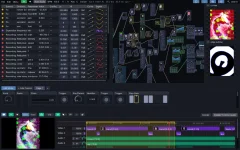
n1m21n has released Infinite, a free modular DAW that lets music makers build sound and visuals in one place. The open-source app runs on macOS, Windows, and Linux, using a node-based setup to link audio, video, and 3D graphics.
Here's what makes it quite different. Sound can drive visuals, while motion and video can change the music. A producer could use a beat to alter a 3D object or let changes in a video affect a synth. It all runs through the same canvas.
Under the hood, Infinite uses a sample-accurate audio engine that pulls data through its node network. The graphics side runs on the GPU, letting users create textures and 3D scenes as the music plays.
And there's plenty to work with. More than 300 built-in nodes cover wavetable synths, metal-like resonators, granular effects, and spectral sound tools. Grain Molder handles spectral resynthesis, while PaulStretch offers extreme time stretching. A 16-pad sampler supports polyphonic playback as well.
Those who prefer their usual plugins aren't left out. Infinite can load VST3 instruments and effects across all three desktop systems. Mac users also get Audio Unit support. Each plugin keeps its native interface, with controls you can automate through exposed modulation pins.
For arranging tracks, users get a clip-based timeline linked to the main BPM clock. It works alongside the modular view, with precise scheduling at the tick level.
The sequencing tools go well beyond basic note patterns. There are Euclidean rhythm makers, arpeggiators, random note generators, timing humanizers, and even ways to trigger MIDI notes through physics.
Visual artists get GLSL shaders, 3D mesh effects, and live video output via Syphon, Spout, and NDI. Audio FFT data, LFOs, step sequencers, and changes in video brightness or movement can all control different parts of a project.
Another neat feature is Field, a built-in language with JIT compilation. It lets users write custom audio processing, pixel shaders, and 3D shape changes right inside Infinite. No separate plugin build or C++ setup is needed.
The app is available under GPLv3 and MIT licenses, with no price attached. Mac users need Big Sur 11 or newer, with support for Apple Silicon and Intel. Windows users can run it on Windows 10 or later through an installer or portable package, with x64 and ARM64 support.
Linux users get an x86_64 AppImage. For anyone keen to try a modular setup that brings music and real-time graphics into one workspace, Infinite is ready to explore without paying for a license.