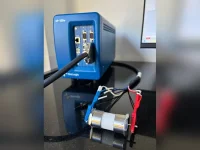
Researchers at Nagaland University created a flexible supercapacitor device capable of powering wearable electronics, electric vehicles, and renewable energy systems. The Indian Institute of Science, Bangalore, supported the research, and the Anusandhan National Research Foundation funded the project. The team constructed a working prototype that demonstrates practical applications in health-monitoring devices, IoT gadgets, robotics, and electric vehicles.
The device uses cobalt-doped molybdenum diselenide and delivers an energy density of 34.54 W h kg⁻¹. It maintains stability over 10,000 charge-discharge cycles and retains performance after repeated bending and twisting. The innovation could reduce India's dependence on imported batteries and advance clean energy storage technologies. The Advanced Materials for Device Applications Research Laboratory in the Lumami campus developed the prototype.
The researchers plan to optimize the electrode-electrolyte interface, improve safety with solid-state gel electrolytes, and scale production to pilot levels. Industry collaborations are under exploration to advance commercialization efforts. The study compared tungsten, vanadium, and cobalt doping in molybdenum diselenide for energy storage, with cobalt proving to be the most effective.
The device uses cobalt-doped molybdenum diselenide and delivers an energy density of 34.54 W h kg⁻¹. It maintains stability over 10,000 charge-discharge cycles and retains performance after repeated bending and twisting. The innovation could reduce India's dependence on imported batteries and advance clean energy storage technologies. The Advanced Materials for Device Applications Research Laboratory in the Lumami campus developed the prototype.
The researchers plan to optimize the electrode-electrolyte interface, improve safety with solid-state gel electrolytes, and scale production to pilot levels. Industry collaborations are under exploration to advance commercialization efforts. The study compared tungsten, vanadium, and cobalt doping in molybdenum diselenide for energy storage, with cobalt proving to be the most effective.