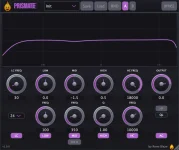
Prismate’s Natural Phase mode uses 2x oversampling and reports latency to the host only while the mode is active. Those two facts matter because neither one makes it a linear-phase equalizer, despite how easily the terms get bundled together.
A normal minimum-phase EQ changes magnitude and phase together, while a linear-phase EQ keeps the relative phase response linear across frequency. Natural Phase sits outside that neat pair because the name has no industry-wide technical definition. One developer can use it for analog-style phase matching, another for a shortened FIR design, and another for oversampled EQ behavior near Nyquist.
In Prismate, Natural Phase engages 2x oversampling to stop the upper EQ curve from cramping near Nyquist. The plugin also reports latency only while the mode is active, so a host can keep tracks aligned during compensated playback. Nothing in that description says the processor becomes linear phase, and latency by itself cannot tell you which phase topology an EQ uses.
The practical lesson is simple. Treat “Natural Phase” as a product-specific mode name until the developer explains what happens under the hood. Assuming every plugin means the FabFilter definition can lead you to expect phase behavior, transient behavior, or latency characteristics that another EQ never promised.
Digital parametric filters can misbehave near the top of the spectrum because common filter designs warp as they approach the Nyquist limit. A shelf or bell that should keep a broad analog-style shape may tighten or bend unexpectedly at high frequencies. The technical problem is well established in high-frequency EQ cramping, and oversampling is one established way to move the troublesome boundary farther away during processing.
Linear-phase processing solves another problem. It is concerned with preserving phase relationships across frequencies rather than making an ordinary digital EQ curve behave better near the top of the spectrum. A linear-phase filter can still require substantial latency because its processing needs future samples to produce a symmetrical impulse response.
Pre-ringing follows from that symmetry and is one reason linear phase is not automatically the cleaner choice. Sharp low-frequency filters, narrow boosts, and aggressive corrections can place ringing before a transient, softening attacks or creating an audible lead-in. Minimum-phase processing keeps its ringing after the event instead, while also introducing frequency-dependent phase rotation.
Prismate’s conditional latency is therefore worth reading literally. The host needs compensation when Natural Phase is active, but the presence of compensation does not prove that the mode is linear phase. Prismate’s Natural Phase implementation is better understood from its documented purpose, which is preserving the intended high-frequency EQ shape through 2x oversampled processing.
Linear phase can be useful in those cases because matching magnitude changes without changing relative phase may keep the recombination more predictable. The cost is latency and possible pre-ringing, especially with aggressive filters. Neither drawback makes the mode bad, but both are reasons to choose it for a specific job instead of treating it as an automatic upgrade.
At a 44.1 kHz session rate, Nyquist sits at 22.05 kHz, so a high shelf can approach the digital boundary quickly. Running the EQ internally at a higher rate gives its filters more space to form the intended top-end curve before the audio returns to the session rate. Prismate’s 2x mode targets that specific problem rather than claiming the phase behavior of a dedicated linear-phase EQ.
A normal minimum-phase EQ changes magnitude and phase together, while a linear-phase EQ keeps the relative phase response linear across frequency. Natural Phase sits outside that neat pair because the name has no industry-wide technical definition. One developer can use it for analog-style phase matching, another for a shortened FIR design, and another for oversampled EQ behavior near Nyquist.
Natural Phase is a label, not a filter standard
FabFilter uses Natural Phase for a mode designed to match both the magnitude and phase response of analog EQ more closely than its zero-latency mode. Another current EQ describes its own Natural mode as a shorter linear-phase FIR implementation with less latency than its full linear setting. Prismate documents something different again.In Prismate, Natural Phase engages 2x oversampling to stop the upper EQ curve from cramping near Nyquist. The plugin also reports latency only while the mode is active, so a host can keep tracks aligned during compensated playback. Nothing in that description says the processor becomes linear phase, and latency by itself cannot tell you which phase topology an EQ uses.
The practical lesson is simple. Treat “Natural Phase” as a product-specific mode name until the developer explains what happens under the hood. Assuming every plugin means the FabFilter definition can lead you to expect phase behavior, transient behavior, or latency characteristics that another EQ never promised.
Digital parametric filters can misbehave near the top of the spectrum because common filter designs warp as they approach the Nyquist limit. A shelf or bell that should keep a broad analog-style shape may tighten or bend unexpectedly at high frequencies. The technical problem is well established in high-frequency EQ cramping, and oversampling is one established way to move the troublesome boundary farther away during processing.
Oversampling fixes a different problem from linear phase
Oversampling raises the internal sample rate before processing and then returns the signal to the session rate afterward. For a clean EQ, one useful reason is giving high-frequency filters more room to maintain their intended shape before they run into the Nyquist ceiling. Prismate’s own description ties its 2x mode directly to preventing curve cramping.Linear-phase processing solves another problem. It is concerned with preserving phase relationships across frequencies rather than making an ordinary digital EQ curve behave better near the top of the spectrum. A linear-phase filter can still require substantial latency because its processing needs future samples to produce a symmetrical impulse response.
Pre-ringing follows from that symmetry and is one reason linear phase is not automatically the cleaner choice. Sharp low-frequency filters, narrow boosts, and aggressive corrections can place ringing before a transient, softening attacks or creating an audible lead-in. Minimum-phase processing keeps its ringing after the event instead, while also introducing frequency-dependent phase rotation.
Prismate’s conditional latency is therefore worth reading literally. The host needs compensation when Natural Phase is active, but the presence of compensation does not prove that the mode is linear phase. Prismate’s Natural Phase implementation is better understood from its documented purpose, which is preserving the intended high-frequency EQ shape through 2x oversampled processing.
Phase mode matters most when signals have to recombine
On a single vocal, synth, or drum track, a minimum-phase EQ can be completely appropriate even though it rotates phase around the frequencies being changed. Problems become easier to hear when the processed signal must recombine with a closely related version of itself. Parallel buses, multi-mic recordings, duplicated layers, and mid-side paths can expose phase differences through partial cancellation.Linear phase can be useful in those cases because matching magnitude changes without changing relative phase may keep the recombination more predictable. The cost is latency and possible pre-ringing, especially with aggressive filters. Neither drawback makes the mode bad, but both are reasons to choose it for a specific job instead of treating it as an automatic upgrade.
At a 44.1 kHz session rate, Nyquist sits at 22.05 kHz, so a high shelf can approach the digital boundary quickly. Running the EQ internally at a higher rate gives its filters more space to form the intended top-end curve before the audio returns to the session rate. Prismate’s 2x mode targets that specific problem rather than claiming the phase behavior of a dedicated linear-phase EQ.