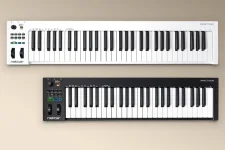
Nektar's Impact GX49 Mk3 and Impact GX61 Mk3 borrow the keyboard from the Impact LX Mk3 and get beefed-up DAW integration. Both are built for people who want full-size keys and real hands-on control without the thing hogging the whole desk. Hardware and software both got upgrades this generation.
The keys are synth-action with a clean-touch feel, low friction and pretty expressive response. Mod and pitch-bend wheels sit right next to them. And the Octave buttons light up and double as transpose controls.
New firmware adds Scale and Hold, which help beginners and pros alike. Scale locks whatever gets played into a scale chosen with dedicated buttons. Hold keeps notes ringing legato until fresh ones take over, while a sostenuto-type option freezes whatever is held down and lets everything else on the keys play as usual.
Players can instantly see what Octave, Scale, Hold, Select, Loop, Stop, Play and Record are doing, thanks to RGB lighting on all 9 buttons. Looks good and actually helps.
The old pot is gone. In its place sits a big encoder with full resolution, and with Nektar's integration it controls almost any parameter in a DAW or plug-in that supports automation, all in one relative turn.
Select flips the encoder through 3 modes. One handles volume and panning per channel, another covers cutoff and resonance on filters, and the third is Click and Control for whatever parameter can be automated. The encoder can also scrub audio, nudge the loop position, set the tempo and move through the timeline.
Nektar Loop Record shows up here after debuting on the Impact LX Mk3. One button press after a take locks in the loop points and kicks off playback, ready to stack overdubs.
For DAW control, 7 transport buttons and a Shift key handle transport duties and navigation through tracks and the browser. They also open the Mixer, Plugin and Channel views. Select doubles as another modifier for pre-count, marking where loops begin and end, jumping back to a loop's beginning, undo and quantize.
Supported DAWs got a lot wider. Ableton Live Suite 11+ is covered, with a simpler script for older versions. Bitwig Studio 5+, Cakewalk/Sonar, Cubase 13 and up, Fender Studio Pro, FL Studio and GarageBand all work. Logic Pro 10.8 and up, Nuendo 14+, Reason 9+, Reaper 7+ and Studio One 6 through 7 round out the roster.
Connection runs over USB-C, and a USB-C to USB-A cable comes in the box. The controller draws power through USB, and there's a quarter-inch TRS jack for a footswitch.
Each unit ships with 4 software titles. BLEASS Megalit is a synth that mixes subtractive and wavetable synthesis, and MOK Miniraze is an effects plug-in that Nektar hypes as pretty wild. Bitwig Studio 8-Track gives users a slimmed-down take on Bitwig's DAW. And Melodics, a keyboard practice app, throws in 40 lessons at no cost, with playback that the controller's transport buttons can drive.
The Impact GX49 Mk3 goes for £83.29 or €99.99, while the Impact GX61 Mk3 costs £99.99 or €119.99. UK prices already cover VAT. Color options are white and black, and both models are on sale already.