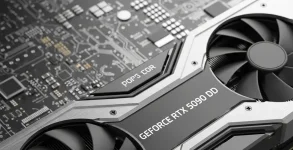
NVIDIA plans to release a new graphics card for China in August. The company created the GeForce RTX 5090 DD to follow updated American trade rules. These rules blocked the original RTX 5090 D from entering Chinese markets. The graphics card maker changed the hardware to meet new export requirements. This move allows NVIDIA to keep selling powerful gaming cards to Chinese customers.
The RTX 5090 DD keeps the same processing power as its predecessor. Engineers included 21,760 CUDA cores for graphics work. The card also features 170 ray tracing cores for realistic lighting effects. AI tasks run on 680 tensor cores that speed up machine learning. These numbers match the banned RTX 5090 D model exactly.
Memory systems received major changes for the China version. NVIDIA reduced the memory pathway from 512 bits to 384 bits. Video memory dropped from 32 gigabytes to 24 gigabytes total. The company kept memory speeds fast at 28 gigabits per second. These cuts likely help the card pass American export rules.
Artificial intelligence performance also saw reductions on the RTX 5090 DD. The card processes 2375 trillion operations per second for AI work. This number falls below the original RTX 5090 D capabilities. The change affects deep learning and AI graphics features. Regulatory compliance probably drove this decision.
Chinese stores sold all RTX 5090 D cards before June started. No new shipments have arrived since that time. The RTX 5090 DD should fill empty shelves when it launches. NVIDIA adapted its supply chain to work around trade restrictions.
The RTX 5090 DD keeps the same processing power as its predecessor. Engineers included 21,760 CUDA cores for graphics work. The card also features 170 ray tracing cores for realistic lighting effects. AI tasks run on 680 tensor cores that speed up machine learning. These numbers match the banned RTX 5090 D model exactly.
Memory systems received major changes for the China version. NVIDIA reduced the memory pathway from 512 bits to 384 bits. Video memory dropped from 32 gigabytes to 24 gigabytes total. The company kept memory speeds fast at 28 gigabits per second. These cuts likely help the card pass American export rules.
Artificial intelligence performance also saw reductions on the RTX 5090 DD. The card processes 2375 trillion operations per second for AI work. This number falls below the original RTX 5090 D capabilities. The change affects deep learning and AI graphics features. Regulatory compliance probably drove this decision.
Chinese stores sold all RTX 5090 D cards before June started. No new shipments have arrived since that time. The RTX 5090 DD should fill empty shelves when it launches. NVIDIA adapted its supply chain to work around trade restrictions.