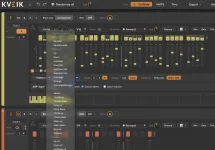
Kveik 1.3 lets ARP tracks take their chord source from the DAW, a test chord, or another Kveik track playing chords. The important part is what happens after you choose the source. Several parts can respond to the same harmonic movement without sharing the same rhythm.
A bass track can stay sparse while a stab track hits offbeats and an arpeggio runs faster above both. With Kveik’s shared chord-source routing, those tracks can read the same changing chord while keeping their own steps, blocks, gates, probabilities, and other lane settings. You edit the harmony once instead of manually repairing three separate pitched patterns after every chord change.
This is not a global reharmonize switch for everything in the sequencer. A dependent track needs to be in ARP mode to interpret the incoming chord as material for its steps, while normal SEQ tracks keep their programmed behavior. The separation is useful because only the parts that should follow the chord source have to follow it.
The same basic idea appears in chord-conditioned bass and melody systems, where multiple musical lines are generated in relation to common chord information. Kveik is not using the model described in that paper. The useful connection is structural because one harmonic condition can guide different parts while each part still has its own musical role.
This makes arrangement edits less brittle. Replace a chord in the progression and the ARP tracks do not need a fresh set of fixed MIDI notes drawn for the new harmony. Their step choices continue to determine which chord members are used, so the bass rhythm, stab placement, and arp shape can survive a harmonic revision.
Channel selection matters when several MIDI streams are moving through the host. A dedicated channel can keep the harmony feed separate from notes intended for another instrument, while the key zone gives you a range for the chord input. Latch is useful when you want the current harmony to remain available without physically holding every note throughout the pattern.
Input velocity also belongs to the DAW chord-source setup. If your progression comes from live playing, that control gives the incoming performance another dimension beyond pitch alone. For a programmed progression, the same setup keeps the harmonic source in the DAW, where chord lengths and changes can be edited against the rest of the arrangement.
The built-in test chord serves a different job. It gives an ARP track harmonic material while you shape the pattern, even when no external progression is currently feeding Kveik. You can work on note order, rhythm, gate, and pitch movement first, then switch to the real source when the phrase is ready to follow the song.
This is handy when you want the progression and the dependent patterns edited in the same sequencer. A chord-playing track can establish the movement, while separate ARP tracks handle bass, upper motion, or rhythmic chord hits. Each follower can use a different block length, step placement, and Arp-lane choice without duplicating the progression itself.
Keep the harmonic track simple enough to edit quickly. If the second chord changes, change the source rather than redrawing every follower around a new set of fixed notes. The musical variation then lives where it belongs, with harmony on the source track and rhythm, articulation, probability, and chord-tone choice on the tracks that consume it.
A bass track can stay sparse while a stab track hits offbeats and an arpeggio runs faster above both. With Kveik’s shared chord-source routing, those tracks can read the same changing chord while keeping their own steps, blocks, gates, probabilities, and other lane settings. You edit the harmony once instead of manually repairing three separate pitched patterns after every chord change.
This is not a global reharmonize switch for everything in the sequencer. A dependent track needs to be in ARP mode to interpret the incoming chord as material for its steps, while normal SEQ tracks keep their programmed behavior. The separation is useful because only the parts that should follow the chord source have to follow it.
One chord source can coordinate independent parts
Kveik’s ARP mode decides pitches from a supplied chord, but the receiving track still owns its pattern. One ARP track might choose lower chord tones for a bass figure, another can pick upper notes for a brighter sequence, and a third can trigger the whole chord for stabs. Changing the source chord changes the available harmony without forcing those three tracks into one shared phrase.The same basic idea appears in chord-conditioned bass and melody systems, where multiple musical lines are generated in relation to common chord information. Kveik is not using the model described in that paper. The useful connection is structural because one harmonic condition can guide different parts while each part still has its own musical role.
This makes arrangement edits less brittle. Replace a chord in the progression and the ARP tracks do not need a fresh set of fixed MIDI notes drawn for the new harmony. Their step choices continue to determine which chord members are used, so the bass rhythm, stab placement, and arp shape can survive a harmonic revision.
DAW input keeps an outside progression in charge
Use the DAW MIDI source when the chord progression already lives in a clip, another MIDI device, or a performance track. Kveik exposes channel, key-zone, latch, and input-velocity controls for this source, giving you ways to narrow what the ARP tracks treat as harmonic input. This is more controlled than sending every MIDI note in the project toward the same chord follower.Channel selection matters when several MIDI streams are moving through the host. A dedicated channel can keep the harmony feed separate from notes intended for another instrument, while the key zone gives you a range for the chord input. Latch is useful when you want the current harmony to remain available without physically holding every note throughout the pattern.
Input velocity also belongs to the DAW chord-source setup. If your progression comes from live playing, that control gives the incoming performance another dimension beyond pitch alone. For a programmed progression, the same setup keeps the harmonic source in the DAW, where chord lengths and changes can be edited against the rest of the arrangement.
The built-in test chord serves a different job. It gives an ARP track harmonic material while you shape the pattern, even when no external progression is currently feeding Kveik. You can work on note order, rhythm, gate, and pitch movement first, then switch to the real source when the phrase is ready to follow the song.
An internal chord track keeps harmony inside Kveik
Kveik 1.2 already added a Chord lane with up to four notes per step, 24 chord types, scale-based stacking, fixed intervals, and per-block strum. Version 1.3 lets another Kveik track that plays chords become the source for ARP tracks. Put those features together and one internal track can hold the harmonic sequence while several other tracks react to it.This is handy when you want the progression and the dependent patterns edited in the same sequencer. A chord-playing track can establish the movement, while separate ARP tracks handle bass, upper motion, or rhythmic chord hits. Each follower can use a different block length, step placement, and Arp-lane choice without duplicating the progression itself.
Keep the harmonic track simple enough to edit quickly. If the second chord changes, change the source rather than redrawing every follower around a new set of fixed notes. The musical variation then lives where it belongs, with harmony on the source track and rhythm, articulation, probability, and chord-tone choice on the tracks that consume it.