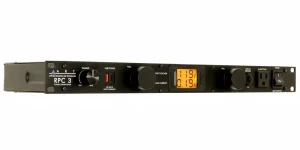
ART rates its new RPC 1 rack conditioner for 15 amps and 1,800 watts, with surge protection and RFI filtering in the same 1U chassis. A rack power conditioner can combine several electrical jobs in one box, but the name on the front says little about which jobs are included. Some units filter interference only, while others add metering, voltage protection, or active regulation.
A recent example is ART Pro Audio’s RPC power conditioner range, where surge protection and line filtering sit inside the same rack format. The useful lesson is not which model to buy. It is that a conditioner describes a bundle of possible functions, not one guaranteed electrical behavior.
A plain power strip is simpler again. It can provide extra outlets without offering meaningful surge suppression or noise filtering at all, so the words power strip, surge protector, and power conditioner should not be treated as interchangeable shopping labels. Read the electrical specifications before trusting the category name.
Many common protectors use metal oxide varistors, usually shortened to MOVs. These components can degrade after repeated surge exposure, which means a strip may continue supplying power even after its protective margin has been reduced. MOV degradation under repeated surges matters here because protection has a service life, so a status indicator is worth more than decorative rack lights when you are judging whether the protection stage is still healthy.
A power conditioner may contain the same kind of surge stage, but it can add other circuitry around it. In audio gear, the most common extra is EMI or RFI filtering intended to reduce high-frequency interference riding on the AC line. A dimmer, switching power supply, charger, motor, or other electronic load can put unwanted energy onto shared mains wiring, and filtering is aimed at that problem rather than at a brief voltage spike.
Filtering also should not be confused with voltage regulation. A conditioner that advertises EMI or RFI reduction may simply attenuate unwanted high-frequency energy while passing the normal AC waveform at whatever acceptable voltage the wall is already supplying. Active voltage regulation is a separate feature that deliberately adjusts the output when incoming voltage moves above or below its target range.
Manufacturers make the confusion worse by using power conditioner for products with very different internals. One 1U unit may be little more than rack distribution, surge suppression, and a basic line filter. Another may monitor incoming voltage, disconnect the load outside safe limits, or actively buck and boost voltage while keeping connected equipment online.
For studio use, this matters more than the logo on the faceplate. If your only concern is transient protection for an interface, computer, monitors, and a few outboard boxes, a properly specified surge protector may already cover the problem you are trying to solve. Buying one purely because it sounds more professional can leave you paying for rack convenience instead of a function you need.
Then check the filtering language. A proper spec should tell you whether the unit filters EMI, RFI, or both, and better documentation may give an attenuation figure across a frequency range instead of simply promising clean power. Vague claims about better detail, wider sound, or improved punch are not substitutes for electrical specifications.
Voltage regulation deserves its own line item. If the manual never says the device regulates voltage, do not assume it does because the chassis says power conditioner. Overvoltage shutdown, voltage metering, surge suppression, line filtering, and automatic voltage regulation are separate functions even when several of them share the same rack space.
For US buyers, a UL 1449 listing gives you a standards-based check on the surge protective device itself. It does not certify sonic improvement or prove voltage regulation, but it shows the surge stage was evaluated as an SPD instead of being described only with vague protection language. If surge protection is the reason for the purchase, that line is more useful than phrases such as studio grade or clean power.
A recent example is ART Pro Audio’s RPC power conditioner range, where surge protection and line filtering sit inside the same rack format. The useful lesson is not which model to buy. It is that a conditioner describes a bundle of possible functions, not one guaranteed electrical behavior.
A plain power strip is simpler again. It can provide extra outlets without offering meaningful surge suppression or noise filtering at all, so the words power strip, surge protector, and power conditioner should not be treated as interchangeable shopping labels. Read the electrical specifications before trusting the category name.
The label on the box tells you very little
A surge protector has one main job. It limits short, high-energy voltage transients before they reach connected equipment, usually by diverting or clamping excess energy when the line voltage jumps beyond a designed threshold. Grid switching, nearby lightning activity, and large electrical loads can all create transient events, although no plug-in strip makes direct lightning harmless.Many common protectors use metal oxide varistors, usually shortened to MOVs. These components can degrade after repeated surge exposure, which means a strip may continue supplying power even after its protective margin has been reduced. MOV degradation under repeated surges matters here because protection has a service life, so a status indicator is worth more than decorative rack lights when you are judging whether the protection stage is still healthy.
A power conditioner may contain the same kind of surge stage, but it can add other circuitry around it. In audio gear, the most common extra is EMI or RFI filtering intended to reduce high-frequency interference riding on the AC line. A dimmer, switching power supply, charger, motor, or other electronic load can put unwanted energy onto shared mains wiring, and filtering is aimed at that problem rather than at a brief voltage spike.
Surge protection and filtering solve different faults
This distinction gets flattened in a lot of buying advice. A surge protector can be perfectly good at catching transients while doing very little about conducted radio-frequency noise, and a filtered rack unit can still lack active voltage regulation. Paying more does not automatically mean every power problem is being corrected.Filtering also should not be confused with voltage regulation. A conditioner that advertises EMI or RFI reduction may simply attenuate unwanted high-frequency energy while passing the normal AC waveform at whatever acceptable voltage the wall is already supplying. Active voltage regulation is a separate feature that deliberately adjusts the output when incoming voltage moves above or below its target range.
Manufacturers make the confusion worse by using power conditioner for products with very different internals. One 1U unit may be little more than rack distribution, surge suppression, and a basic line filter. Another may monitor incoming voltage, disconnect the load outside safe limits, or actively buck and boost voltage while keeping connected equipment online.
For studio use, this matters more than the logo on the faceplate. If your only concern is transient protection for an interface, computer, monitors, and a few outboard boxes, a properly specified surge protector may already cover the problem you are trying to solve. Buying one purely because it sounds more professional can leave you paying for rack convenience instead of a function you need.
The useful specs are buried below the product name
Start with the protection section of the spec sheet. Look for actual surge-protection information, a protection-status indicator, the unit’s current rating, and any stated overvoltage or undervoltage behavior. Outlet count is useful, but nine sockets do not tell you anything about how the connected gear is protected.Then check the filtering language. A proper spec should tell you whether the unit filters EMI, RFI, or both, and better documentation may give an attenuation figure across a frequency range instead of simply promising clean power. Vague claims about better detail, wider sound, or improved punch are not substitutes for electrical specifications.
Voltage regulation deserves its own line item. If the manual never says the device regulates voltage, do not assume it does because the chassis says power conditioner. Overvoltage shutdown, voltage metering, surge suppression, line filtering, and automatic voltage regulation are separate functions even when several of them share the same rack space.
For US buyers, a UL 1449 listing gives you a standards-based check on the surge protective device itself. It does not certify sonic improvement or prove voltage regulation, but it shows the surge stage was evaluated as an SPD instead of being described only with vague protection language. If surge protection is the reason for the purchase, that line is more useful than phrases such as studio grade or clean power.