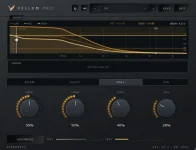
Vellum Pro delays low frequencies slightly more than high frequencies, then repeats that offset on each pass around its reverb tank. The result is dispersion, a timing effect across frequencies rather than a simple change in how many reflections you hear.
Diffusion solves a different problem. It changes how quickly separate echoes lose their edges and build into a smoother field, so a low-diffusion tail can sound grainy even when every frequency reaches you on roughly the same schedule.
Confusing the two is easy because both can make reverb feel smoother or less obviously echo-like. Vellum Pro’s dispersive reverb tank matters precisely because its frequency timing sits alongside early reflections, decay shaping, and ducking rather than replacing those parts.
Digital reverbs can recreate related behavior without using a metal plate. Allpass structures are especially useful because they can alter phase and group delay while avoiding the obvious tonal boost or cut you would expect from an EQ, and frequency-dependent allpass behavior gives designers a formal way to shape those timing differences.
Vellum Pro applies the idea inside its tank. CarbonDSP describes low frequencies as arriving fractionally later than high frequencies and then becoming later again on successive trips around the feedback path, so the timing spread can accumulate through the decay instead of happening once at the entrance.
A short transient makes this easier to hear than a held pad. The upper part of a hit can establish itself first while lower components follow behind, changing the shape of the wet attack even when the decay time and overall level stay fixed.
Density, size, decay, and diffusion can interact inside the same reverb without being interchangeable. Dispersion belongs in that same family of separate controls because a reverb can be highly diffused yet barely dispersive, or strongly dispersive while still exposing a relatively sparse reflection pattern.
The difference becomes obvious if you imagine two impulse responses with the same number of reflections. One can keep those reflections densely packed while delaying low-frequency energy slightly behind the highs, while the other can spread the reflection events more densely without introducing much frequency-dependent timing at all.
Changing diffusion can also soften the perceived front edge because a crowded reflection field hides individual arrivals. Changing dispersion can soften or reshape the front edge for another reason, since parts of the spectrum are no longer landing together. Similar impression, different mechanism. One is reorganizing reflection density, while the other is redistributing timing across the spectrum.
Repeated passes make the effect more interesting. If a small timing offset is applied again every time energy circulates through a tank, later portions of the reverb can become progressively more separated by frequency while the nominal decay curve stays under independent control.
This also explains why dispersion is not just another damping control. Damping changes how strongly certain frequencies survive through the decay, usually by removing energy faster in some bands, while dispersion can move those frequencies in time without necessarily reducing their level.
On vocals or sustained instruments, subtle settings may register mainly as width, depth, or a less static tail. Percussion exposes the mechanism more brutally because sharp attacks give you a clear reference for hearing high-frequency onset, low-frequency lag, and any chirp-like behavior caused by stronger dispersion.
The useful move in Vellum Pro is to judge dispersion separately from diffusion-like smoothness. Keep decay, wet level, and source material steady, then listen to the front edge and the way frequency timing evolves deeper into the tail before deciding whether the reverb needs more reflection density or more spectral timing spread.
Diffusion solves a different problem. It changes how quickly separate echoes lose their edges and build into a smoother field, so a low-diffusion tail can sound grainy even when every frequency reaches you on roughly the same schedule.
Confusing the two is easy because both can make reverb feel smoother or less obviously echo-like. Vellum Pro’s dispersive reverb tank matters precisely because its frequency timing sits alongside early reflections, decay shaping, and ducking rather than replacing those parts.
Dispersion changes arrival time across the spectrum
In a dispersive system, different frequencies do not share one propagation speed. Plate reverbs are a useful physical example because bending waves in metal travel at frequency-dependent speeds, with higher frequencies moving faster than lower ones.Digital reverbs can recreate related behavior without using a metal plate. Allpass structures are especially useful because they can alter phase and group delay while avoiding the obvious tonal boost or cut you would expect from an EQ, and frequency-dependent allpass behavior gives designers a formal way to shape those timing differences.
Vellum Pro applies the idea inside its tank. CarbonDSP describes low frequencies as arriving fractionally later than high frequencies and then becoming later again on successive trips around the feedback path, so the timing spread can accumulate through the decay instead of happening once at the entrance.
A short transient makes this easier to hear than a held pad. The upper part of a hit can establish itself first while lower components follow behind, changing the shape of the wet attack even when the decay time and overall level stay fixed.
Diffusion changes how reflections crowd together
Diffusion is more about reflection structure than frequency travel time. Increase it in a conventional reverb and separate echoes generally become harder to pick apart as the reverberant field builds, while lower settings can leave chatter, gaps, or a coarse texture.Density, size, decay, and diffusion can interact inside the same reverb without being interchangeable. Dispersion belongs in that same family of separate controls because a reverb can be highly diffused yet barely dispersive, or strongly dispersive while still exposing a relatively sparse reflection pattern.
The difference becomes obvious if you imagine two impulse responses with the same number of reflections. One can keep those reflections densely packed while delaying low-frequency energy slightly behind the highs, while the other can spread the reflection events more densely without introducing much frequency-dependent timing at all.
Changing diffusion can also soften the perceived front edge because a crowded reflection field hides individual arrivals. Changing dispersion can soften or reshape the front edge for another reason, since parts of the spectrum are no longer landing together. Similar impression, different mechanism. One is reorganizing reflection density, while the other is redistributing timing across the spectrum.
Repeated dispersion can reshape the tail without extending it
Decay time answers how long energy persists, while dispersion answers when different frequency components arrive within that persistence. Increasing frequency-dependent delay does not automatically mean the reverb rings longer in the usual RT60 sense, even though the tail may feel more stretched or animated.Repeated passes make the effect more interesting. If a small timing offset is applied again every time energy circulates through a tank, later portions of the reverb can become progressively more separated by frequency while the nominal decay curve stays under independent control.
This also explains why dispersion is not just another damping control. Damping changes how strongly certain frequencies survive through the decay, usually by removing energy faster in some bands, while dispersion can move those frequencies in time without necessarily reducing their level.
On vocals or sustained instruments, subtle settings may register mainly as width, depth, or a less static tail. Percussion exposes the mechanism more brutally because sharp attacks give you a clear reference for hearing high-frequency onset, low-frequency lag, and any chirp-like behavior caused by stronger dispersion.
The useful move in Vellum Pro is to judge dispersion separately from diffusion-like smoothness. Keep decay, wet level, and source material steady, then listen to the front edge and the way frequency timing evolves deeper into the tail before deciding whether the reverb needs more reflection density or more spectral timing spread.