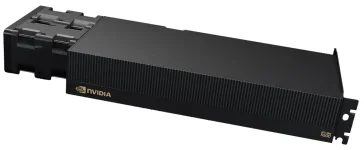
The RTX PRO 5500 can operate as one 84 GB GPU or two isolated MIG instances with up to 42 GB each. NVIDIA is pitching the card for rack-mounted workstation use, which makes that split more than a checkbox on a specification sheet.
A normal shared GPU still has several jobs fighting over the same underlying resources. MIG takes a harder line by carving the processor into hardware-backed instances with their own memory, cache, and compute resources. Each user gets a much clearer boundary around what they can consume.
The practical appeal is simple. Two people can run substantial AI, simulation, or compute jobs on one card without relying on loose software scheduling alone, provided each workload fits inside its half of the hardware.
Memory is only part of the partition. NVIDIA says each RTX PRO 5500 MIG instance receives dedicated high-bandwidth memory, cache, and compute cores with quality-of-service guarantees. Generic MIG documentation also describes physical partitioning as providing memory protection, error isolation, compute isolation, and memory-bandwidth quality of service.
This is a different proposition from simply launching two processes on one unsliced GPU. CUDA streams or software sharing can improve utilization, but the jobs still compete more directly for common hardware. MIG is meant for cases where noisy neighbors are a problem and predictable service matters more than letting one job burst across the entire card.
The 84 GB RTX PRO 5500 workstation design also creates an unusually chunky split. Forty-two gigabytes per user leaves enough room for many quantized language models, large graphics scenes, or scientific datasets while preserving separation between jobs. Smaller tasks may waste some of that allocation, so MIG is not automatically the most efficient choice.
The PCIe path deserves particular attention when both users move large amounts of data between host memory and the card. PCIe bandwidth contention across MIG instances has been measured on earlier MIG hardware, showing why GPU partitioning should not be mistaken for two completely separate machines. RTX PRO 5500 behavior still needs direct testing before the same limits can be assumed.
Local storage can become the duller bottleneck. Two 42 GB AI jobs loading model weights at the same time can hammer the same SSD, while simulation or video pipelines may compete for CPU preprocessing and network throughput. MIG protects the GPU slice from a neighbor, not every component feeding it.
Monitoring should therefore stay per workload as well as per GPU. If one user reports slow inference, checking only GPU utilization can hide a saturated host link or CPU stage. Shared workstation design works best when the whole data path has enough headroom for two serious jobs at once.
You should not blindly copy driver minimums, display-mode steps, or profile names from another Blackwell model and assume they are identical. The product is still marked as coming soon, and the general MIG documentation has not caught up with the newly announced card. Production deployment needs the 5500-specific support entry before those details should be treated as settled.
The split itself also creates a hard capacity decision. A job needing 50 GB cannot borrow eight spare gigabytes from the neighboring 42 GB instance, even if the second user is idle. You would need to return the card to a larger configuration instead of treating MIG memory like a flexible shared pool.
For teams with two steady workloads below 42 GB, that rigidity is often the point. Each job gets a defined piece of a very large GPU and cannot casually consume the other user’s allocation. Teams with one bursty workload that regularly crosses 42 GB may get better utilization from the full 84 GB configuration rather than forcing a tidy split that does not match the work.
A normal shared GPU still has several jobs fighting over the same underlying resources. MIG takes a harder line by carving the processor into hardware-backed instances with their own memory, cache, and compute resources. Each user gets a much clearer boundary around what they can consume.
The practical appeal is simple. Two people can run substantial AI, simulation, or compute jobs on one card without relying on loose software scheduling alone, provided each workload fits inside its half of the hardware.
Two 42GB instances change who can share the card
Forty-two gigabytes is large enough for workloads that would overwhelm many consumer cards. A team could assign one instance to an inference service and the other to a separate development job, or give two users predictable GPU capacity without buying two full 84 GB boards. Both sides still need to live within their own slice.Memory is only part of the partition. NVIDIA says each RTX PRO 5500 MIG instance receives dedicated high-bandwidth memory, cache, and compute cores with quality-of-service guarantees. Generic MIG documentation also describes physical partitioning as providing memory protection, error isolation, compute isolation, and memory-bandwidth quality of service.
This is a different proposition from simply launching two processes on one unsliced GPU. CUDA streams or software sharing can improve utilization, but the jobs still compete more directly for common hardware. MIG is meant for cases where noisy neighbors are a problem and predictable service matters more than letting one job burst across the entire card.
The 84 GB RTX PRO 5500 workstation design also creates an unusually chunky split. Forty-two gigabytes per user leaves enough room for many quantized language models, large graphics scenes, or scientific datasets while preserving separation between jobs. Smaller tasks may waste some of that allocation, so MIG is not automatically the most efficient choice.
Hardware isolation does not isolate the whole system
Calling the instances isolated can sound broader than it really is. MIG divides important resources inside the GPU, but the card still sits inside one host with shared CPUs, system memory, storage, networking, power, cooling, and PCIe connectivity. A badly balanced workstation can bottleneck both instances outside the GPU.The PCIe path deserves particular attention when both users move large amounts of data between host memory and the card. PCIe bandwidth contention across MIG instances has been measured on earlier MIG hardware, showing why GPU partitioning should not be mistaken for two completely separate machines. RTX PRO 5500 behavior still needs direct testing before the same limits can be assumed.
Local storage can become the duller bottleneck. Two 42 GB AI jobs loading model weights at the same time can hammer the same SSD, while simulation or video pipelines may compete for CPU preprocessing and network throughput. MIG protects the GPU slice from a neighbor, not every component feeding it.
Monitoring should therefore stay per workload as well as per GPU. If one user reports slow inference, checking only GPU utilization can hide a saturated host link or CPU stage. Shared workstation design works best when the whole data path has enough headroom for two serious jobs at once.
The software documentation still has a 5500-sized gap
There is an awkward deployment detail at launch. NVIDIA’s RTX PRO 5500 product page and PNY both advertise one 84 GB instance or two 42 GB instances, but NVIDIA’s current general MIG support tables do not yet list the RTX PRO 5500 alongside the RTX PRO 5000 and 6000 Blackwell cards.You should not blindly copy driver minimums, display-mode steps, or profile names from another Blackwell model and assume they are identical. The product is still marked as coming soon, and the general MIG documentation has not caught up with the newly announced card. Production deployment needs the 5500-specific support entry before those details should be treated as settled.
The split itself also creates a hard capacity decision. A job needing 50 GB cannot borrow eight spare gigabytes from the neighboring 42 GB instance, even if the second user is idle. You would need to return the card to a larger configuration instead of treating MIG memory like a flexible shared pool.
For teams with two steady workloads below 42 GB, that rigidity is often the point. Each job gets a defined piece of a very large GPU and cannot casually consume the other user’s allocation. Teams with one bursty workload that regularly crosses 42 GB may get better utilization from the full 84 GB configuration rather than forcing a tidy split that does not match the work.