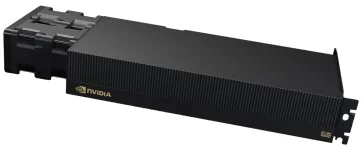
The RTX PRO 5500 carries 84 GB of ECC GDDR7, while the RTX PRO 6000 raises capacity to 96 GB. Both are Blackwell workstation cards built for heavy AI, rendering, simulation, and data work, but the flagship does more than add another 12 GB.
On paper, the 5500 sits unusually close to the top card. Its 21,760 CUDA cores trail the 6000’s 24,064 by about 11 percent, and both can draw up to 600 W. Anyone choosing between them should look past the model number and decide which limits will actually bite first in daily work.
The biggest clue is memory bandwidth, not memory capacity. NVIDIA rates the 5500 at 1,398 GB/s and the 6000 at 1,792 GB/s, giving the 6000 roughly 28 percent more bandwidth. Workloads that repeatedly stream large weights, textures, simulation data, or frames through VRAM can hit this difference before they need another 12 GB.
You should not assume a workload that fits both cards will run almost identically. Memory-bound tasks can care more about the 1,792 GB/s path than the difference in core count. Compute units cannot help much when they are waiting on data, so the bandwidth gap here is too large to dismiss.
The 5500 still lands in an interesting spot because NVIDIA's 84 GB Blackwell workstation card gives you most of the flagship’s memory capacity. It is not simply a 6000 with a smaller number on the box. If your models, scenes, or datasets stay comfortably below 84 GB, unused flagship capacity may have little practical value.
For a single user, those layouts may be irrelevant. For a studio, lab, or rack-mounted workstation shared by several people, they change how much useful work one card can serve at once. Four smaller partitions suit several moderate jobs, while two 42 GB partitions favor fewer users who each need much more memory.
MIG also provides more than a neat software division. Separate instances receive dedicated portions of memory, cache, and compute resources, which is why hardware-isolated GPU partitioning matters when concurrent jobs need predictable behavior. The 6000 therefore has a density advantage that raw CUDA-core comparisons barely capture.
Media work adds another quiet separator. The 5500 carries three ninth-generation NVENC encoders and three sixth-generation NVDEC decoders, while the 6000 carries four of each. Heavy multi-stream ingest, transcodes, remote production, or simultaneous encode jobs can make the fourth engine useful even when 84 GB of VRAM is already excessive.
Physical design is less symmetrical, with NVIDIA listing the 5500 at 4.4 inches high and 11.1 inches long in its standard dual-slot form. The RTX PRO 6000 Workstation Edition is 5.4 inches high and 12 inches long with a double-flow-through cooler. The 5500 may fit some rack layouts more easily.
Cooling style matters in dense systems too, and the 5500 is listed with active air cooling plus a liquid-cooled RXM option. The standard 6000 uses double-flow-through cooling instead. Those labels do not tell you sustained clocks, so a rack builder still needs to check the actual airflow path.
The purchase decision gets fairly plain once those constraints are visible. Choose the 6000 when 96 GB removes a real memory ceiling, higher bandwidth feeds your workload, or four MIG partitions improve utilization. The fourth encode and decode engines can also matter in busy media pipelines, while the 5500 makes more sense when 84 GB already leaves comfortable working room.
On paper, the 5500 sits unusually close to the top card. Its 21,760 CUDA cores trail the 6000’s 24,064 by about 11 percent, and both can draw up to 600 W. Anyone choosing between them should look past the model number and decide which limits will actually bite first in daily work.
The biggest clue is memory bandwidth, not memory capacity. NVIDIA rates the 5500 at 1,398 GB/s and the 6000 at 1,792 GB/s, giving the 6000 roughly 28 percent more bandwidth. Workloads that repeatedly stream large weights, textures, simulation data, or frames through VRAM can hit this difference before they need another 12 GB.
The 96 GB card buys headroom and faster memory
Twelve extra gigabytes sounds modest beside capacities this large, but it changes the edge cases. A job near the 84 GB ceiling leaves little room for caches, temporary buffers, larger batches, or a second model. The 96 GB card gives you another 14 percent of capacity before software has to offload work or shrink the job.You should not assume a workload that fits both cards will run almost identically. Memory-bound tasks can care more about the 1,792 GB/s path than the difference in core count. Compute units cannot help much when they are waiting on data, so the bandwidth gap here is too large to dismiss.
The 5500 still lands in an interesting spot because NVIDIA's 84 GB Blackwell workstation card gives you most of the flagship’s memory capacity. It is not simply a 6000 with a smaller number on the box. If your models, scenes, or datasets stay comfortably below 84 GB, unused flagship capacity may have little practical value.
MIG changes the choice for shared workstations
Multi-Instance GPU support creates a sharper difference. The RTX PRO 5500 can run as one 84 GB instance or split into two isolated 42 GB instances. The RTX PRO 6000 supports one 96 GB instance, two 48 GB instances, or as many as four 24 GB instances.For a single user, those layouts may be irrelevant. For a studio, lab, or rack-mounted workstation shared by several people, they change how much useful work one card can serve at once. Four smaller partitions suit several moderate jobs, while two 42 GB partitions favor fewer users who each need much more memory.
MIG also provides more than a neat software division. Separate instances receive dedicated portions of memory, cache, and compute resources, which is why hardware-isolated GPU partitioning matters when concurrent jobs need predictable behavior. The 6000 therefore has a density advantage that raw CUDA-core comparisons barely capture.
Media work adds another quiet separator. The 5500 carries three ninth-generation NVENC encoders and three sixth-generation NVDEC decoders, while the 6000 carries four of each. Heavy multi-stream ingest, transcodes, remote production, or simultaneous encode jobs can make the fourth engine useful even when 84 GB of VRAM is already excessive.
Chassis fit and power do not follow the price ladder
Both cards can reach 600 W, so choosing the 5500 does not automatically buy you a gentler power or cooling problem. A workstation designed around either card needs serious power delivery and airflow. The final chassis and cooling configuration matter more than the lower model number.Physical design is less symmetrical, with NVIDIA listing the 5500 at 4.4 inches high and 11.1 inches long in its standard dual-slot form. The RTX PRO 6000 Workstation Edition is 5.4 inches high and 12 inches long with a double-flow-through cooler. The 5500 may fit some rack layouts more easily.
Cooling style matters in dense systems too, and the 5500 is listed with active air cooling plus a liquid-cooled RXM option. The standard 6000 uses double-flow-through cooling instead. Those labels do not tell you sustained clocks, so a rack builder still needs to check the actual airflow path.
The purchase decision gets fairly plain once those constraints are visible. Choose the 6000 when 96 GB removes a real memory ceiling, higher bandwidth feeds your workload, or four MIG partitions improve utilization. The fourth encode and decode engines can also matter in busy media pipelines, while the 5500 makes more sense when 84 GB already leaves comfortable working room.