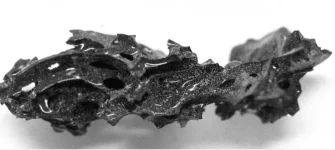
Scientists have made a remarkable discovery about a person who died during the Vesuvius volcanic eruption almost 2,000 years ago. The intense heat from the eruption transformed a young man's brain into glass - something researchers have never seen before with human tissue.
The research team found small pieces of black glass inside the skull of a victim who was approximately 20 years old when Vesuvius erupted in 79 AD near what we know today as Naples. These glass fragments range from specks just millimeters across to pieces measuring 1-2 centimeters.
Initially discovered in 2020, scientists speculated these fragments might be a fossilized brain, but they weren't sure exactly how it formed. Through recent analysis, they've determined that an extremely hot ash cloud - reaching temperatures of 510 degrees Celsius - enveloped the brain and then cooled down rapidly, creating this unique glass transformation.
Professor Guido Giordano from Università Roma Tre explained to BBC News that the conditions needed for this brain vitrification are incredibly rare, making this discovery unique. The brain belonged to a person who died in bed inside a building called the Collegium on the main street of Herculaneum, a Roman city.
The catastrophic Vesuvius eruption destroyed both Herculaneum and the nearby city of Pompeii, areas where approximately 20,000 people lived. Archaeologists have recovered the remains of about 1,500 victims from these sites.
Based on their research, scientists believe most deaths occurred when the initial superheated ash cloud descended from Vesuvius. This was followed by a pyroclastic flow - a fast-moving current of hot gas and volcanic matter that buried the entire area.
The researchers determined that the ash cloud caused brain vitrification because pyroclastic flows typically don't reach sufficiently high temperatures or cool quickly enough to create glass. For something to transform into glass naturally, very specific conditions must exist - the substance needs extreme heat followed by rapid cooling.
Using advanced techniques, including X-rays and electron microscopy, the research team concluded that the brain must have heated to at least 510 degrees Celsius before cooling extremely quickly. Interestingly, no other parts of the victim's body turned to glass.
Scientists explain this happens because glass formation requires materials containing some liquid. Bones couldn't vitrify because they lack sufficient moisture. Other soft tissues and organs likely burned away completely before they could cool enough to transform into glass. The skull apparently provided just enough protection to allow the brain to undergo this extremely rare natural process.
The complete findings from this fascinating research appear in a peer-reviewed scientific publication where experts share their discoveries with other researchers in their field.
The research team found small pieces of black glass inside the skull of a victim who was approximately 20 years old when Vesuvius erupted in 79 AD near what we know today as Naples. These glass fragments range from specks just millimeters across to pieces measuring 1-2 centimeters.
Initially discovered in 2020, scientists speculated these fragments might be a fossilized brain, but they weren't sure exactly how it formed. Through recent analysis, they've determined that an extremely hot ash cloud - reaching temperatures of 510 degrees Celsius - enveloped the brain and then cooled down rapidly, creating this unique glass transformation.
Professor Guido Giordano from Università Roma Tre explained to BBC News that the conditions needed for this brain vitrification are incredibly rare, making this discovery unique. The brain belonged to a person who died in bed inside a building called the Collegium on the main street of Herculaneum, a Roman city.
The catastrophic Vesuvius eruption destroyed both Herculaneum and the nearby city of Pompeii, areas where approximately 20,000 people lived. Archaeologists have recovered the remains of about 1,500 victims from these sites.
Based on their research, scientists believe most deaths occurred when the initial superheated ash cloud descended from Vesuvius. This was followed by a pyroclastic flow - a fast-moving current of hot gas and volcanic matter that buried the entire area.
The researchers determined that the ash cloud caused brain vitrification because pyroclastic flows typically don't reach sufficiently high temperatures or cool quickly enough to create glass. For something to transform into glass naturally, very specific conditions must exist - the substance needs extreme heat followed by rapid cooling.
Using advanced techniques, including X-rays and electron microscopy, the research team concluded that the brain must have heated to at least 510 degrees Celsius before cooling extremely quickly. Interestingly, no other parts of the victim's body turned to glass.
Scientists explain this happens because glass formation requires materials containing some liquid. Bones couldn't vitrify because they lack sufficient moisture. Other soft tissues and organs likely burned away completely before they could cool enough to transform into glass. The skull apparently provided just enough protection to allow the brain to undergo this extremely rare natural process.
The complete findings from this fascinating research appear in a peer-reviewed scientific publication where experts share their discoveries with other researchers in their field.