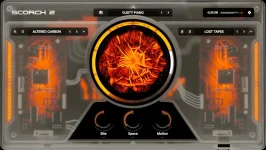
Scorch 2 ships with 475 factory presets and a completely rebuilt dual-sampler engine, while the original Scorch centered on 200 presets. Sauceware kept the older sounds, so moving up does not mean abandoning the library you already know. The bigger change is what happens after you load one.
Scorch 1 was built for speed, with ready-made sounds, a chord generator, built-in effects, and a simple front-end approach. You picked a tone, made a few moves, and got back to the beat instead of treating the plugin as a full sound-design workstation.
The new version keeps that fast entry point, but it no longer stops there. Inside Scorch 2’s rebuilt sampler architecture, two sound sources can be blended, tuned, filtered, panned, enveloped, and pushed through deeper modulation. You can still grab a preset and move, but now there is somewhere useful to go when the preset is close rather than perfect.
Scorch 1 offered customization, but its old sales material leaned heavily on preconfigured sounds, effect variations, and one-finger chord generation. Scorch 2 shifts more of the shaping into the instrument itself, with less preset dependence and more direct editing.
One marketing number needs care. Scorch 1 advertised more than 2,000 effects, but its own page described those as pre-made effect versions attached to the sound library, not 2,000 separate processors. Scorch 2 instead names five effect families and exposes a dedicated effects page, so comparing those headline counts directly would be misleading.
The A and B structure is one of the clearest examples. One source can carry the body while the other adds texture, then you can decide how much of either survives in the final patch. Academic work on continuous timbre interpolation describes a more technical process than simple source blending, so Scorch 2's morphing language should be read as a production feature rather than a claim of laboratory-style interpolation.
Chaos has changed as well. Scorch 1's central-control idea was deliberately simple, while Scorch 2 lets Chaos move a wider set of parameters and adds Bite, Space, and Motion for saturation, ambience, and modulation speed. Randomize handles a different job by building new patches from curated source combinations instead of merely pushing the current sound around.
The practical difference is where the plugin stops helping. Scorch 1 could give you harmonic material quickly, while Scorch 2 can carry a rough musical sketch further before you return to the piano roll. Individual MIDI parts can then be dragged into the DAW, where you can rewrite notes, swap instruments, or break the generated relationship completely.
For producers who use Scorch to get past a blank session, this change matters more than the larger preset count. More sounds give you more starting points, while coordinated chord, melody, and bass material changes how much of an idea can exist before you leave the plugin.
One quieter difference sits in the system requirements. Scorch 1's older product page called for at least 20 GB of free drive space and supported VST, VST3, and AU formats, including older 32-bit and 64-bit VST builds. Scorch 2 lists 10 GB of free space, but officially narrows the formats to VST3 and AU while raising the Windows requirement from Windows 7 to Windows 10.
Legacy sessions are the awkward edge case. A project built around an older VST host may still depend on Scorch 1 even if Scorch 2 is installed beside it. Current VST3 or AU setups avoid that problem, but the format change is worth checking before you remove the original plugin from a working archive.
Scorch 1 was built for speed, with ready-made sounds, a chord generator, built-in effects, and a simple front-end approach. You picked a tone, made a few moves, and got back to the beat instead of treating the plugin as a full sound-design workstation.
The new version keeps that fast entry point, but it no longer stops there. Inside Scorch 2’s rebuilt sampler architecture, two sound sources can be blended, tuned, filtered, panned, enveloped, and pushed through deeper modulation. You can still grab a preset and move, but now there is somewhere useful to go when the preset is close rather than perfect.
Scorch 2 changes the sound engine, not just the skin
Each Scorch 2 patch can use two sampler engines, with separate filters and envelopes plus three LFOs and three additional envelopes for modulation. Sauceware also exposes speed, pitch, panning, unison, and sub playback controls, which gives the raw sources far more room to change before you reach for another plugin.Scorch 1 offered customization, but its old sales material leaned heavily on preconfigured sounds, effect variations, and one-finger chord generation. Scorch 2 shifts more of the shaping into the instrument itself, with less preset dependence and more direct editing.
One marketing number needs care. Scorch 1 advertised more than 2,000 effects, but its own page described those as pre-made effect versions attached to the sound library, not 2,000 separate processors. Scorch 2 instead names five effect families and exposes a dedicated effects page, so comparing those headline counts directly would be misleading.
The A and B structure is one of the clearest examples. One source can carry the body while the other adds texture, then you can decide how much of either survives in the final patch. Academic work on continuous timbre interpolation describes a more technical process than simple source blending, so Scorch 2's morphing language should be read as a production feature rather than a claim of laboratory-style interpolation.
Chaos has changed as well. Scorch 1's central-control idea was deliberately simple, while Scorch 2 lets Chaos move a wider set of parameters and adds Bite, Space, and Motion for saturation, ambience, and modulation speed. Randomize handles a different job by building new patches from curated source combinations instead of merely pushing the current sound around.
The MIDI system now goes beyond one-finger chords
Scorch 1's chord generator was sold as a quick route to full chords from a single note, especially for producers with limited theory. Scorch 2 expands the idea into separate chord, melody, and bass parts that sit inside the same harmony system.The practical difference is where the plugin stops helping. Scorch 1 could give you harmonic material quickly, while Scorch 2 can carry a rough musical sketch further before you return to the piano roll. Individual MIDI parts can then be dragged into the DAW, where you can rewrite notes, swap instruments, or break the generated relationship completely.
For producers who use Scorch to get past a blank session, this change matters more than the larger preset count. More sounds give you more starting points, while coordinated chord, melody, and bass material changes how much of an idea can exist before you leave the plugin.
Existing Scorch users gain depth without losing the library
Sauceware says every original Scorch sound is included in Scorch 2, so the new 475-preset factory library expands rather than replaces the old collection. Existing owners also get an upgrade discount, while new buyers can run Scorch 2 by itself without owning Scorch 1.One quieter difference sits in the system requirements. Scorch 1's older product page called for at least 20 GB of free drive space and supported VST, VST3, and AU formats, including older 32-bit and 64-bit VST builds. Scorch 2 lists 10 GB of free space, but officially narrows the formats to VST3 and AU while raising the Windows requirement from Windows 7 to Windows 10.
Legacy sessions are the awkward edge case. A project built around an older VST host may still depend on Scorch 1 even if Scorch 2 is installed beside it. Current VST3 or AU setups avoid that problem, but the format change is worth checking before you remove the original plugin from a working archive.