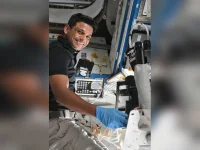
Union Minister Jitendra Singh revealed Wednesday that astronaut Shubhanshu Shukla performed biological experiments during his International Space Station mission. The Indian Air Force Group Captain tested three native microalgae species and two cyanobacteria strains to examine space-based life support possibilities. Shukla completed his historic 18-day orbital laboratory stay on July 15, marking him as the first Indian astronaut to visit the ISS.
The microalgae experiments focused on Chlorella sorokiniana-I, Parachlorellakessleri-I, and Dysmorphococcus globosus-HI under microgravity conditions. These organisms demonstrate potential for absorbing excess carbon dioxide while producing essential nutrients and food supplements for astronaut survival. The research compared simultaneous growth patterns between space and Earth-based laboratory environments.
Shukla examined Spirulina and Synechococcus cyanobacteria strains using nitrate and urea nitrogen sources during microgravity exposure. These experiments advance biological life support system development for future space exploration missions. The research represents foundational work for India's planned Gaganyaan human spaceflight program scheduled for 2027.
The microalgae experiments focused on Chlorella sorokiniana-I, Parachlorellakessleri-I, and Dysmorphococcus globosus-HI under microgravity conditions. These organisms demonstrate potential for absorbing excess carbon dioxide while producing essential nutrients and food supplements for astronaut survival. The research compared simultaneous growth patterns between space and Earth-based laboratory environments.
Shukla examined Spirulina and Synechococcus cyanobacteria strains using nitrate and urea nitrogen sources during microgravity exposure. These experiments advance biological life support system development for future space exploration missions. The research represents foundational work for India's planned Gaganyaan human spaceflight program scheduled for 2027.