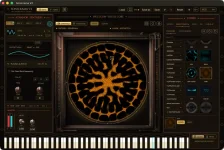
Sonicrama V2 solves a vibrating plate’s modal response on the GPU and drives 400,000 particles from the incoming audio at up to 60 fps. It is not reading a spectrum and decorating the result with a sand animation.
The Sonicrama V2 cymatics engine treats the plate as part of the calculation. Hold one note, then change the plate thickness, tension, material, size, or shape, and the pattern reorganizes even though the note has not moved.
Waveform matters too. A saw and square wave played at the same fundamental do not feed the plate the same collection of partials, so Sonicrama can produce a different figure without changing pitch. Each spectral component excites nearby plate modes, which makes the display respond to timbre as well as note choice.
Sonicrama calculates those modes instead of storing a library of premade shapes. The underlying approach has a useful physical check in measured Chladni plate reconstruction, where experimentally observed nodal patterns are reconstructed from the response of a driven thin plate. Sonicrama’s developer says the sand implementation was cross-checked against those published measurements.
A visualizer can look convincing while having only a loose relationship with the sound. Sonicrama instead feeds the note and its harmonics into a modal solver, while the particles reveal the resulting nodal geometry. The picture changes because the simulated physical system changes.
There is also a practical resonance tool inside the plate view. Modal frequencies appear along a ruler, and selecting one can retune an oscillator to that mode. Instead of hunting blindly for a frequency that wakes up a clean pattern, you can move directly onto one of the plate’s resonances and hear the oscillator meet the visual system.
Non-circular plates carry an explicit approximation. Sonicrama uses an averaged effective radius for those shapes because their true eigenvalues are not described by the same Bessel solution. It is a useful boundary to know, especially if you are comparing the screen with a laboratory plate and expecting every geometry to match point for point.
The liquid view makes a larger concession for readability. It uses Faraday-wave dispersion, but real cells at audio-rate excitation become extremely small, so Sonicrama log-compresses spatial frequency above roughly 40 cycles. The resulting motion still follows the liquid model, yet the displayed scale is deliberately enlarged where a literal one-to-one view would become unreadable.
Density, viscosity, and depth remain meaningful controls in the liquid model. Moving them changes the calculated wave behavior rather than swapping between canned animations. The distinction is simple enough to remember in use. Sand aims at physical spatial scale, while liquid keeps the dynamics but uses a declared visual lens.
Plate changes become useful during sound design rather than only after the patch is finished. Keep the note steady and move thickness or tension, and you can see where resonances migrate. Keep the plate steady and change the waveform, and new harmonic content starts feeding different modal regions.
The GPU handles the particle field and modal graphics while the audio engine continues on its own thread, which is important when the visual side is updating tens of times each second. Four hundred thousand particles sound extravagant until you remember what they are doing here. They are not the physics themselves. They are the visible material responding to a calculation underneath.
The most revealing experiments are controlled ones. Hold a single pitch, change one plate property, and watch the nodal lines shift. Then restore the plate and change only the waveform. The sonicrama becomes much easier to read once you separate what the plate is doing from what the spectrum is feeding into it.
The Sonicrama V2 cymatics engine treats the plate as part of the calculation. Hold one note, then change the plate thickness, tension, material, size, or shape, and the pattern reorganizes even though the note has not moved.
Waveform matters too. A saw and square wave played at the same fundamental do not feed the plate the same collection of partials, so Sonicrama can produce a different figure without changing pitch. Each spectral component excites nearby plate modes, which makes the display respond to timbre as well as note choice.
Chladni figures come from the plate’s own modes
A Chladni figure appears when a plate is driven near one of its resonant modes. Some parts of the plate move strongly while nodal lines move very little, allowing loose grains to gather along those quieter regions. Change the plate or the driving frequency, and the modal pattern changes with it.Sonicrama calculates those modes instead of storing a library of premade shapes. The underlying approach has a useful physical check in measured Chladni plate reconstruction, where experimentally observed nodal patterns are reconstructed from the response of a driven thin plate. Sonicrama’s developer says the sand implementation was cross-checked against those published measurements.
A visualizer can look convincing while having only a loose relationship with the sound. Sonicrama instead feeds the note and its harmonics into a modal solver, while the particles reveal the resulting nodal geometry. The picture changes because the simulated physical system changes.
There is also a practical resonance tool inside the plate view. Modal frequencies appear along a ruler, and selecting one can retune an oscillator to that mode. Instead of hunting blindly for a frequency that wakes up a clean pattern, you can move directly onto one of the plate’s resonances and hear the oscillator meet the visual system.
The sand model and liquid model are not equally literal
The sand view is the stricter model. AcusMagic describes its modal frequencies and spatial scale as physically exact, so raising the render resolution adds visual detail rather than changing the underlying plate calculation. Circular plate behavior uses analytic mode shapes based on Bessel functions.Non-circular plates carry an explicit approximation. Sonicrama uses an averaged effective radius for those shapes because their true eigenvalues are not described by the same Bessel solution. It is a useful boundary to know, especially if you are comparing the screen with a laboratory plate and expecting every geometry to match point for point.
The liquid view makes a larger concession for readability. It uses Faraday-wave dispersion, but real cells at audio-rate excitation become extremely small, so Sonicrama log-compresses spatial frequency above roughly 40 cycles. The resulting motion still follows the liquid model, yet the displayed scale is deliberately enlarged where a literal one-to-one view would become unreadable.
Density, viscosity, and depth remain meaningful controls in the liquid model. Moving them changes the calculated wave behavior rather than swapping between canned animations. The distinction is simple enough to remember in use. Sand aims at physical spatial scale, while liquid keeps the dynamics but uses a declared visual lens.
The useful part is how sound and plate settings interact
A fixed pitch does not own one Chladni figure. Resonant geometry belongs to the combination of frequency, spectral content, plate dimensions, material properties, boundary assumptions, and the modes those conditions support. Sonicrama exposes enough of those variables to make the same held note behave differently without turning the exercise into a video effect preset.Plate changes become useful during sound design rather than only after the patch is finished. Keep the note steady and move thickness or tension, and you can see where resonances migrate. Keep the plate steady and change the waveform, and new harmonic content starts feeding different modal regions.
The GPU handles the particle field and modal graphics while the audio engine continues on its own thread, which is important when the visual side is updating tens of times each second. Four hundred thousand particles sound extravagant until you remember what they are doing here. They are not the physics themselves. They are the visible material responding to a calculation underneath.
The most revealing experiments are controlled ones. Hold a single pitch, change one plate property, and watch the nodal lines shift. Then restore the plate and change only the waveform. The sonicrama becomes much easier to read once you separate what the plate is doing from what the spectrum is feeding into it.