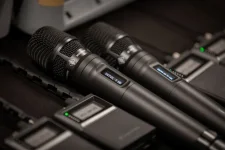
Sennheiser rates the Spectera SKM for more than six hours of battery operation in Live mode using a BA 70 family pack. Useful, but not luxurious. Rehearsal, soundcheck, standby time, and a long performance can turn one apparently healthy charge into a poor place to gamble.
The Spectera SKM handheld transmitter uses a removable rechargeable pack rather than loose AA cells, so battery planning becomes an inventory and charging problem. A crew can swap a depleted pack quickly, but only if charged spares are already labeled, staged, and easy to reach. Runtime alone never tells you whether the charging bench can keep pace with the show.
Sennheiser now sells two compatible versions, the original BA 70 and the newer BA 70 2.2. The older pack is rated at 1720 mAh, while BA 70 2.2 rises to 2250 mAh, an increase of about 31 percent in rated capacity. Sennheiser describes the revision as offering improved operating time, but it does not publish a separate Spectera SKM runtime figure for the 2.2 pack, so multiplying six hours by 1.31 would be guesswork.
The important catch sits on the charger side because BA 70 2.2 requires L 6000 firmware 3.1.0 or later, while CHG 70N and CHG 70N-C need version 4.0.0 or later. A battery can be mechanically compatible with the rack and still create an avoidable show-day problem if the charging hardware was never updated.
Capacity should also be treated as margin rather than permission to stretch every pack to the edge. Lithium-ion cells change as they age, and temperature, state of charge, and cycling all affect degradation. Heat-driven lithium-ion battery aging is especially relevant to touring stock that spends its life moving between hot trucks, cold docks, charging racks, and stage environments.
Eight slots sounds generous until the microphone count climbs. A 12-handheld show cannot recharge one complete 12-pack rotation simultaneously from a single fully populated L 6000. Either some batteries return to service on a second charging cycle, another charger joins the rack, or the production carries enough charged inventory to make turnaround time irrelevant.
The compact L 70 USB charges two BA 70 packs and specifies a maximum 3.5-hour charge with the appropriate power supply. It makes sense for smaller kits, fly dates, or a backup position where rack space matters more than throughput, but two slots disappear quickly once several depleted handheld batteries arrive together.
For the handheld, the practical routine is therefore battery removal and pack rotation. You can charge the loose BA 70 in an L 70 USB, an L 6000 fitted with LM 6070 modules, or a compatible CHG 70N-C slot, then return a charged pack to the microphone. A labeled spare pool is cleaner than treating every handheld as permanently married to one battery.
The six-hour-plus specification should be the floor for planning, not the schedule. A battery that starts soundcheck at 100 percent may have already spent hours powering rehearsals, line checks, pauses, and pre-show handling before the artist reaches the stage. Swapping during a known break gives the crew control over the timing instead of waiting for a low-battery warning to choose the moment.
Spectera reports battery information through its bidirectional control path, so engineers can watch status remotely while the microphone is in use. Monitoring is useful for catching an unexpected drain or a pack that behaves differently from the rest, but it does not replace spare capacity, and the strongest battery plan is boring on purpose, with enough charged packs and charger slots that no single battery has to finish the day heroically.
The Spectera SKM handheld transmitter uses a removable rechargeable pack rather than loose AA cells, so battery planning becomes an inventory and charging problem. A crew can swap a depleted pack quickly, but only if charged spares are already labeled, staged, and easy to reach. Runtime alone never tells you whether the charging bench can keep pace with the show.
Sennheiser now sells two compatible versions, the original BA 70 and the newer BA 70 2.2. The older pack is rated at 1720 mAh, while BA 70 2.2 rises to 2250 mAh, an increase of about 31 percent in rated capacity. Sennheiser describes the revision as offering improved operating time, but it does not publish a separate Spectera SKM runtime figure for the 2.2 pack, so multiplying six hours by 1.31 would be guesswork.
The newer BA 70 changes inventory more than workflow
BA 70 2.2 introduced new compatible product sets from August 2026, and Sennheiser made the revision easy to spot because the original BA 70 is black while the 2.2 pack is gray. Both remain compatible with Spectera, EW-D, EW-DP, and EW-DX hardware.The important catch sits on the charger side because BA 70 2.2 requires L 6000 firmware 3.1.0 or later, while CHG 70N and CHG 70N-C need version 4.0.0 or later. A battery can be mechanically compatible with the rack and still create an avoidable show-day problem if the charging hardware was never updated.
Capacity should also be treated as margin rather than permission to stretch every pack to the edge. Lithium-ion cells change as they age, and temperature, state of charge, and cycling all affect degradation. Heat-driven lithium-ion battery aging is especially relevant to touring stock that spends its life moving between hot trucks, cold docks, charging racks, and stage environments.
Charger throughput decides how many spares you need
The L 6000 is the high-density option, and with four LM 6070 modules installed, one chassis can charge as many as eight BA 70 packs at once. Sennheiser specifies roughly one hour and 45 minutes to reach 80 percent and about three hours and 30 minutes for a full BA 70 charge at 20 degrees Celsius.Eight slots sounds generous until the microphone count climbs. A 12-handheld show cannot recharge one complete 12-pack rotation simultaneously from a single fully populated L 6000. Either some batteries return to service on a second charging cycle, another charger joins the rack, or the production carries enough charged inventory to make turnaround time irrelevant.
The compact L 70 USB charges two BA 70 packs and specifies a maximum 3.5-hour charge with the appropriate power supply. It makes sense for smaller kits, fly dates, or a backup position where rack space matters more than throughput, but two slots disappear quickly once several depleted handheld batteries arrive together.
Spectera SKM charging has one practical wrinkle
The CHG 70N-C reaches a full charge in a maximum of 3.5 hours and provides two charging bays. Current Sennheiser compatibility information allows a bare BA 70 to charge directly and a Spectera SEK bodypack to charge with its battery installed, while the Spectera SKM itself is not listed for in-device charging in that dock.For the handheld, the practical routine is therefore battery removal and pack rotation. You can charge the loose BA 70 in an L 70 USB, an L 6000 fitted with LM 6070 modules, or a compatible CHG 70N-C slot, then return a charged pack to the microphone. A labeled spare pool is cleaner than treating every handheld as permanently married to one battery.
The six-hour-plus specification should be the floor for planning, not the schedule. A battery that starts soundcheck at 100 percent may have already spent hours powering rehearsals, line checks, pauses, and pre-show handling before the artist reaches the stage. Swapping during a known break gives the crew control over the timing instead of waiting for a low-battery warning to choose the moment.
Spectera reports battery information through its bidirectional control path, so engineers can watch status remotely while the microphone is in use. Monitoring is useful for catching an unexpected drain or a pack that behaves differently from the rest, but it does not replace spare capacity, and the strongest battery plan is boring on purpose, with enough charged packs and charger slots that no single battery has to finish the day heroically.