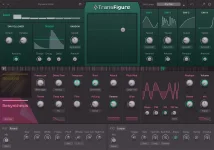
Transfigure’s Spectral Engine splits incoming audio into frequency bands, while its Resynthesis Processor analyzes those frequencies and rebuilds them with up to 120 oscillators. If you want to preserve the source’s spectral fingerprint while freezing, shifting, delaying, or thinning parts of it, Spectral is the more direct choice. If you want the analysis to become pitch information for a newly synthesized output, Resynthesis rebuilds the result much more radically.
The touchscreen workflow in Transfigure on iPad makes switching between the two processors quick, but they are not interchangeable flavors of the same effect. Spectral mode keeps working with frequency energy from the incoming signal. Resynthesis listens to that information, maps it to pitches, then lets an internal oscillator bank generate the result.
You can hear the difference fastest on a drum loop. Spectral processing can smear the cymbals, freeze a narrow slice, delay separate bands, or pull transient energy away from the body of the loop. Resynthesis can turn the same percussion into pitched material because its analysis data drives a synthesis engine rather than simply reshaping the original spectrum.
Resolution therefore belongs near the start of your decision, not buried at the end of a preset tweak. A low setting can be useful when you want obvious breakup, but it can also make harmonization less clean. Stronger spectral harmonization can soften transients, while higher resolutions suit gentler bending, sustained textures, and jobs where individual frequency areas need more controlled treatment.
Spectral audio has long separated analysis from reconstruction. Xavier Serra and Julius Smith’s Spectral Modeling Synthesis formalized an influential model built from spectral components rather than a raw waveform. Transfigure turns a related technical distinction into two practical sound-design routes without asking you to assemble the analysis and synthesis chain yourself.
Per-band control matters just as much. The Band setup can decide which frequencies are frozen, how strongly they are affected, how long individual spectral delays run, and how stereo energy is distributed. Spectral delay can run continuously or advance only when a freeze happens, which makes rhythmic spectral movement possible without treating every frequency the same way.
Harmonization also behaves differently here because Transfigure bends frequency bands toward a selected scale rather than handing those bands to a fresh oscillator bank. Lower FFT resolutions can make that process increasingly distorted, while stronger attack settings soften transients and can take bite out of drums. Spectral mode is therefore the better fit when the source itself still needs to remain recognizable beneath the processing.
Pitch handling then becomes much more musical than a conventional spectral freeze. You can constrain the output to scales, use chord-oriented modes, blend from chromatic behavior toward the chosen scale, or keep only the strongest detected frequency in Single Note mode. Attack and Release determine how quickly analyzed energy becomes oscillator activity, and Sugar Bytes recommends adding at least a little of both when abrupt changes cause crackles or unwanted noise.
Resynthesis also gives you controls that only make sense once a synthesizer is generating the output. The oscillator can morph from sine through triangle and square to saw, add pulse width changes, self-frequency modulation, bit reduction, glide, and pitch modulation. Even the factory preset strategy reflects this architecture, with high-frequency oscillator levels commonly reduced in the Band setup so the reconstructed top end does not dominate the sound.
Choose Spectral when you want the original audio to remain the material being edited. Choose Resynthesis when the input is better treated as analysis data for a new pitched or harmonically organized sound, especially with drums, noisy loops, or sources whose pitch content is messy enough to become interesting once an oscillator bank interprets it.
The touchscreen workflow in Transfigure on iPad makes switching between the two processors quick, but they are not interchangeable flavors of the same effect. Spectral mode keeps working with frequency energy from the incoming signal. Resynthesis listens to that information, maps it to pitches, then lets an internal oscillator bank generate the result.
You can hear the difference fastest on a drum loop. Spectral processing can smear the cymbals, freeze a narrow slice, delay separate bands, or pull transient energy away from the body of the loop. Resynthesis can turn the same percussion into pitched material because its analysis data drives a synthesis engine rather than simply reshaping the original spectrum.
The two engines change different parts of the signal
Spectral processing is built around frequency-domain frames. Transfigure lets you choose an FFT resolution from 64 to 4096, which changes how finely the signal is divided for processing. Sugar Bytes recommends 1024 or 2048 for most algorithms, while lower settings tend toward rougher, more distorted results and higher settings become smoother and airier.Resolution therefore belongs near the start of your decision, not buried at the end of a preset tweak. A low setting can be useful when you want obvious breakup, but it can also make harmonization less clean. Stronger spectral harmonization can soften transients, while higher resolutions suit gentler bending, sustained textures, and jobs where individual frequency areas need more controlled treatment.
Spectral audio has long separated analysis from reconstruction. Xavier Serra and Julius Smith’s Spectral Modeling Synthesis formalized an influential model built from spectral components rather than a raw waveform. Transfigure turns a related technical distinction into two practical sound-design routes without asking you to assemble the analysis and synthesis chain yourself.
Spectral mode rewards deliberate frequency editing
Freeze is more detailed than a simple hold switch. Transfigure can freeze on a host-synced interval, respond to its trigger unit, or recapture frequency information before the previous freeze period ends. The Character modes also decide how phase is recreated, so a frozen sound can stay steady, borrow phase behavior from the live input, or become deliberately noisier through randomized phase.Per-band control matters just as much. The Band setup can decide which frequencies are frozen, how strongly they are affected, how long individual spectral delays run, and how stereo energy is distributed. Spectral delay can run continuously or advance only when a freeze happens, which makes rhythmic spectral movement possible without treating every frequency the same way.
Harmonization also behaves differently here because Transfigure bends frequency bands toward a selected scale rather than handing those bands to a fresh oscillator bank. Lower FFT resolutions can make that process increasingly distorted, while stronger attack settings soften transients and can take bite out of drums. Spectral mode is therefore the better fit when the source itself still needs to remain recognizable beneath the processing.
Resynthesis becomes a new oscillator-driven sound
Resynthesis begins with analysis but does not stop there. The processor maps detected frequencies across a pitch range and can use up to 120 oscillators to generate the new signal. Normal mode follows the analyzed frequency distribution, Inverse flips high and low relationships, Center bends material toward the middle of the chosen range, and Border stretches it toward the range edges.Pitch handling then becomes much more musical than a conventional spectral freeze. You can constrain the output to scales, use chord-oriented modes, blend from chromatic behavior toward the chosen scale, or keep only the strongest detected frequency in Single Note mode. Attack and Release determine how quickly analyzed energy becomes oscillator activity, and Sugar Bytes recommends adding at least a little of both when abrupt changes cause crackles or unwanted noise.
Resynthesis also gives you controls that only make sense once a synthesizer is generating the output. The oscillator can morph from sine through triangle and square to saw, add pulse width changes, self-frequency modulation, bit reduction, glide, and pitch modulation. Even the factory preset strategy reflects this architecture, with high-frequency oscillator levels commonly reduced in the Band setup so the reconstructed top end does not dominate the sound.
Choose Spectral when you want the original audio to remain the material being edited. Choose Resynthesis when the input is better treated as analysis data for a new pitched or harmonically organized sound, especially with drums, noisy loops, or sources whose pitch content is messy enough to become interesting once an oscillator bank interprets it.