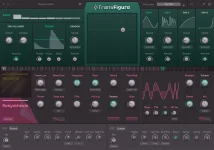
Transfigure can freeze analyzed spectral information permanently at 100 percent Freeze Rate, while lower settings hold it only for a chosen interval. The control also switches between tempo-synced, trigger-driven, and retriggerable behavior, so freeze is more than a static hold.
For Transfigure spectral processing on iPad, the useful distinction is what gets captured and when. A weak capture can leave a frozen sound thin or uninteresting, while a few milliseconds of trigger delay can preserve the stronger spectral state just after a signal peak.
The Spectral Engine also separates frequency energy from phase behavior. Freeze locks the analyzed energy, but the Character section decides how phase is recreated, which changes whether the result feels stable, partly connected to the live input, wider, or deliberately noisy.
Trigger Mode holds the captured spectrum for the chosen duration. Retrigger Mode is different because a new trigger can recapture the frequencies before the previous freeze time has expired, which makes rapidly changing textures possible without waiting for each hold to finish. Sync Mode instead relates the freeze interval to the host BPM.
FFT resolution changes what the freeze has available to hold. Transfigure spans 64 to 4096 frequency ranges and recommends 1024 or 2048 for most algorithms. Lower resolutions tend to become rougher and more distorted, while higher settings produce a smoother, airier result with finer spectral separation.
This is also why resolution should be chosen by ear before you spend time refining modulation. A coarse FFT setting can be exactly right for broken digital texture, but it gives Freeze fewer, broader bands to work with. A larger FFT provides more frequency detail, though the resulting sound can feel softer around fast transients.
Transfigure exposes this directly through Character. Hold A/B blends between two phase recreation methods, with A using the phase captured at the freeze point and B using a more mathematical reconstruction. Hold/Live mixes frozen phase with phase from the current input, which can restore some movement from whatever is still playing underneath.
Hold/Rnd blends the frozen phase with randomized phase and becomes noisier as you move toward the random side. Live/Rnd uses current input phase instead of frozen phase before introducing the same random component. These settings are useful when a perfectly static hold feels too sterile, but they can also make a carefully captured tone lose focus quickly.
Stereo, LFO, and Unisono push the phase treatment in other directions. Stereo offsets phase creation between left and right, LFO modulates phase recreation over time, and Unisono adds a frequency-dependent phase offset. None of these controls changes which spectral bands were captured, but each can make the reconstruction feel noticeably different.
Resolution matters again here because the available frequency divisions depend on the FFT setting. More spectral resolution gives the Band setup finer areas to shape, while a lower setting makes each controlled region broader. The best setting therefore depends on whether you want surgical separation or a rougher block of frozen energy.
Spectral Delay can also be tied directly to Freeze through Freeze Link. In its normal Always mode, delay processing continues constantly. Freeze Link only feeds and advances the spectral delay when a freeze occurs, so each capture can move the delayed frequency content forward instead of letting the delay run continuously between events.
A practical setup starts with the source, not the most dramatic Character mode. Set a sensible FFT resolution, capture a useful moment with Sync or the trigger unit, then decide whether the held spectrum needs live phase, random phase, stereo offset, or selective bands. Freeze becomes far more controllable once capture timing and phase recreation are treated as separate decisions.
For Transfigure spectral processing on iPad, the useful distinction is what gets captured and when. A weak capture can leave a frozen sound thin or uninteresting, while a few milliseconds of trigger delay can preserve the stronger spectral state just after a signal peak.
The Spectral Engine also separates frequency energy from phase behavior. Freeze locks the analyzed energy, but the Character section decides how phase is recreated, which changes whether the result feels stable, partly connected to the live input, wider, or deliberately noisy.
Spectral freeze starts with the captured frame
Transfigure’s trigger unit can activate Freeze when the input crosses a threshold. Its Delay control postpones the trigger, and Sugar Bytes specifically notes that a short delay can be useful when you want the freeze to happen just after the signal peaks. On drums, plucks, and other transient material, this can capture more of the body after the initial spike instead of pinning only the sharpest instant.Trigger Mode holds the captured spectrum for the chosen duration. Retrigger Mode is different because a new trigger can recapture the frequencies before the previous freeze time has expired, which makes rapidly changing textures possible without waiting for each hold to finish. Sync Mode instead relates the freeze interval to the host BPM.
FFT resolution changes what the freeze has available to hold. Transfigure spans 64 to 4096 frequency ranges and recommends 1024 or 2048 for most algorithms. Lower resolutions tend to become rougher and more distorted, while higher settings produce a smoother, airier result with finer spectral separation.
This is also why resolution should be chosen by ear before you spend time refining modulation. A coarse FFT setting can be exactly right for broken digital texture, but it gives Freeze fewer, broader bands to work with. A larger FFT provides more frequency detail, though the resulting sound can feel softer around fast transients.
Phase character changes the frozen sound substantially
A frozen spectrum is not defined by magnitude alone. Frequency-domain reconstruction also needs phase information, and phase-vocoder phase reconstruction remains a central problem in FFT-based audio processing because different phase handling can change the audible result even when spectral energy is similar.Transfigure exposes this directly through Character. Hold A/B blends between two phase recreation methods, with A using the phase captured at the freeze point and B using a more mathematical reconstruction. Hold/Live mixes frozen phase with phase from the current input, which can restore some movement from whatever is still playing underneath.
Hold/Rnd blends the frozen phase with randomized phase and becomes noisier as you move toward the random side. Live/Rnd uses current input phase instead of frozen phase before introducing the same random component. These settings are useful when a perfectly static hold feels too sterile, but they can also make a carefully captured tone lose focus quickly.
Stereo, LFO, and Unisono push the phase treatment in other directions. Stereo offsets phase creation between left and right, LFO modulates phase recreation over time, and Unisono adds a frequency-dependent phase offset. None of these controls changes which spectral bands were captured, but each can make the reconstruction feel noticeably different.
Band control turns Freeze into selective processing
The Band setup decides which frequencies Freeze affects and how strongly it affects them. You do not have to hold the entire spectrum at the same amount, so a kick can keep moving while upper percussion hangs, or a vocal can retain live low-mid energy while selected highs become sustained texture.Resolution matters again here because the available frequency divisions depend on the FFT setting. More spectral resolution gives the Band setup finer areas to shape, while a lower setting makes each controlled region broader. The best setting therefore depends on whether you want surgical separation or a rougher block of frozen energy.
Spectral Delay can also be tied directly to Freeze through Freeze Link. In its normal Always mode, delay processing continues constantly. Freeze Link only feeds and advances the spectral delay when a freeze occurs, so each capture can move the delayed frequency content forward instead of letting the delay run continuously between events.
A practical setup starts with the source, not the most dramatic Character mode. Set a sensible FFT resolution, capture a useful moment with Sync or the trigger unit, then decide whether the held spectrum needs live phase, random phase, stereo offset, or selective bands. Freeze becomes far more controllable once capture timing and phase recreation are treated as separate decisions.