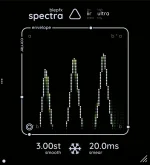
blepfx Spectra ships with four envelope-transfer algorithms, and each one changes how timing, spectral detail, and latency shape the result. Linear, Hilbert, LPC, and IIR are not just four flavors of the same processing.
Spectra separates the main and sidechain signals into spectral envelope and harmonic detail before recombining them. Change the extraction method, and you change more than color. Attacks can soften, resonances can loosen, and the processor can feel either immediate or slightly more polished.
Linear uses FFT-based envelope transfer, Hilbert is designed to reduce its pre-ringing, LPC gives up some precision for character, and IIR uses a zero-latency filter bank. Those are the practical choices inside Spectra’s spectral morphing engine, so picking a mode is really about matching the compromise to the source.
Pre-ringing is easiest to notice on material with abrupt attacks. Kick drums, rimshots, picked guitar, short piano notes, and clipped percussion make the front edge obvious. Pads and long vowels can hide the same effect because the ear has less sudden timing information to grab.
Hilbert exists to reduce the pre-ringing of Linear while keeping a similarly detailed style of envelope transfer. Try it when Linear gives you the right tonal shape but makes the attack feel slightly softened or preceded by a faint lead-in. It is not automatically the cleaner choice, but it gives you another timing behavior without jumping to a completely different model.
The difference matters because linear-phase processing can spread ringing around an impulse, including before the transient. In practical terms, a beautiful spectral match can still feel wrong if the attack loses its snap. On percussion, timing often beats microscopic spectral accuracy.
Keep Smear restrained during this test. Spectra already lets you blur envelope behavior over time, so heavy smearing can hide the exact timing differences you are trying to hear. Once the engine is chosen, bring Smear back and judge it as an effect rather than part of the comparison.
IIR takes a different route from the FFT modes. It uses a bank of narrow band-pass filters, the classic architecture associated with vocoders, and blepfx specifies zero latency for this mode. Live input, monitored vocals, and performance routing are obvious places where immediate response can matter more than the finest envelope resolution.
Zero latency is not a synonym for transparent. A filter-bank vocoder divides the spectrum into bands and follows their changing levels, so the number and behavior of those bands influence how finely the envelope is represented. Spectra’s IIR mode is therefore a structural choice, not merely a low-latency switch.
blepfx describes its LPC mode as less precise than the FFT-based options, but also says it has a distinct character and virtually no pre-ringing. Less precision can be useful on vocals, reeds, synth leads, and other sources where broad resonant shape matters more than tiny spectral detail. The result may feel more shaped and less forensic.
Speech-like material is a sensible place to audition LPC first because its underlying method was built around speech modeling. High-pitched or strongly harmonic material can also expose the limits of LPC envelope estimation, since widely spaced harmonics give the model fewer spectral landmarks to follow. In those cases, Linear or Hilbert may hold the spectral outline more tightly.
Dense pads and sustained vocals give Linear and Hilbert enough steady material to show off their finer envelope behavior. Drums, live routing, and hard transient material make Hilbert and IIR more interesting because timing becomes harder to ignore. LPC earns its keep when a slightly looser, formant-led result sounds better than a technically tighter transfer.
Spectra separates the main and sidechain signals into spectral envelope and harmonic detail before recombining them. Change the extraction method, and you change more than color. Attacks can soften, resonances can loosen, and the processor can feel either immediate or slightly more polished.
Linear uses FFT-based envelope transfer, Hilbert is designed to reduce its pre-ringing, LPC gives up some precision for character, and IIR uses a zero-latency filter bank. Those are the practical choices inside Spectra’s spectral morphing engine, so picking a mode is really about matching the compromise to the source.
Four engines change timing before they change tone
Linear is the clean starting point when you want the transferred envelope to remain relatively precise. blepfx describes it as FFT-based processing, which means the signal is analyzed in short blocks before the envelope is reconstructed and applied. Its stated drawback is pre-ringing, with some energy appearing before a sharp event instead of staying entirely after it.Pre-ringing is easiest to notice on material with abrupt attacks. Kick drums, rimshots, picked guitar, short piano notes, and clipped percussion make the front edge obvious. Pads and long vowels can hide the same effect because the ear has less sudden timing information to grab.
Hilbert exists to reduce the pre-ringing of Linear while keeping a similarly detailed style of envelope transfer. Try it when Linear gives you the right tonal shape but makes the attack feel slightly softened or preceded by a faint lead-in. It is not automatically the cleaner choice, but it gives you another timing behavior without jumping to a completely different model.
The difference matters because linear-phase processing can spread ringing around an impulse, including before the transient. In practical terms, a beautiful spectral match can still feel wrong if the attack loses its snap. On percussion, timing often beats microscopic spectral accuracy.
Transients make the tradeoffs obvious
The quickest comparison is to feed Spectra material with hard, repeated attacks and cycle through all four engines at matched settings. Listen to the first few milliseconds rather than the overall timbre. A dry snare, tight drum loop, muted guitar part, or staccato synth line will tell you more than a washed-out pad.Keep Smear restrained during this test. Spectra already lets you blur envelope behavior over time, so heavy smearing can hide the exact timing differences you are trying to hear. Once the engine is chosen, bring Smear back and judge it as an effect rather than part of the comparison.
IIR takes a different route from the FFT modes. It uses a bank of narrow band-pass filters, the classic architecture associated with vocoders, and blepfx specifies zero latency for this mode. Live input, monitored vocals, and performance routing are obvious places where immediate response can matter more than the finest envelope resolution.
Zero latency is not a synonym for transparent. A filter-bank vocoder divides the spectrum into bands and follows their changing levels, so the number and behavior of those bands influence how finely the envelope is represented. Spectra’s IIR mode is therefore a structural choice, not merely a low-latency switch.
LPC and IIR favor character and immediacy
LPC sits between precise spectral transfer and deliberate simplification. The speech-coding model behind LPC predicts a signal from recent samples and represents important vocal-tract resonances with a compact spectral model. Spectra borrows that family of techniques for envelope transfer rather than ordinary speech compression.blepfx describes its LPC mode as less precise than the FFT-based options, but also says it has a distinct character and virtually no pre-ringing. Less precision can be useful on vocals, reeds, synth leads, and other sources where broad resonant shape matters more than tiny spectral detail. The result may feel more shaped and less forensic.
Speech-like material is a sensible place to audition LPC first because its underlying method was built around speech modeling. High-pitched or strongly harmonic material can also expose the limits of LPC envelope estimation, since widely spaced harmonics give the model fewer spectral landmarks to follow. In those cases, Linear or Hilbert may hold the spectral outline more tightly.
Dense pads and sustained vocals give Linear and Hilbert enough steady material to show off their finer envelope behavior. Drums, live routing, and hard transient material make Hilbert and IIR more interesting because timing becomes harder to ignore. LPC earns its keep when a slightly looser, formant-led result sounds better than a technically tighter transfer.