A resistor marked 10 kΩ can sit above or below that nominal value while remaining inside its stated manufacturing tolerance. Capacitors, inductors, transformers, and other physical parts have their own spreads too, so two correctly built analog units never need to contain perfectly identical component values.
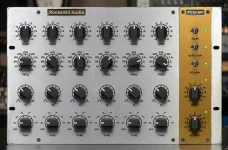
Audio plugin developers can model some of this variation instead of cloning one fixed set of numbers across every instance. Rocksolid Audio uses component-value variation in TEQ-6P as part of its Unique Edition concept, where generated copies are intended to behave slightly differently. The interesting part is not vague “warmth.” It is what changed values actually do inside a circuit.
A tolerance figure also tells you less than it appears to. A five percent resistor tolerance means the resistance may depart from its nominal value within the specified range, not that every audible property of the whole device moves by five percent. Circuit topology decides how strongly each component matters.
A peaking EQ makes the point neatly because several component values can contribute to its center frequency, gain, and Q at once. Two parts with the same tolerance label can have very different effects once their positions in the circuit are taken into account. Component percentage and audible deviation are not interchangeable numbers.
Sensitivity is the key idea. One component may have a strong influence on a particular filter parameter while another part with the same percentage tolerance barely moves it. Treating every resistor or capacitor as equally important produces a cartoon version of real manufacturing variation.
Timing circuits follow the same logic. Attack, release, integration, and other time-dependent behavior can rely on resistor-capacitor relationships. Small component differences can therefore change how quickly two nominally identical analog channels respond, even before nonlinear devices enter the picture.
Stereo matching makes those differences easier to think about. If left and right channels contain slightly different effective values, their magnitude and phase responses do not have to line up perfectly at every frequency. A tiny mismatch may be harmless, audible, useful, or annoying depending on the circuit and material. “Different” is not automatically “better.”
Brainworx described one formal approach in its digital tolerance-modeling patent. The method assigns working values to modeled components within stated tolerances and can use statistically independent, normally distributed pseudo-random values. It also describes seeded generation so the resulting variations can be reproduced instead of changing unpredictably every time a session opens.
Reproducibility is easy to overlook, but it matters in music production. If a plugin generated fresh component values every launch, a recalled mix could move without you touching a control. A fixed seed or stored model instance lets the plugin provide variation while preserving recall.
Distribution matters as well. Throwing every component anywhere between its minimum and maximum with equal probability can exaggerate edge cases compared with a model based on a more realistic statistical spread. More variance creates more difference, but not necessarily more realism.
This distinction is useful when a plugin offers “analog” channel variation. Static per-instance differences can alter filter centers, phase relationships, gain, or timing without creating extra harmonics. Nonlinear stages may add harmonic or level-dependent behavior, but tolerance modeling alone does not guarantee any particular kind of distortion.
You can hear the practical consequence by comparing matched and varied channels at controlled levels. Use identical settings, level-match the outputs, and check whether differences remain in frequency response, stereo balance, timing, or phase before reaching for language like depth or glue. Measurements are particularly useful here because very small response shifts can be mistaken for a change in saturation.
A fixed tolerance model should also remain fixed unless the plugin deliberately exposes another form of variation. If identical input and settings produce changing results across repeated renders, some additional randomized or time-varying process is involved. Manufacturing tolerance by itself describes a spread between possible component values, not a component continually choosing a new value while the track plays.
Audio plugin developers can model some of this variation instead of cloning one fixed set of numbers across every instance. Rocksolid Audio uses component-value variation in TEQ-6P as part of its Unique Edition concept, where generated copies are intended to behave slightly differently. The interesting part is not vague “warmth.” It is what changed values actually do inside a circuit.
A tolerance figure also tells you less than it appears to. A five percent resistor tolerance means the resistance may depart from its nominal value within the specified range, not that every audible property of the whole device moves by five percent. Circuit topology decides how strongly each component matters.
Small value changes can move filters and timing
In a simple RC filter, resistance and capacitance help set the cutoff frequency. Change either value and the cutoff moves. More complicated filters spread responsibility across several parts, so tolerance can also alter Q, gain, bandwidth, or the exact shape around a boost or cut.A peaking EQ makes the point neatly because several component values can contribute to its center frequency, gain, and Q at once. Two parts with the same tolerance label can have very different effects once their positions in the circuit are taken into account. Component percentage and audible deviation are not interchangeable numbers.
Sensitivity is the key idea. One component may have a strong influence on a particular filter parameter while another part with the same percentage tolerance barely moves it. Treating every resistor or capacitor as equally important produces a cartoon version of real manufacturing variation.
Timing circuits follow the same logic. Attack, release, integration, and other time-dependent behavior can rely on resistor-capacitor relationships. Small component differences can therefore change how quickly two nominally identical analog channels respond, even before nonlinear devices enter the picture.
Stereo matching makes those differences easier to think about. If left and right channels contain slightly different effective values, their magnitude and phase responses do not have to line up perfectly at every frequency. A tiny mismatch may be harmless, audible, useful, or annoying depending on the circuit and material. “Different” is not automatically “better.”
Random variation needs rules, or it becomes a gimmick
A convincing tolerance model needs more than adding a random percentage to everything. Real parts have specified ranges, distributions, correlations, matching practices, and circuit positions. Designers often choose tighter tolerances for critical components precisely because some errors matter more than others.Brainworx described one formal approach in its digital tolerance-modeling patent. The method assigns working values to modeled components within stated tolerances and can use statistically independent, normally distributed pseudo-random values. It also describes seeded generation so the resulting variations can be reproduced instead of changing unpredictably every time a session opens.
Reproducibility is easy to overlook, but it matters in music production. If a plugin generated fresh component values every launch, a recalled mix could move without you touching a control. A fixed seed or stored model instance lets the plugin provide variation while preserving recall.
Distribution matters as well. Throwing every component anywhere between its minimum and maximum with equal probability can exaggerate edge cases compared with a model based on a more realistic statistical spread. More variance creates more difference, but not necessarily more realism.
Tolerances are not the same as drift, noise, or saturation
Component tolerance describes deviation from a nominal value. It does not, by itself, mean the value wanders constantly during playback. Temperature coefficients, aging, noise, hysteresis, nonlinear saturation, and other behaviors are separate physical effects that require their own models if a developer wants to reproduce them.This distinction is useful when a plugin offers “analog” channel variation. Static per-instance differences can alter filter centers, phase relationships, gain, or timing without creating extra harmonics. Nonlinear stages may add harmonic or level-dependent behavior, but tolerance modeling alone does not guarantee any particular kind of distortion.
You can hear the practical consequence by comparing matched and varied channels at controlled levels. Use identical settings, level-match the outputs, and check whether differences remain in frequency response, stereo balance, timing, or phase before reaching for language like depth or glue. Measurements are particularly useful here because very small response shifts can be mistaken for a change in saturation.
A fixed tolerance model should also remain fixed unless the plugin deliberately exposes another form of variation. If identical input and settings produce changing results across repeated renders, some additional randomized or time-varying process is involved. Manufacturing tolerance by itself describes a spread between possible component values, not a component continually choosing a new value while the track plays.