An audio transformer transfers an AC signal between windings through a magnetic core, and its behavior changes with frequency, level, source impedance, and load. In a guitar pedal, the transformer can do electrical work before anyone reaches for words like warmth or weight.
A winding ratio can trade voltage for current and reflect the connected load toward the driving circuit at a different impedance. The relationship is not decorative. A stage that sees an easier or harder load can change its own gain, headroom, and distortion before the transformer’s magnetic nonlinearity becomes obvious.
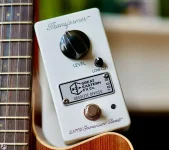
Great Eastern FX’s Transformer Boost puts a germanium transistor straight into a directly driven output transformer stage, so the useful question is not whether a transformer somehow “adds vintage tone.” What matters is how the driver, transformer, signal level, and frequency content lean on one another.
Small pedal stages live in a very different electrical world from a tube amplifier pushing a loudspeaker. A pedal transformer may provide coupling, isolation, level conversion, impedance conversion, intentional coloration, or some combination of those jobs. Calling every transformer-equipped pedal “tube-like” skips the circuit doing the work.
Frequency response is part of the design too. Primary inductance helps determine how comfortably low frequencies pass, while leakage inductance and winding capacitance matter more toward the top of the spectrum. Core material, winding geometry, source impedance, and load all move those boundaries, so two transformers with similar ratios can behave quite differently in the same nominal job.
A transformer can also change the way a pedal drives the next device without sounding obviously distorted on its own. Lower output impedance, altered level, or galvanic isolation can be practical benefits, while deliberate coloration remains a separate design choice rather than an automatic property of having iron in the box.
Peer-reviewed measurements of guitar-amplifier transformers show the frequency dependence clearly. Researchers found distortion concentrated mainly below about 100 Hz in one Fender output transformer and below about 30 Hz in a Hammond model, showing how strongly the result depends on the actual transformer. The measured output-transformer nonlinearity also included hysteresis and saturation rather than treating “transformer color” as a fixed EQ curve.
Hysteresis matters before full saturation. The magnetic state of the core depends partly on where it has just been, so the relationship between input and output is not perfectly memoryless. Once signal level and low-frequency energy rise far enough, the core becomes less linear and harmonic content increases.
A low-cut control placed before a transformer-driven stage can therefore alter more than bass quantity. Removing some low-frequency energy reduces the magnetic excursion demanded from the core and can leave more headroom for the rest of the signal. Keeping the bass intact can do the opposite, making the stage denser or more compressed without requiring a conventional clipping diode to enter the picture.
The driver matters just as much. A transistor that runs out of clean swing before the transformer becomes strongly nonlinear will dominate what you hear. A transformer pushed harder by a capable driver can contribute more of its own level-dependent behavior, but the two devices still form one system rather than independent flavor controls.
Load changes complicate the picture again. Plugging the same transformer-coupled pedal into different following devices can alter the reflected load seen by the primary, especially when the destination impedance is low enough to matter. Modern guitar inputs are often high impedance, so the effect may be small, but designers still choose winding ratios and surrounding resistances for a target operating condition.
When the following input loads the secondary more heavily than intended, the driver can be asked for more current and the transformer's response can shift with it. The audible result may be less output, earlier breakup, or a different low-end contour rather than some universal transformer signature. Matching the transformer to the circuit is where the interesting behavior starts.
A winding ratio can trade voltage for current and reflect the connected load toward the driving circuit at a different impedance. The relationship is not decorative. A stage that sees an easier or harder load can change its own gain, headroom, and distortion before the transformer’s magnetic nonlinearity becomes obvious.
Great Eastern FX’s Transformer Boost puts a germanium transistor straight into a directly driven output transformer stage, so the useful question is not whether a transformer somehow “adds vintage tone.” What matters is how the driver, transformer, signal level, and frequency content lean on one another.
Impedance sets the conditions before color appears
A transformer does not have one magic impedance stamped into its personality. Its turns ratio reflects the impedance connected to the secondary back into the primary, approximately by the square of that ratio in an ideal transformer. Change the load and the driving transistor can experience a different electrical condition even though you never touched its bias or gain control.Small pedal stages live in a very different electrical world from a tube amplifier pushing a loudspeaker. A pedal transformer may provide coupling, isolation, level conversion, impedance conversion, intentional coloration, or some combination of those jobs. Calling every transformer-equipped pedal “tube-like” skips the circuit doing the work.
Frequency response is part of the design too. Primary inductance helps determine how comfortably low frequencies pass, while leakage inductance and winding capacitance matter more toward the top of the spectrum. Core material, winding geometry, source impedance, and load all move those boundaries, so two transformers with similar ratios can behave quite differently in the same nominal job.
A transformer can also change the way a pedal drives the next device without sounding obviously distorted on its own. Lower output impedance, altered level, or galvanic isolation can be practical benefits, while deliberate coloration remains a separate design choice rather than an automatic property of having iron in the box.
Low frequencies push transformer cores first
Magnetic cores have finite flux capacity. At a given signal voltage, lower frequencies demand larger magnetic flux swings, which is why transformer distortion usually appears in the low end before it becomes an across-the-board fuzz effect. More bass can therefore change the texture of a transformer-driven stage even when the treble content entering it has not changed.Peer-reviewed measurements of guitar-amplifier transformers show the frequency dependence clearly. Researchers found distortion concentrated mainly below about 100 Hz in one Fender output transformer and below about 30 Hz in a Hammond model, showing how strongly the result depends on the actual transformer. The measured output-transformer nonlinearity also included hysteresis and saturation rather than treating “transformer color” as a fixed EQ curve.
Hysteresis matters before full saturation. The magnetic state of the core depends partly on where it has just been, so the relationship between input and output is not perfectly memoryless. Once signal level and low-frequency energy rise far enough, the core becomes less linear and harmonic content increases.
A low-cut control placed before a transformer-driven stage can therefore alter more than bass quantity. Removing some low-frequency energy reduces the magnetic excursion demanded from the core and can leave more headroom for the rest of the signal. Keeping the bass intact can do the opposite, making the stage denser or more compressed without requiring a conventional clipping diode to enter the picture.
Useful saturation stops well short of collapse
Transformer saturation gets romanticized because the word sounds inherently desirable. Real circuits have a usable range instead. Mild nonlinearity can add harmonics and soften peaks, while severe saturation can damage low-frequency transfer, increase intermodulation, and turn definition into mud.The driver matters just as much. A transistor that runs out of clean swing before the transformer becomes strongly nonlinear will dominate what you hear. A transformer pushed harder by a capable driver can contribute more of its own level-dependent behavior, but the two devices still form one system rather than independent flavor controls.
Load changes complicate the picture again. Plugging the same transformer-coupled pedal into different following devices can alter the reflected load seen by the primary, especially when the destination impedance is low enough to matter. Modern guitar inputs are often high impedance, so the effect may be small, but designers still choose winding ratios and surrounding resistances for a target operating condition.
When the following input loads the secondary more heavily than intended, the driver can be asked for more current and the transformer's response can shift with it. The audible result may be less output, earlier breakup, or a different low-end contour rather than some universal transformer signature. Matching the transformer to the circuit is where the interesting behavior starts.