A controlled FPS aiming experiment found 27-inch 1440p players finished a tiny-target task 111 milliseconds faster than on 24.5-inch 1080p. The difference was only about 3 percent, but it went in the opposite direction from the usual claim that a smaller esports monitor automatically improves target acquisition. Accuracy barely changed between the two setups.
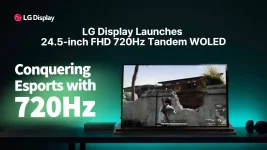
The 24.5-inch format still makes plenty of sense for Counter-Strike 2, Valorant, and other fast shooters. It keeps 1080p reasonably sharp, fits shallow tournament desks, and makes extreme refresh rates easier for a PC to feed. LG Display’s 24.5-inch 720Hz esports OLED follows that familiar competitive layout, but screen size by itself does not grant better aim.
Some of that is practical rather than biological. Esports events need hardware that fits identical desks, runs the same settings, and can drive very high frame rates across many machines. A 1080p 24.5-inch monitor is convenient for all of those jobs, so its popularity does not prove that 24.5 inches is the optimum physical size for human aiming.
Viewing distance muddies things further. Move a 27-inch monitor farther away and its apparent size can get close to a 24.5-inch screen sitting nearer your face. A player who claims 27 inches forces more eye movement may really be comparing two monitors at the same desk position rather than two carefully matched viewing angles.
Resolution matters too. Full HD on 24.5 inches works out to roughly 90 pixels per inch, while 2560×1440 on 27 inches is about 109 pixels per inch. The larger QHD display can therefore make a distant head or thin edge easier to resolve even though the screen itself occupies more physical space.
The result was statistically significant for completion time, while the accuracy difference was not. Players were getting through the tiny-target task slightly faster rather than simply spraying more shots and accepting extra misses. For a head-sized target represented by only a few pixels, extra image detail can matter.
The experiment does not prove that every 27-inch monitor improves FPS aim. Screen size and resolution changed together, so the test cannot tell us how much of the result came from the extra 2.5 inches and how much came from 1440p showing the targets with more pixels. Its task was deliberately designed to make small-target visibility matter, which is also a narrower situation than a complete match.
Earlier experiments in the same work compared smaller rendered display areas and found aiming generally improved as the visible display became larger. Gains started tapering as size approached 30 inches. Player-to-player differences were also larger than the gap between the 24.5-inch and 27-inch conditions, so monitor size never became the dominant factor.
Games complicate the comparison because many competitive players intentionally use lower resolutions, stretched aspect ratios, or aggressive graphics settings. In that environment, buying a 27-inch QHD monitor for extra target detail makes little sense if you immediately run the game at a low internal resolution. The display can only show detail the rendered frame actually contains.
Desk depth can flip the experience as well. A 27-inch panel pushed right behind the keyboard may feel oversized, while the same monitor farther back can occupy a comfortable visual angle. A 24.5-inch panel pulled unusually close can fill more of your vision than the larger screen does at a sensible distance.
Refresh rate, pixel response, input lag, frame consistency, resolution, viewing distance, and the size of the targets you usually fight all sit beside diagonal size. A player holding close angles in Counter-Strike may value the familiar compact layout, while someone taking long-range fights can benefit from the extra target definition of a high-refresh 27-inch QHD display. Neither result comes from the diagonal measurement alone.
The 24.5-inch format still makes plenty of sense for Counter-Strike 2, Valorant, and other fast shooters. It keeps 1080p reasonably sharp, fits shallow tournament desks, and makes extreme refresh rates easier for a PC to feed. LG Display’s 24.5-inch 720Hz esports OLED follows that familiar competitive layout, but screen size by itself does not grant better aim.
The usual 24.5-inch esports argument leaves out context
Advice on competitive monitor size tends to repeat the same explanation. A 24.5-inch screen supposedly keeps the entire image inside your vision, reduces eye travel, and lets you react without scanning a larger panel. Tournament use reinforces the idea because players spend years practicing on displays around this size.Some of that is practical rather than biological. Esports events need hardware that fits identical desks, runs the same settings, and can drive very high frame rates across many machines. A 1080p 24.5-inch monitor is convenient for all of those jobs, so its popularity does not prove that 24.5 inches is the optimum physical size for human aiming.
Viewing distance muddies things further. Move a 27-inch monitor farther away and its apparent size can get close to a 24.5-inch screen sitting nearer your face. A player who claims 27 inches forces more eye movement may really be comparing two monitors at the same desk position rather than two carefully matched viewing angles.
Resolution matters too. Full HD on 24.5 inches works out to roughly 90 pixels per inch, while 2560×1440 on 27 inches is about 109 pixels per inch. The larger QHD display can therefore make a distant head or thin edge easier to resolve even though the screen itself occupies more physical space.
Small targets expose where a larger display can help
The controlled FPS aiming experiment compared a 24.5-inch 1080p 360Hz display with a 27-inch 1440p 360Hz display using deliberately tiny targets. Twelve participants remained in the final analysis after one participant was excluded, and they completed thousands of target hits across the two setups. Mean task completion time fell from 3.75 seconds on the smaller display to 3.64 seconds on the larger one.The result was statistically significant for completion time, while the accuracy difference was not. Players were getting through the tiny-target task slightly faster rather than simply spraying more shots and accepting extra misses. For a head-sized target represented by only a few pixels, extra image detail can matter.
The experiment does not prove that every 27-inch monitor improves FPS aim. Screen size and resolution changed together, so the test cannot tell us how much of the result came from the extra 2.5 inches and how much came from 1440p showing the targets with more pixels. Its task was deliberately designed to make small-target visibility matter, which is also a narrower situation than a complete match.
Earlier experiments in the same work compared smaller rendered display areas and found aiming generally improved as the visible display became larger. Gains started tapering as size approached 30 inches. Player-to-player differences were also larger than the gap between the 24.5-inch and 27-inch conditions, so monitor size never became the dominant factor.
Screen size and resolution have to be judged together
A 24.5-inch 1080p setup still has one huge competitive advantage. It is easier to render. QHD contains about 78 percent more pixels per frame than Full HD, and maintaining 500, 600, or 720 frames per second becomes considerably harder once the GPU has to shade all of them.Games complicate the comparison because many competitive players intentionally use lower resolutions, stretched aspect ratios, or aggressive graphics settings. In that environment, buying a 27-inch QHD monitor for extra target detail makes little sense if you immediately run the game at a low internal resolution. The display can only show detail the rendered frame actually contains.
Desk depth can flip the experience as well. A 27-inch panel pushed right behind the keyboard may feel oversized, while the same monitor farther back can occupy a comfortable visual angle. A 24.5-inch panel pulled unusually close can fill more of your vision than the larger screen does at a sensible distance.
Refresh rate, pixel response, input lag, frame consistency, resolution, viewing distance, and the size of the targets you usually fight all sit beside diagonal size. A player holding close angles in Counter-Strike may value the familiar compact layout, while someone taking long-range fights can benefit from the extra target definition of a high-refresh 27-inch QHD display. Neither result comes from the diagonal measurement alone.