Modartt built Airteq by refining the physical pipe-organ model already used in Organteq for continuous control of each pipe’s air supply. The family resemblance is real, but the two instruments organize those physics around very different jobs.
Organteq behaves like a configurable pipe organ. Its four virtual keyboards are Pédale, Positif, Grand Orgue, and Récit, with 50 stop slots spread across those divisions and 74 factory stop models available for assignment. Couplers, expression pedals, a 24-step crescendo pedal, temperament controls, pipe-by-pipe voicing, and multichannel routing all support the habits of an organist rather than a general-purpose synthesist.
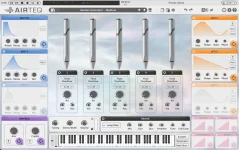
Airteq strips away most of that organ-console structure and keeps a smaller sound-design core. You can instantiate up to five stop slots from 21 available stops, then push them with continuously variable air, envelopes, LFOs, performance gestures, and macros. Airteq’s modeled pipe architecture is therefore related to Organteq without being a cut-down edition of it.
Researchers were exploring the same broad computational problem long before either product existed. An older organ-pipe physical-model synthesis paper discusses waveguide-based synthesis and compares generated pipe sounds with real ones. Modartt’s implementations are proprietary, but the underlying idea explains why changing a physical input can alter more than volume.
Organteq already uses airflow as part of its model. Its tremulants modulate the upstream air feeding selected pipes, and the model turns those changes into movement in pitch, intensity, and harmonic content rather than adding a tremolo effect afterward. Airteq does not invent airflow modeling from nothing.
The difference is how much authority you get over it. Airteq refines the model so the Air value for each stop can be moved continuously as a primary sound-design parameter. Its manual treats those individual Air gauges as central controls, with a nominal value of 0.5 providing the tuned reference point for every stop.
Its pipe editing also goes much deeper than choosing a preset. Individual pipes can be adjusted for volume, detune, brightness, air noise, wind jitter, chiff, and tremulant sensitivity. Division acoustics, C and C-sharp spatial separation, convolution reverb, and up to eight output channels help you construct an instrument that behaves like an organ installation.
Performance controls follow the same philosophy. Expression pedals operate divisions, the crescendo pedal brings registrations in across 24 stages, and couplers move registrations between keyboards. Even when you heavily customize Organteq, the system keeps pulling you back toward organ technique and organ architecture.
Airteq removes that obligation. It does not ask you to maintain a plausible Grand Orgue or build historically sensible registrations. Five pipes can become a pad, bass, rhythmic pulse, unstable wind texture, or something that barely reads as an organ at all.
One macro can control several Air gauges at different depths while also moving an LFO or another modulation link. A five-pipe patch can therefore change internal balance and airflow together from one performance control. Organteq offers extensive voicing, but it is not organized around this kind of synth-style modulation network.
Airteq also lets its pipes leave normal organ operating conditions on purpose. Depending on the selected response, changing Air can introduce aeolian noise, alter pitch, push a pipe toward overblowing, or hold pitch steady while the spectrum changes. Those behaviors are useful precisely because Airteq is allowed to stop behaving like a convincing church organ.
Airteq’s architecture also makes unusual pipe combinations routine. A five-stop patch can place different pipe families under separate Air values, pan positions, transpositions, envelopes, and shared macro movement without assigning them to organ divisions. Organteq reserves its deeper control for registration, voicing, divisions, couplers, room behavior, and console performance, while Airteq concentrates control around what happens when modeled pipes are deliberately pushed away from ordinary organ behavior.
Organteq behaves like a configurable pipe organ. Its four virtual keyboards are Pédale, Positif, Grand Orgue, and Récit, with 50 stop slots spread across those divisions and 74 factory stop models available for assignment. Couplers, expression pedals, a 24-step crescendo pedal, temperament controls, pipe-by-pipe voicing, and multichannel routing all support the habits of an organist rather than a general-purpose synthesist.
Airteq strips away most of that organ-console structure and keeps a smaller sound-design core. You can instantiate up to five stop slots from 21 available stops, then push them with continuously variable air, envelopes, LFOs, performance gestures, and macros. Airteq’s modeled pipe architecture is therefore related to Organteq without being a cut-down edition of it.
The shared pipe model is only the starting point
Both instruments generate their pipe sound in real time rather than playing back recordings of individual notes. Physical modeling matters here because an organ pipe is a dynamic system. Airflow, the resonator, the excitation mechanism, and the pipe geometry interact while the note is sounding.Researchers were exploring the same broad computational problem long before either product existed. An older organ-pipe physical-model synthesis paper discusses waveguide-based synthesis and compares generated pipe sounds with real ones. Modartt’s implementations are proprietary, but the underlying idea explains why changing a physical input can alter more than volume.
Organteq already uses airflow as part of its model. Its tremulants modulate the upstream air feeding selected pipes, and the model turns those changes into movement in pitch, intensity, and harmonic content rather than adding a tremolo effect afterward. Airteq does not invent airflow modeling from nothing.
The difference is how much authority you get over it. Airteq refines the model so the Air value for each stop can be moved continuously as a primary sound-design parameter. Its manual treats those individual Air gauges as central controls, with a nominal value of 0.5 providing the tuned reference point for every stop.
Organteq preserves the logic of a playable organ
Organteq’s structure makes sense once you think in registrations instead of synth layers. The Grand Orgue has 20 stop slots, while Pédale, Positif, and Récit each have 10. You select stops, distribute them across divisions, couple keyboards, shape their voicing, and control how those divisions sit in an acoustic space.Its pipe editing also goes much deeper than choosing a preset. Individual pipes can be adjusted for volume, detune, brightness, air noise, wind jitter, chiff, and tremulant sensitivity. Division acoustics, C and C-sharp spatial separation, convolution reverb, and up to eight output channels help you construct an instrument that behaves like an organ installation.
Performance controls follow the same philosophy. Expression pedals operate divisions, the crescendo pedal brings registrations in across 24 stages, and couplers move registrations between keyboards. Even when you heavily customize Organteq, the system keeps pulling you back toward organ technique and organ architecture.
Airteq removes that obligation. It does not ask you to maintain a plausible Grand Orgue or build historically sensible registrations. Five pipes can become a pad, bass, rhythmic pulse, unstable wind texture, or something that barely reads as an organ at all.
Airteq turns the pipe model into a modulation system
The most important Airteq change is the modulation layer wrapped around the physical source. Its Main Air Envelope shapes the air supplied to every active stop and runs polyphonically, so each played note receives its own envelope behavior. Two additional envelopes, LFOs, gesture modulators, and assignable macros can then target parameters across the instrument.One macro can control several Air gauges at different depths while also moving an LFO or another modulation link. A five-pipe patch can therefore change internal balance and airflow together from one performance control. Organteq offers extensive voicing, but it is not organized around this kind of synth-style modulation network.
Airteq also lets its pipes leave normal organ operating conditions on purpose. Depending on the selected response, changing Air can introduce aeolian noise, alter pitch, push a pipe toward overblowing, or hold pitch steady while the spectrum changes. Those behaviors are useful precisely because Airteq is allowed to stop behaving like a convincing church organ.
Airteq’s architecture also makes unusual pipe combinations routine. A five-stop patch can place different pipe families under separate Air values, pan positions, transpositions, envelopes, and shared macro movement without assigning them to organ divisions. Organteq reserves its deeper control for registration, voicing, divisions, couplers, room behavior, and console performance, while Airteq concentrates control around what happens when modeled pipes are deliberately pushed away from ordinary organ behavior.