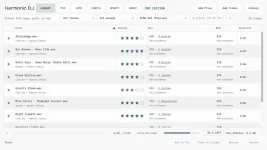
APU Harmonic DJ 1.2.0 adds plug-in versions while keeping the music library, scanning, and analysis tied to the installed desktop application. The split has a practical purpose.
You load Harmonic DJ on a stereo audio track, open its editor, and work with the same analyzed library used by the standalone app. The Harmonic DJ plug-in expansion changes where you can plan and audition mixes without turning every plug-in instance into another library database. It is a host-facing workspace, not a second library manager.
Several instances can point at the same Harmonic DJ Library while carrying different Mixes. One might hold a short transition test while another contains a longer sequence for a different part of the project. Editing one does not silently replace another, and a plug-in Mix is not a live mirror of whichever named Mix is open in the standalone application.
This separation matters when a production grows beyond one experiment. You can keep separate harmonic plans alongside different tracks without constantly saving and reopening standalone Mix documents. The DAW handles instance state, while Harmonic DJ remains responsible for the shared source library.
The audio track beneath the plug-in is not swallowed by the planning tool either. When Harmonic DJ's preview player is idle, the host track passes through the plug-in. Auditioning uses the plug-in's host output, so checking a candidate does not require a separate desktop playback path.
A DAW can scan or restore the plug-in without forcing the full Harmonic DJ window onto the screen. Opening the editor establishes the Library connection, and the application can run without presenting its main window when needed. Choosing Manage in App brings the library-management side forward when you actually need to change the collection.
Local tracks can move the other direction too. Harmonic DJ lets you drag playable local tracks into the host arrangement, turning a planned choice into something you can place on the DAW timeline. AUv3 uses a sandbox-safe file path for the transfer, but the visible workflow stays much the same.
A stopped application does not automatically strand an open plug-in. Once the application returns, the plug-in is designed to reconnect. Version mismatches are less forgiving because the application and plug-ins are meant to come from the same release, so mixed installation versions can trigger a warning.
No beat grid appears just because the plug-in can read tempo. Harmonic DJ does not add downbeat detection, quantized starts, phrase alignment, or automatic time stretching through Host BPM. Academic work on pitch-preserving audio stretching treats time-scale modification as a substantial signal-processing problem, and Harmonic DJ does not claim to hide one inside its tempo connection.
You still need the DAW, DJ software, or your own editing decisions for timing work that depends on bars, phrases, cue points, and transient placement. Harmonic DJ contributes harmonic and tempo constraints used to plan candidates, then leaves arrangement mechanics where they already belong.
Its own BPM policies make the distinction clearer. Same Mix BPM can treat a detected tempo as a rounded planning match while leaving playback at its native rate, while the pitch-shifted option changes speed and pitch together when a qualifying semitone shift is allowed. Harmonic DJ deliberately avoids pitch-preserving time stretching, so reading a host tempo should never be mistaken for full synchronization. A qualifying shifted match can therefore move pitch with playback speed instead of preserving the original key.
You load Harmonic DJ on a stereo audio track, open its editor, and work with the same analyzed library used by the standalone app. The Harmonic DJ plug-in expansion changes where you can plan and audition mixes without turning every plug-in instance into another library database. It is a host-facing workspace, not a second library manager.
Each DAW instance keeps its own mix state
Every Harmonic DJ instance owns an independent Mix, and the DAW project stores that Mix with the instance. Close the plug-in window and reopen it later, and the Mix remains there. Reopen the DAW project, and its current revision returns with it.Several instances can point at the same Harmonic DJ Library while carrying different Mixes. One might hold a short transition test while another contains a longer sequence for a different part of the project. Editing one does not silently replace another, and a plug-in Mix is not a live mirror of whichever named Mix is open in the standalone application.
This separation matters when a production grows beyond one experiment. You can keep separate harmonic plans alongside different tracks without constantly saving and reopening standalone Mix documents. The DAW handles instance state, while Harmonic DJ remains responsible for the shared source library.
The audio track beneath the plug-in is not swallowed by the planning tool either. When Harmonic DJ's preview player is idle, the host track passes through the plug-in. Auditioning uses the plug-in's host output, so checking a candidate does not require a separate desktop playback path.
Library work still belongs to the desktop app
Scanning folders, adding tracks, removing entries, rescanning files, and organizing the Library stay in the application. The plug-in connects to that Library when its editor opens, and changes made through the app become available to connected instances. Keeping the standalone component installed is normal plug-in use, not leftover baggage from the earlier standalone release.A DAW can scan or restore the plug-in without forcing the full Harmonic DJ window onto the screen. Opening the editor establishes the Library connection, and the application can run without presenting its main window when needed. Choosing Manage in App brings the library-management side forward when you actually need to change the collection.
Local tracks can move the other direction too. Harmonic DJ lets you drag playable local tracks into the host arrangement, turning a planned choice into something you can place on the DAW timeline. AUv3 uses a sandbox-safe file path for the transfer, but the visible workflow stays much the same.
A stopped application does not automatically strand an open plug-in. Once the application returns, the plug-in is designed to reconnect. Version mismatches are less forgiving because the application and plug-ins are meant to come from the same release, so mixed installation versions can trigger a warning.
Host BPM guides planning rather than rebuilding audio
Host BPM is useful, but its job is narrower than the name might suggest. When enabled and the DAW supplies tempo, Harmonic DJ uses the host value for Mix planning and audition rate in that instance. If host tempo is unavailable, the plug-in falls back to the Mix BPM.No beat grid appears just because the plug-in can read tempo. Harmonic DJ does not add downbeat detection, quantized starts, phrase alignment, or automatic time stretching through Host BPM. Academic work on pitch-preserving audio stretching treats time-scale modification as a substantial signal-processing problem, and Harmonic DJ does not claim to hide one inside its tempo connection.
You still need the DAW, DJ software, or your own editing decisions for timing work that depends on bars, phrases, cue points, and transient placement. Harmonic DJ contributes harmonic and tempo constraints used to plan candidates, then leaves arrangement mechanics where they already belong.
Its own BPM policies make the distinction clearer. Same Mix BPM can treat a detected tempo as a rounded planning match while leaving playback at its native rate, while the pitch-shifted option changes speed and pitch together when a qualifying semitone shift is allowed. Harmonic DJ deliberately avoids pitch-preserving time stretching, so reading a host tempo should never be mistaken for full synchronization. A qualifying shifted match can therefore move pitch with playback speed instead of preserving the original key.