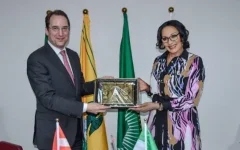
Two governments shook hands, talked strategy, and quietly lined up trade, security, and education deals while the world stays messy.
What actually went down
What actually went down
- Nigeria and Austria agreed to level up their relationship.
- The focus hit bilateral ties, multilateral teamwork, and practical partnerships.
- This followed a high-level meeting on January 22, 2026.
- Nigeria was represented by Bianca Odumiegwu-Ojukwu.
- Austria sent Nikolaus Marschik.
- The talks were framed as forward-looking, not ceremonial.
- Global politics are shifting fast.
- Europe and Africa are dealing with economic pressure and security stress.
- Both sides agreed that silence is not a strategy right now.
- Odumiegwu-Ojukwu pointed out that the partnership has lasted over five decades.
- Austria’s long diplomatic presence in Nigeria got a nod.
- Cultural familiarity and goodwill were credited for keeping things smooth.
- Trade and investment topped the wishlist.
- Priority sectors named were renewable energy, green tech, food security, agro-processing, infrastructure, digital innovation, and ICT.
- Austrian private companies were encouraged to look at Nigeria’s Special Economic Zones.
- The African Continental Free Trade Area was pitched as a wider market door.
- Cultural exchange agreements already exist.
- Interest from Nigerians studying and training in Austria is growing.
- Nigeria signaled readiness to expand scholarships and academic partnerships.
- Universities, research centers, and cultural institutions were all mentioned.
- Nigeria briefed Austria on counterterrorism efforts.
- Boko Haram, violent extremism, and organized crime were part of the discussion.
- Intelligence sharing, post-conflict rebuilding, and displaced persons came up.
- The message was clear: insecurity is not local anymore.
- Odumiegwu-Ojukwu pushed for humane and balanced migration policies.
- Root causes like unemployment and skills gaps were highlighted.
- Skills training and structured mobility were framed as smarter solutions.
- Marschik praised Nigeria’s leadership role in Africa.
- He described Nigeria as one of Austria’s most important partners on the continent.
- Austria is working on a new Africa strategy built on equality and shared learning.
- Nigerian input is expected to shape that strategy.
- Fragmented policies are being pulled into one framework.
- Democracy, human rights, and the rule of law stay central.
- Results and measurable impact are the focus.
- Key areas include peace, markets, migration tied to skills, education, culture, and environmental protection.
- Austria emphasized its role as a neutral host of major international organizations.
- Appreciation was shown for Nigeria’s backing of Austria’s UN Security Council bid.
- Austria promised reciprocal support for Nigeria’s future multilateral goals.
- Both sides doubled down on rules-based global order talk.
- Nigeria shared concerns about West Africa’s stability.
- Regional integration, governance issues, and security challenges were flagged.
- Ongoing engagement with regional partners was described as essential.
- Instability anywhere makes cooperation unavoidable.
- Dialogue and institutions still matter.
- Education, training, and people-to-people exchange were tagged as long-term glue.
- Nigeria closed by signaling readiness to move from talk to results with Austria.