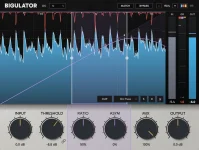
Bigulator puts a VCA directly in the audio path and drives its control port at audio rate with a peak-skimming full-wave rectifier. The important bit is not the VCA by itself, but what feeds it and how quickly that control signal changes.
A conventional VCA compressor usually has a separate level detector and control stage between the incoming audio and the gain element. Attack and release settings slow or shape that control movement, so gain reduction can keep changing after the tallest part of a transient has already passed. Bigulator leaves that timing layer out.
The Bigulator 1.0.1 clipping workflow adds useful level matching and band monitoring, but neither feature changes this underlying circuit idea. The processor still reacts from the waveform itself, so the lack of attack and release stops looking like a missing feature once the signal path makes sense.
Bigulator uses a full-wave rectified version of the signal to create that control, meaning positive and negative waveform halves both contribute to gain reduction instead of one polarity being ignored. The peak-skimming part limits when the control action starts, while Threshold and Ratio determine where it bites and how firmly it pushes back.
There is no normal envelope hanging around afterward. A snare peak can drive attenuation during the part of the waveform that crosses the threshold, then the gain can move back as soon as the signal no longer demands the same reduction. You are not waiting for a 20 ms, 100 ms, or 300 ms release curve to finish its business.
Calling Bigulator a VCA compressor misses the useful distinction. Plenty of compressors use VCAs, but their detectors deliberately turn fast audio into a slower control signal, while Bigulator keeps the control path fast enough for waveform shape to matter directly.
Bigulator reaches a similar no-envelope territory through a different route. Its rectifier creates a control signal, and the VCA applies gain according to that control, so the nonlinear law comes from the interaction between those pieces rather than from one obvious clipping curve. In practical terms, both approaches can behave as memoryless nonlinear processors when no state is carried from one instant to the next.
Two memoryless nonlinearities still do not have to draw the same waveform. Threshold position, ratio, rectifier behavior, VCA control law, asymmetry, and the modeled hardware response can all influence the final transfer relationship, so two processors may both lack attack and release yet produce different harmonic structures and peak shapes.
There is a catch in digital. Hard clipping can generate strong aliasing products when new harmonics run beyond the available digital bandwidth, and other nonlinear curves can create the same basic problem to different degrees. Bigulator includes oversampling, which is relevant whenever its nonlinear processing generates enough high-frequency content for foldback to become audible.
Bigulator’s architecture does not create that kind of delayed recovery by design. Once the waveform drops away from the region driving the peak-skimmer, the control action drops with it, so short peaks can be reshaped without automatically imposing a separate recovery envelope over the material immediately afterward.
Sustained signals expose the other side of this behavior. A loud bass note that keeps crossing the threshold does not get a free pass simply because there is no release time. The circuit keeps responding wherever the waveform demands it, so a long low-frequency note can spend far more of each cycle under nonlinear gain control than a tiny percussion spike.
You can hear the difference most clearly with material that has obvious contrast between isolated transients and sustained energy. Start with a modest Ratio, lower Threshold until only the tallest peaks are affected, then compare a snare-heavy section with a held bass or vocal phrase at matched output. The transient may lose height while the following material stays comparatively untouched, whereas the sustained source reveals the harmonic cost much sooner.
A conventional VCA compressor usually has a separate level detector and control stage between the incoming audio and the gain element. Attack and release settings slow or shape that control movement, so gain reduction can keep changing after the tallest part of a transient has already passed. Bigulator leaves that timing layer out.
The Bigulator 1.0.1 clipping workflow adds useful level matching and band monitoring, but neither feature changes this underlying circuit idea. The processor still reacts from the waveform itself, so the lack of attack and release stops looking like a missing feature once the signal path makes sense.
The control circuit matters more than the VCA label
A VCA is just a gain element whose level changes according to a control signal. Put an RMS detector in front of it, and you can build a familiar compressor. Feed it something much faster, and the same basic component starts behaving very differently.Bigulator uses a full-wave rectified version of the signal to create that control, meaning positive and negative waveform halves both contribute to gain reduction instead of one polarity being ignored. The peak-skimming part limits when the control action starts, while Threshold and Ratio determine where it bites and how firmly it pushes back.
There is no normal envelope hanging around afterward. A snare peak can drive attenuation during the part of the waveform that crosses the threshold, then the gain can move back as soon as the signal no longer demands the same reduction. You are not waiting for a 20 ms, 100 ms, or 300 ms release curve to finish its business.
Calling Bigulator a VCA compressor misses the useful distinction. Plenty of compressors use VCAs, but their detectors deliberately turn fast audio into a slower control signal, while Bigulator keeps the control path fast enough for waveform shape to matter directly.
Audio-rate gain control is not a normal static clipper
A basic digital clipper can be described with a transfer curve. Feed in one sample value, and the curve tells you the output value, with harder curves flattening peaks more abruptly and softer curves bending them sooner. No attack or release is required because there is no envelope to charge and discharge.Bigulator reaches a similar no-envelope territory through a different route. Its rectifier creates a control signal, and the VCA applies gain according to that control, so the nonlinear law comes from the interaction between those pieces rather than from one obvious clipping curve. In practical terms, both approaches can behave as memoryless nonlinear processors when no state is carried from one instant to the next.
Two memoryless nonlinearities still do not have to draw the same waveform. Threshold position, ratio, rectifier behavior, VCA control law, asymmetry, and the modeled hardware response can all influence the final transfer relationship, so two processors may both lack attack and release yet produce different harmonic structures and peak shapes.
There is a catch in digital. Hard clipping can generate strong aliasing products when new harmonics run beyond the available digital bandwidth, and other nonlinear curves can create the same basic problem to different degrees. Bigulator includes oversampling, which is relevant whenever its nonlinear processing generates enough high-frequency content for foldback to become audible.
The missing release stage changes what happens after peaks
Release time is not just a recovery knob. In a normal limiter or compressor, it decides how long the gain stays reduced after the detector has been pushed by a loud event. A hard snare can therefore pull down part of the body, ambience, bass, or vocal that follows it even when those sounds never crossed the original threshold themselves.Bigulator’s architecture does not create that kind of delayed recovery by design. Once the waveform drops away from the region driving the peak-skimmer, the control action drops with it, so short peaks can be reshaped without automatically imposing a separate recovery envelope over the material immediately afterward.
Sustained signals expose the other side of this behavior. A loud bass note that keeps crossing the threshold does not get a free pass simply because there is no release time. The circuit keeps responding wherever the waveform demands it, so a long low-frequency note can spend far more of each cycle under nonlinear gain control than a tiny percussion spike.
You can hear the difference most clearly with material that has obvious contrast between isolated transients and sustained energy. Start with a modest Ratio, lower Threshold until only the tallest peaks are affected, then compare a snare-heavy section with a held bass or vocal phrase at matched output. The transient may lose height while the following material stays comparatively untouched, whereas the sustained source reveals the harmonic cost much sooner.