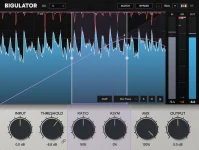
Bigulator’s ASYM control comes from a bias-trim mismatch in the original peak-skimming circuit, where one half began reducing peaks slightly before the other. Instead of correcting the mismatch, Big Man Labs modeled it and made the amount adjustable.
Zero percent removes the asymmetry and gives the clipping stage a symmetric response. The middle position recreates the measured hardware behavior, while the upper end pushes the mismatch far beyond the physical unit for deliberate saturation rather than restoration.
None of this changes the new Bigulator 1.0.1 peak-control workflow, which still handles typed crossover values, band soloing, and MATCH separately. ASYM lives deeper in the nonlinear stage, so its job is not output compensation or stereo balance. It changes how the positive and negative portions of a waveform meet the peak-skimmer.
ASYM exposes that imperfection instead of hiding it. At zero, the positive and negative sides follow the same clipping law. Move toward the modeled hardware position and one half starts bending sooner, then pushing farther exaggerates the difference beyond what the analog box naturally produced.
This is easy to misread as a left-versus-right control because product descriptions sometimes call the original quirk a channel imbalance. It is not a stereo pan or balance parameter. The relevant split is between the two halves of the peak-skimming action, which changes waveform symmetry before you ever get to ordinary left and right imaging decisions.
Threshold and Ratio still matter because asymmetry only becomes audible when the signal is actually driving the nonlinear stage. If the source barely touches the threshold, spinning ASYM hard can produce less drama than expected. Lower the threshold or feed the stage harder, and the difference becomes much easier to hear.
The common shortcut says asymmetric clipping adds even harmonics, so it must sound warmer or more musical. Real behavior is messier. Asymmetric clipping also keeps odd harmonics, and complex music creates intermodulation products once several frequencies hit the same nonlinear stage.
The relationship shows up clearly in time and frequency analysis of asymmetric soft clipping, where unequal treatment of the waveform produces a mixture of odd and even components rather than some neat even-only spectrum. On a bass or simple synth tone, the second harmonic may stand out cleanly. On a dense mix, the same control is feeding many frequencies into the nonlinearity at once.
Source shape matters too. A real drum hit, vocal, or bass note rarely arrives as a perfectly centered laboratory sine wave, so ASYM is changing an already complicated waveform. Treat the harmonic labels as a description of the mechanism, not a promise that every sound suddenly acquires the same soft octave sheen.
Past that point, ASYM becomes a creative control. Bigulator can push the effect to roughly ten times the original mismatch, which moves the processor away from subtle hardware recreation and toward obvious saturation. More is not a higher-quality version of the model. It is simply more unequal clipping.
The multiband mode makes this especially useful because Ratio and ASYM can be set per band. A bass-heavy source can therefore keep the low band closer to symmetry while a mid or upper band carries more asymmetric color, instead of forcing the entire spectrum through one exaggerated setting.
Keep the listening level close before judging it. Added harmonics can make a processed signal feel more present even when peak control has not improved, and the effect gets easier to overrate once the brighter or denser version also seems louder. Bigulator’s MATCH can align peaks, but it is not a perceived-loudness matcher, so ASYM still needs a careful listening comparison.
A simple test tells you more than staring at the knob. Put ASYM at zero, set Threshold and Ratio until the processor is clearly working, then move to the hardware position and finally into the exaggerated range without changing anything else. Listen for changes in density, edge, low-end shape, and transient texture rather than waiting for some generic “analog warmth” to announce itself.
Zero percent removes the asymmetry and gives the clipping stage a symmetric response. The middle position recreates the measured hardware behavior, while the upper end pushes the mismatch far beyond the physical unit for deliberate saturation rather than restoration.
None of this changes the new Bigulator 1.0.1 peak-control workflow, which still handles typed crossover values, band soloing, and MATCH separately. ASYM lives deeper in the nonlinear stage, so its job is not output compensation or stereo balance. It changes how the positive and negative portions of a waveform meet the peak-skimmer.
The mismatch makes one half of the waveform give first
The original hardware did not treat both halves of its peak-skimming circuit identically. A small bias mismatch meant one side crossed into gain reduction a little earlier, so the resulting transfer behavior stopped being perfectly mirrored around zero.ASYM exposes that imperfection instead of hiding it. At zero, the positive and negative sides follow the same clipping law. Move toward the modeled hardware position and one half starts bending sooner, then pushing farther exaggerates the difference beyond what the analog box naturally produced.
This is easy to misread as a left-versus-right control because product descriptions sometimes call the original quirk a channel imbalance. It is not a stereo pan or balance parameter. The relevant split is between the two halves of the peak-skimming action, which changes waveform symmetry before you ever get to ordinary left and right imaging decisions.
Threshold and Ratio still matter because asymmetry only becomes audible when the signal is actually driving the nonlinear stage. If the source barely touches the threshold, spinning ASYM hard can produce less drama than expected. Lower the threshold or feed the stage harder, and the difference becomes much easier to hear.
Even harmonics are only part of what changes
A perfectly symmetric nonlinear transfer applied to a centered sine wave cancels the even-order terms, leaving the familiar odd-harmonic series. Break the symmetry and even-order components appear because the positive and negative halves no longer cancel in the same way.The common shortcut says asymmetric clipping adds even harmonics, so it must sound warmer or more musical. Real behavior is messier. Asymmetric clipping also keeps odd harmonics, and complex music creates intermodulation products once several frequencies hit the same nonlinear stage.
The relationship shows up clearly in time and frequency analysis of asymmetric soft clipping, where unequal treatment of the waveform produces a mixture of odd and even components rather than some neat even-only spectrum. On a bass or simple synth tone, the second harmonic may stand out cleanly. On a dense mix, the same control is feeding many frequencies into the nonlinearity at once.
Source shape matters too. A real drum hit, vocal, or bass note rarely arrives as a perfectly centered laboratory sine wave, so ASYM is changing an already complicated waveform. Treat the harmonic labels as a description of the mechanism, not a promise that every sound suddenly acquires the same soft octave sheen.
The useful range runs from correction to deliberate color
Zero percent is the clean reference because it removes the modeled mismatch. The hardware position is more interesting historically, since it preserves the small bias error measured in the analog circuit instead of pretending the original box was perfectly matched.Past that point, ASYM becomes a creative control. Bigulator can push the effect to roughly ten times the original mismatch, which moves the processor away from subtle hardware recreation and toward obvious saturation. More is not a higher-quality version of the model. It is simply more unequal clipping.
The multiband mode makes this especially useful because Ratio and ASYM can be set per band. A bass-heavy source can therefore keep the low band closer to symmetry while a mid or upper band carries more asymmetric color, instead of forcing the entire spectrum through one exaggerated setting.
Keep the listening level close before judging it. Added harmonics can make a processed signal feel more present even when peak control has not improved, and the effect gets easier to overrate once the brighter or denser version also seems louder. Bigulator’s MATCH can align peaks, but it is not a perceived-loudness matcher, so ASYM still needs a careful listening comparison.
A simple test tells you more than staring at the knob. Put ASYM at zero, set Threshold and Ratio until the processor is clearly working, then move to the hardware position and finally into the exaggerated range without changing anything else. Listen for changes in density, edge, low-end shape, and transient texture rather than waiting for some generic “analog warmth” to announce itself.