Dolby Atmos binaural render mode metadata can assign Off, Near, Mid, or Far behavior to individual objects and bed channels on headphones. Those settings change the headphone presentation without rewriting where the same material sits in a physical Atmos speaker array.
A mix can therefore survive a level-matched comparison on speakers and feel different when you repeat the test on headphones. The processor may be identical, the gain may be identical, and the object coordinates may be unchanged. The renderer is still producing a different listening presentation.
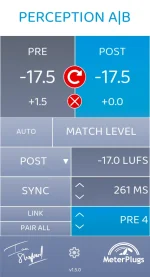
A Perception AB comparison across Atmos monitoring is most useful when you treat speaker and binaural playback as separate checks rather than assuming one proves the other. Matching loudness keeps either test fair, but it cannot erase differences created by the renderer itself.
This becomes important when processing changes the cues you use to judge distance. Brightness, transient shape, ambience, and direct-to-reverberant balance can all alter how close a source seems, so a small EQ or dynamics move may interact with the selected binaural mode. The same move can feel less dramatic over speakers because the room and loudspeaker geometry supply different spatial cues.
Render mode metadata is also stored for the program rather than automated moment by moment. If a lead object changes role halfway through a song, you cannot simply sweep its binaural mode from Near to Far as another automation lane. Panning, level, effects, or object choices have to carry any changing spatial intention instead.
Beds introduce a different limitation. Binaural metadata can be assigned to bed channels, but corresponding channels across multiple beds share the same setting, while individual objects can receive their own binaural modes. Moving an important element from a bed into an object can therefore provide more independent headphone control without changing the basic speaker placement you wanted.
Objects also help when precise headphone localization matters. Dolby recommends objects for material that needs placement between fixed speaker positions, and its current guidance notes that object use improves spatial accuracy in the headphone renderer. The benefit is especially relevant for overhead movement and positions that do not map neatly onto fixed bed channels.
Human anatomy adds another variable. Individualized HRTF localization research found substantially better vertical-plane localization with a listener’s own HRTF than with generic or another person’s HRTF. A binaural placement that feels sharply overhead to you may therefore feel flatter or less certain to another listener even when both hear the same encoded master.
The binaural pass asks whether the same creative choices survive a headphone renderer that has to synthesize spatial cues at your ears. Binaural metadata, HRTF behavior, and object placement can change the apparent depth or elevation enough to alter a close judgment. Equal gain does not make those two monitoring domains perceptually identical.
Use the discrepancy as diagnostic information rather than forcing both versions to sound indistinguishable. If an EQ move works on speakers but pushes an object too far forward on headphones, inspect its binaural mode, ambience, and object placement before undoing the processing automatically. If only one listener hears an elevation problem, HRTF variation belongs on the suspect list as well.
A reliable comparison keeps the variable under test narrow. Change the processor while leaving monitoring mode, binaural metadata, object coordinates, and playback level fixed, then repeat the same comparison in the other monitoring domain. Any disagreement is easier to interpret when the renderer is not changing several things at once.
A mix can therefore survive a level-matched comparison on speakers and feel different when you repeat the test on headphones. The processor may be identical, the gain may be identical, and the object coordinates may be unchanged. The renderer is still producing a different listening presentation.
A Perception AB comparison across Atmos monitoring is most useful when you treat speaker and binaural playback as separate checks rather than assuming one proves the other. Matching loudness keeps either test fair, but it cannot erase differences created by the renderer itself.
Binaural metadata changes only the headphone decision
Dolby’s Near, Mid, and Far settings apply different distance models during binaural rendering, while Off bypasses binaural processing for the selected object or bed channel. A vocal object can therefore feel more intimate or more detached on headphones without moving to a different coordinate in the speaker mix.This becomes important when processing changes the cues you use to judge distance. Brightness, transient shape, ambience, and direct-to-reverberant balance can all alter how close a source seems, so a small EQ or dynamics move may interact with the selected binaural mode. The same move can feel less dramatic over speakers because the room and loudspeaker geometry supply different spatial cues.
Render mode metadata is also stored for the program rather than automated moment by moment. If a lead object changes role halfway through a song, you cannot simply sweep its binaural mode from Near to Far as another automation lane. Panning, level, effects, or object choices have to carry any changing spatial intention instead.
Object placement can make the headphone test behave oddly
Dolby specifically warns about objects placed in the exact center of the room. At that position, the binaural render mode has no effect, so cycling through Near, Mid, and Far will not create the expected distance change. An A/B built around that setting can look broken when the renderer is actually behaving as designed.Beds introduce a different limitation. Binaural metadata can be assigned to bed channels, but corresponding channels across multiple beds share the same setting, while individual objects can receive their own binaural modes. Moving an important element from a bed into an object can therefore provide more independent headphone control without changing the basic speaker placement you wanted.
Objects also help when precise headphone localization matters. Dolby recommends objects for material that needs placement between fixed speaker positions, and its current guidance notes that object use improves spatial accuracy in the headphone renderer. The benefit is especially relevant for overhead movement and positions that do not map neatly onto fixed bed channels.
Human anatomy adds another variable. Individualized HRTF localization research found substantially better vertical-plane localization with a listener’s own HRTF than with generic or another person’s HRTF. A binaural placement that feels sharply overhead to you may therefore feel flatter or less certain to another listener even when both hear the same encoded master.
Speaker and headphone passes answer different questions
A speaker A/B tells you how the processing behaves once the renderer distributes the scene across a physical layout. You hear real loudspeaker spacing, room reflections, acoustic crosstalk, and the geometry of the monitoring system. None of those conditions are reproduced literally by two headphone drivers.The binaural pass asks whether the same creative choices survive a headphone renderer that has to synthesize spatial cues at your ears. Binaural metadata, HRTF behavior, and object placement can change the apparent depth or elevation enough to alter a close judgment. Equal gain does not make those two monitoring domains perceptually identical.
Use the discrepancy as diagnostic information rather than forcing both versions to sound indistinguishable. If an EQ move works on speakers but pushes an object too far forward on headphones, inspect its binaural mode, ambience, and object placement before undoing the processing automatically. If only one listener hears an elevation problem, HRTF variation belongs on the suspect list as well.
A reliable comparison keeps the variable under test narrow. Change the processor while leaving monitoring mode, binaural metadata, object coordinates, and playback level fixed, then repeat the same comparison in the other monitoring domain. Any disagreement is easier to interpret when the renderer is not changing several things at once.