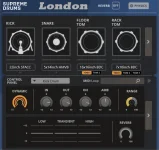
Sound Magic built Supreme Drums London from 326 GB of source recordings, yet the finished library occupies 2.2 GB. Native Instruments takes a different route with Abbey Road 70s Drummer, which ships more than 29,000 samples and needs 6.3 GB compressed.
Both can land in broadly similar musical territory, but the path from loading the instrument to hearing a finished drum part is completely different. The useful comparison is not which library owns the most famous room or the longest kit list. It is how much setup, routing, editing, and commitment each one asks from you.
The Supreme Drums London British rock collection also arrives as its own instrument rather than asking you to enter a larger sampler ecosystem. You choose the kit, shape the response, and work inside the controls Sound Magic designed for its drums.
Abbey Road 70s Drummer behaves more like a traditional sampled instrument. It runs inside Kontakt Player or Kontakt, offers two vintage kits, reaches up to 30 velocity layers with as many as six alternate hits per drum, and includes 1,000 grooves covering styles such as hard rock, progressive rock, funk, disco, and reggae.
Kontakt is not necessarily a burden if it already lives in your sessions. For somebody who avoids it, though, another host layer changes installation, preset management, window behavior, and project recall before a single snare note is written.
Interface design is not cosmetic once you repeat the same actions for hundreds of sessions. A peer-reviewed study of DAW track displays describes how production interfaces have to support both high-level orientation and low-level editing tasks, which is a useful way to judge drum software too. Fast access to the controls you actually touch can matter more than another page of features.
Such depth changes where your mix begins. Close microphones, overheads, Decca Tree channels, near and far ambience, a stone-room capture, and surround microphones can be balanced before the signal reaches your DAW mixer, so the drum instrument starts behaving like a recording session rather than a preset box.
BFD Dark Farm follows a related engineer-first philosophy. Its three kits and more than 30 articulated instruments were recorded in the live room at Middle Farm Studios, with the expansion living inside BFD rather than operating as a separate one-purpose rock plugin.
More control is useful only when you intend to use it. If your normal workflow sends kick, snare, toms, overheads, and rooms to separate DAW channels for processing, a deep internal mixer can save work or duplicate work depending on how you prefer to build sessions.
XLN Audio takes a faster middle route with its Classic Rock Collection. Addictive Drums 2 combines kits, presets, MIDI packs, room controls, and standalone or plug-in operation, putting more emphasis on getting from a usable preset to an editable groove without recreating a full multitrack drum session.
Groove content creates the same split. Abbey Road 70s Drummer brings a large period-focused groove library, Drumopolis includes MIDI tailored to its kits, and XLN bundles dedicated rock MIDI with its collection. Producers who write every hit by hand may barely touch any of it.
Expansion dependence deserves attention before buying into a sound. Drumopolis needs Superior Drummer 3, Dark Farm needs BFD, and Abbey Road 70s Drummer lives in Kontakt Player or Kontakt. Each ecosystem can become useful infrastructure if you already own related libraries, but the first purchase also decides where future kits, presets, mappings, and saved sessions will live.
A British rock drum library therefore fits a workflow before it fits a genre label. If you mostly want to choose a convincing kit and keep moving, compact engines and curated presets reduce decisions. If you routinely rebuild microphone balances, print separate room channels, swap articulations, and treat sampled drums like a multitrack recording, the larger ecosystems give those decisions somewhere useful to go.
Both can land in broadly similar musical territory, but the path from loading the instrument to hearing a finished drum part is completely different. The useful comparison is not which library owns the most famous room or the longest kit list. It is how much setup, routing, editing, and commitment each one asks from you.
The player engine decides how you work
Supreme Drums London uses Sound Magic's Epic V2 hybrid modeling system, so much of its variation comes from a modeling engine rather than a conventional pile of recorded alternates. Its compact size matters if you move projects between machines, keep instruments on a small SSD, or want a rock kit without maintaining a large sample installation.The Supreme Drums London British rock collection also arrives as its own instrument rather than asking you to enter a larger sampler ecosystem. You choose the kit, shape the response, and work inside the controls Sound Magic designed for its drums.
Abbey Road 70s Drummer behaves more like a traditional sampled instrument. It runs inside Kontakt Player or Kontakt, offers two vintage kits, reaches up to 30 velocity layers with as many as six alternate hits per drum, and includes 1,000 grooves covering styles such as hard rock, progressive rock, funk, disco, and reggae.
Kontakt is not necessarily a burden if it already lives in your sessions. For somebody who avoids it, though, another host layer changes installation, preset management, window behavior, and project recall before a single snare note is written.
Interface design is not cosmetic once you repeat the same actions for hundreds of sessions. A peer-reviewed study of DAW track displays describes how production interfaces have to support both high-level orientation and low-level editing tasks, which is a useful way to judge drum software too. Fast access to the controls you actually touch can matter more than another page of features.
Deep libraries move mixing inside the instrument
Toontrack's Drumopolis SDX pushes in the opposite direction from a compact self-contained kit. It requires Superior Drummer 3 and gives you eight full kits recorded at Metropolis Studios, separate room configurations, large microphone arrays, surround channels, roughly 72 mix presets, and MIDI made for the included sounds.Such depth changes where your mix begins. Close microphones, overheads, Decca Tree channels, near and far ambience, a stone-room capture, and surround microphones can be balanced before the signal reaches your DAW mixer, so the drum instrument starts behaving like a recording session rather than a preset box.
BFD Dark Farm follows a related engineer-first philosophy. Its three kits and more than 30 articulated instruments were recorded in the live room at Middle Farm Studios, with the expansion living inside BFD rather than operating as a separate one-purpose rock plugin.
More control is useful only when you intend to use it. If your normal workflow sends kick, snare, toms, overheads, and rooms to separate DAW channels for processing, a deep internal mixer can save work or duplicate work depending on how you prefer to build sessions.
XLN Audio takes a faster middle route with its Classic Rock Collection. Addictive Drums 2 combines kits, presets, MIDI packs, room controls, and standalone or plug-in operation, putting more emphasis on getting from a usable preset to an editable groove without recreating a full multitrack drum session.
Storage size hides the real production cost
Disk space is easy to compare because manufacturers print a number. Session friction is harder to measure. A 2.2 GB library that gets you to the right kit quickly can be more practical than a huge installation, while a larger library can save hours if its extra microphones and routing remove processing you would otherwise build manually.Groove content creates the same split. Abbey Road 70s Drummer brings a large period-focused groove library, Drumopolis includes MIDI tailored to its kits, and XLN bundles dedicated rock MIDI with its collection. Producers who write every hit by hand may barely touch any of it.
Expansion dependence deserves attention before buying into a sound. Drumopolis needs Superior Drummer 3, Dark Farm needs BFD, and Abbey Road 70s Drummer lives in Kontakt Player or Kontakt. Each ecosystem can become useful infrastructure if you already own related libraries, but the first purchase also decides where future kits, presets, mappings, and saved sessions will live.
A British rock drum library therefore fits a workflow before it fits a genre label. If you mostly want to choose a convincing kit and keep moving, compact engines and curated presets reduce decisions. If you routinely rebuild microphone balances, print separate room channels, swap articulations, and treat sampled drums like a multitrack recording, the larger ecosystems give those decisions somewhere useful to go.