RapidComposer treats notes as more than fixed MIDI pitches, letting phrases follow chords or scales instead of staying locked to one keyboard note. Version 6.2 makes those relationships easier to see and change across an entire track.
An absolute note is the familiar MIDI idea. C4 stays C4 unless you transpose it or edit the phrase. Relative notes carry musical relationships instead, so the pitch RapidComposer plays can change when the harmony or scale changes underneath them.
Chord-relative and scale-relative notes are not two labels for the same behavior. A chord-relative note points into the current chord, while a scale-relative note points into the active scale. Choosing between them changes what survives when you move a phrase through different harmony.
Transposition follows those chord positions too. Move a three-note chord-relative pattern upward by one step, and RapidComposer advances each note to the next chord member, wrapping the top one into the next octave when needed. The result behaves like a voicing moving through chord tones rather than a melody sliding through neighboring scale notes.
Scale-relative material follows a different sequence. A phrase using the first, second, and third scale degrees moves to the second, third, and fourth degrees when shifted upward by one scale step. On C major, C, D, E becomes D, E, F, which is plainly different from moving through C, E, G as chord members.
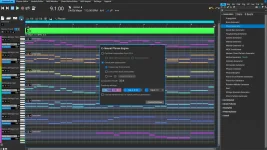
The RapidComposer 6.2 note conversion controls put Chord+, Scale+, and Abs on each track and can convert all phrases there in one move. Those buttons also indicate which note types the track currently contains, which is useful when a part has been assembled from generators, recorded phrases, and imported MIDI.
Drum parts are an obvious case, but pitched material can need the same treatment. A sampled articulation may live on a specific key, a pedal tone may need to remain fixed, or a line may contain deliberate chromatic notes you do not want recast every time the chord changes.
Direct MIDI drag-and-drop is where the distinction becomes practical. Dropping a simple MIDI file into the composition inserts it as a phrase with ordinary absolute notes, while holding Ctrl during the drag can convert those notes to chord-relative form. The conversion depends on RapidComposer interpreting the harmony successfully, so complicated or ambiguous MIDI can produce a result worth checking rather than trusting blindly.
The full MIDI Import workflow goes further by analyzing scale and chords before converting tracks into relative form. With harmony-aware phrase conversion, the imported performance can become reusable across new progressions, but the result is only as useful as the harmonic analysis behind it.
The difference becomes clearer when a progression changes chord quality. A chord-relative third follows the third member of each chord, so its actual interval above the root can change with the chord. A scale-relative third follows the third degree of the selected scale instead, regardless of whether the current chord uses that pitch as one of its members.
RapidComposer can also combine relative ideas with offsets, so its note model is not limited to plain chord tones and scale steps. A note can be tied to a chord member and then displaced, allowing phrases to retain recognizable harmonic logic without becoming mechanically restricted to basic triads.
Phrase Editor settings need separate attention. Its chord, scale, and tempo choices are independent from the composition, which makes the editor useful for designing and testing a phrase under controlled conditions. A phrase that behaves perfectly there can still respond differently after you place it under another composition scale or chord sequence.
Converting an entire track to one note type is therefore best treated as a musical decision, not housekeeping. Chord-relative mapping suits parts whose identity comes from chord membership, scale-relative mapping suits lines whose contour should follow a scale, and absolute notes suit pitches that must remain exactly where they were played.
An absolute note is the familiar MIDI idea. C4 stays C4 unless you transpose it or edit the phrase. Relative notes carry musical relationships instead, so the pitch RapidComposer plays can change when the harmony or scale changes underneath them.
Chord-relative and scale-relative notes are not two labels for the same behavior. A chord-relative note points into the current chord, while a scale-relative note points into the active scale. Choosing between them changes what survives when you move a phrase through different harmony.
Chord-relative notes follow chord membership
RapidComposer represents chord-relative notes by their position inside the chord. The chord root is the first chord note, followed by the next chord member and then the next, so a basic C major triad maps through C, E, and G rather than consecutive scale degrees.Transposition follows those chord positions too. Move a three-note chord-relative pattern upward by one step, and RapidComposer advances each note to the next chord member, wrapping the top one into the next octave when needed. The result behaves like a voicing moving through chord tones rather than a melody sliding through neighboring scale notes.
Scale-relative material follows a different sequence. A phrase using the first, second, and third scale degrees moves to the second, third, and fourth degrees when shifted upward by one scale step. On C major, C, D, E becomes D, E, F, which is plainly different from moving through C, E, G as chord members.
The RapidComposer 6.2 note conversion controls put Chord+, Scale+, and Abs on each track and can convert all phrases there in one move. Those buttons also indicate which note types the track currently contains, which is useful when a part has been assembled from generators, recorded phrases, and imported MIDI.
Absolute MIDI notes preserve the original pitch
Absolute notes ignore the current chord and scale relationship. If a phrase contains an absolute E4, changing the master-track harmony does not reinterpret E4 as a different chord member or scale degree. Fixed pitches are useful when the exact note matters more than harmonic adaptation.Drum parts are an obvious case, but pitched material can need the same treatment. A sampled articulation may live on a specific key, a pedal tone may need to remain fixed, or a line may contain deliberate chromatic notes you do not want recast every time the chord changes.
Direct MIDI drag-and-drop is where the distinction becomes practical. Dropping a simple MIDI file into the composition inserts it as a phrase with ordinary absolute notes, while holding Ctrl during the drag can convert those notes to chord-relative form. The conversion depends on RapidComposer interpreting the harmony successfully, so complicated or ambiguous MIDI can produce a result worth checking rather than trusting blindly.
The full MIDI Import workflow goes further by analyzing scale and chords before converting tracks into relative form. With harmony-aware phrase conversion, the imported performance can become reusable across new progressions, but the result is only as useful as the harmonic analysis behind it.
Scale-relative notes keep melodic shape flexible
Scale-relative notes are often the cleaner choice for melodic material that should remain inside a scale without being forced onto chord tones. A passing note can keep its role as a scale degree even when it is not part of the chord sounding underneath it. Chord-relative mapping would give the same note a stricter harmonic job.The difference becomes clearer when a progression changes chord quality. A chord-relative third follows the third member of each chord, so its actual interval above the root can change with the chord. A scale-relative third follows the third degree of the selected scale instead, regardless of whether the current chord uses that pitch as one of its members.
RapidComposer can also combine relative ideas with offsets, so its note model is not limited to plain chord tones and scale steps. A note can be tied to a chord member and then displaced, allowing phrases to retain recognizable harmonic logic without becoming mechanically restricted to basic triads.
Phrase Editor settings need separate attention. Its chord, scale, and tempo choices are independent from the composition, which makes the editor useful for designing and testing a phrase under controlled conditions. A phrase that behaves perfectly there can still respond differently after you place it under another composition scale or chord sequence.
Converting an entire track to one note type is therefore best treated as a musical decision, not housekeeping. Chord-relative mapping suits parts whose identity comes from chord membership, scale-relative mapping suits lines whose contour should follow a scale, and absolute notes suit pitches that must remain exactly where they were played.