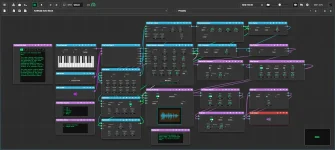
DevOcean’s DAW Bridge is a lightweight VST3 or AU plugin that leaves the modular engine running in the standalone application. MIDI travels from the host into DevOcean, while the patch’s stereo audio returns to the same DAW track. You get DAW control without loading the entire modular environment inside the host process.
A patch built with the DevOcean Modular 1.2 module set still lives in the standalone engine when the Bridge is active. The plugin is closer to a connection point than a second copy of the instrument, which changes how you should think about routing, automation, and multiple instances.
The practical payoff is separation. DevOcean keeps its canvas, DSP engine, and patch state in its own process, while the DAW handles timeline duties and receives finished audio. A separate shared-memory audio bridge architecture presented at the Web Audio Conference uses the same broad IPC approach for real-time communication between an audio plugin and an external process.
Once the Bridge plugin is loaded on a DAW track, MIDI from that track reaches the DAW to MIDI node. Whatever you patch between that input and Audio Output runs in DevOcean, then the resulting stereo signal comes back to the Bridge track. You can therefore play the patch from the DAW timeline without rebuilding the patch as a conventional plugin preset.
The connection runs through shared memory instead of treating the standalone engine like a network service. This matters because the audio and MIDI path stays local to the machine and avoids a separate network stack. It also explains why the Bridge can remain small while the heavier modular system stays outside the DAW process.
This limitation is important if your normal workflow relies on six instances of the same synth across six tracks. With DevOcean, the cleaner route is to treat the Bridge as a funnel, record or render a part, then move on to another patch when needed. It is a different working model, and pretending otherwise will only create confusion when a second Bridge does not behave like a fresh synth instance.
Automation uses the same overall connection but not the MIDI and audio patchbay nodes. Parameters marked for automation in DevOcean’s Patch Tree are exposed to the host with stable names and IDs through the binding system. Your DAW sees those controls as automatable parameters, while MIDI and audio continue through their own dedicated nodes.
Transport follows the host once the Bridge connects. DevOcean hands control of sample rate, play state, tempo, and song position to the DAW, so sequencers, tempo-linked modulators, and other synchronized parts follow the session automatically. If the host closes or crashes, the standalone side detects the lost connection and stops rather than continuing against a dead clock.
This means you do not need to switch the Bridge into a special export mode before freezing or bouncing a track. The same patch can run normally during playback, then follow an accelerated offline render when the host requests one. Once the job is finished, DevOcean returns to ordinary real-time behavior on its own.
The architecture also makes a useful boundary clear. The Bridge is not there to turn DevOcean into a conventional multi-instance plugin with every patch living inside the DAW. It lets one standalone modular engine participate in a host session with MIDI input, stereo audio return, automation, transport sync, and clean offline rendering while keeping the modular workspace separate.
A patch built with the DevOcean Modular 1.2 module set still lives in the standalone engine when the Bridge is active. The plugin is closer to a connection point than a second copy of the instrument, which changes how you should think about routing, automation, and multiple instances.
The practical payoff is separation. DevOcean keeps its canvas, DSP engine, and patch state in its own process, while the DAW handles timeline duties and receives finished audio. A separate shared-memory audio bridge architecture presented at the Web Audio Conference uses the same broad IPC approach for real-time communication between an audio plugin and an external process.
The Bridge keeps the modular engine outside the host
DevOcean’s standalone application is still the main instrument. To connect it, you place a DAW to MIDI node in the patch for incoming note data and an Audio Output node for the stereo return. Those are central patchbay points rather than modules you scatter around the canvas.Once the Bridge plugin is loaded on a DAW track, MIDI from that track reaches the DAW to MIDI node. Whatever you patch between that input and Audio Output runs in DevOcean, then the resulting stereo signal comes back to the Bridge track. You can therefore play the patch from the DAW timeline without rebuilding the patch as a conventional plugin preset.
The connection runs through shared memory instead of treating the standalone engine like a network service. This matters because the audio and MIDI path stays local to the machine and avoids a separate network stack. It also explains why the Bridge can remain small while the heavier modular system stays outside the DAW process.
One connection carries more than notes and audio
Only one Bridge owns the live connection to the standalone engine at a time. Loading another Bridge does not create a second independent DevOcean engine for another patch. The second instance sees the existing connection and can take ownership, which makes the system behave more like one external instrument than a rack of unrelated plugin instances.This limitation is important if your normal workflow relies on six instances of the same synth across six tracks. With DevOcean, the cleaner route is to treat the Bridge as a funnel, record or render a part, then move on to another patch when needed. It is a different working model, and pretending otherwise will only create confusion when a second Bridge does not behave like a fresh synth instance.
Automation uses the same overall connection but not the MIDI and audio patchbay nodes. Parameters marked for automation in DevOcean’s Patch Tree are exposed to the host with stable names and IDs through the binding system. Your DAW sees those controls as automatable parameters, while MIDI and audio continue through their own dedicated nodes.
Transport follows the host once the Bridge connects. DevOcean hands control of sample rate, play state, tempo, and song position to the DAW, so sequencers, tempo-linked modulators, and other synchronized parts follow the session automatically. If the host closes or crashes, the standalone side detects the lost connection and stops rather than continuing against a dead clock.
Offline rendering is where the design earns its keep
Fast offline rendering can break external audio systems when the host races ahead of a process that expects real-time pacing. DevOcean handles this case by detecting an offline bounce or freeze and following the host’s render speed instead of the wall clock. The engine keeps its processing blocks aligned with the DAW until the render finishes.This means you do not need to switch the Bridge into a special export mode before freezing or bouncing a track. The same patch can run normally during playback, then follow an accelerated offline render when the host requests one. Once the job is finished, DevOcean returns to ordinary real-time behavior on its own.
The architecture also makes a useful boundary clear. The Bridge is not there to turn DevOcean into a conventional multi-instance plugin with every patch living inside the DAW. It lets one standalone modular engine participate in a host session with MIDI input, stereo audio return, automation, transport sync, and clean offline rendering while keeping the modular workspace separate.