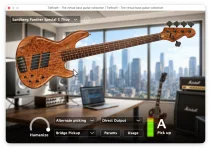
Tiefkraft lets each sampled bass switch between a clean DI signal and a processed amped output inside the same instrument. Those choices are not just two flavors of the same preset. A DI path leaves more of the downstream tone decision in your hands. An amped path commits earlier to processing that has already shaped the bass before it reaches your mixer.
With Tiefkraft’s clean and amped bass paths, the important decision is how much you want to finish later. Pick DI when the bass still needs to fit around guitars, kick, synths, or a mix direction that may change. Pick the amped version when its finished character already works, and you would rather stop tweaking.
Run that output into an amp simulator, and you can change drive, cabinet response, EQ, compression, or saturation without choosing another bass performance. You can also bypass the whole chain tomorrow and start again. This is why DI stays useful when a mix is still moving around.
An amped output trades some of that freedom for speed. Amp processing can smooth transients, add harmonics, reshape the low mids, and roll the top end toward a more finished bass tone. If it already sits under the guitars, there is no prize for rebuilding it from scratch.
Amp processing is also more than a fixed EQ curve. A driven amplifier has nonlinear, level-dependent behavior, so it cannot be reduced to simple frequency shaping alone. Once distortion enters the chain, an EQ after the fact cannot cleanly reconstruct the untouched signal that went in.
A sampled DI is not identical to plugging your own bass straight into an interface, either. The developer already chose the instrument, pickup setting, player, strings, recording level, and capture chain. You retain post-amp freedom, not control over those earlier decisions.
This matters when a part feels wrong for musical reasons. Swapping amp models will not fix a bass line that needs a softer articulation or less aggressive velocity. Change the MIDI performance first, then judge the DI through whatever processing chain you want.
The reverse mistake happens with amped samples. Producers sometimes keep stacking amp sims onto a tone that is already processed. The preset still says “bass,” but another amp stage is now processing an already shaped signal. Extra amplification can be useful as an effect, but it is not the same job as choosing the first amp stage for a clean DI.
A practical split is pretty simple. Use DI when you expect several rounds of arrangement changes, aggressive parallel processing, or genre-specific amp choices later. Use the amped path when the existing tone earns its place quickly and further flexibility would mostly tempt you into needless knob turning.
Cabinet filters, impulse responses, EQ, and other processing can still alter phase or timing relationships. Duplicate a virtual bass into clean and processed paths, then check the blend in mono. Listen to the low end before deciding that two channels must be bigger than one.
Level matching matters too. The louder amped signal will often sound more exciting during a quick comparison, especially once saturation adds upper harmonics. Trim both choices to a similar perceived level before deciding which one actually leaves more room for the kick, guitars, and vocal.
Sometimes the clean DI wins alone. Sometimes the processed path does. Parallel use earns its keep when each channel supplies something the other genuinely lacks, not because recording folklore says bass needs both.
With Tiefkraft’s clean and amped bass paths, the important decision is how much you want to finish later. Pick DI when the bass still needs to fit around guitars, kick, synths, or a mix direction that may change. Pick the amped version when its finished character already works, and you would rather stop tweaking.
DI and amp paths solve different problems
A clean DI bass keeps the signal before the usual amplifier and cabinet coloration. You still hear the sampled instrument, pickup choice, articulation, velocity layer, and recorded performance, so “clean” does not mean blank. It simply means the amp stage has not made the next set of tonal decisions for you.Run that output into an amp simulator, and you can change drive, cabinet response, EQ, compression, or saturation without choosing another bass performance. You can also bypass the whole chain tomorrow and start again. This is why DI stays useful when a mix is still moving around.
An amped output trades some of that freedom for speed. Amp processing can smooth transients, add harmonics, reshape the low mids, and roll the top end toward a more finished bass tone. If it already sits under the guitars, there is no prize for rebuilding it from scratch.
Amp processing is also more than a fixed EQ curve. A driven amplifier has nonlinear, level-dependent behavior, so it cannot be reduced to simple frequency shaping alone. Once distortion enters the chain, an EQ after the fact cannot cleanly reconstruct the untouched signal that went in.
Virtual instruments change what reamping means
Live recording advice usually treats the DI as insurance because the player’s original take can be sent through another amplifier later. With a sampled instrument, the performance itself is already captured before you touch the amp choice. Reamping can change tone, but it cannot replace the finger attack, pick direction, mute, slide, velocity layer, or round-robin take triggered by the MIDI event.A sampled DI is not identical to plugging your own bass straight into an interface, either. The developer already chose the instrument, pickup setting, player, strings, recording level, and capture chain. You retain post-amp freedom, not control over those earlier decisions.
This matters when a part feels wrong for musical reasons. Swapping amp models will not fix a bass line that needs a softer articulation or less aggressive velocity. Change the MIDI performance first, then judge the DI through whatever processing chain you want.
The reverse mistake happens with amped samples. Producers sometimes keep stacking amp sims onto a tone that is already processed. The preset still says “bass,” but another amp stage is now processing an already shaped signal. Extra amplification can be useful as an effect, but it is not the same job as choosing the first amp stage for a clean DI.
A practical split is pretty simple. Use DI when you expect several rounds of arrangement changes, aggressive parallel processing, or genre-specific amp choices later. Use the amped path when the existing tone earns its place quickly and further flexibility would mostly tempt you into needless knob turning.
Blending works only when both paths cooperate
Real bass sessions often combine DI and a miked cabinet, but the two signals do not automatically reinforce each other. The microphone path arrives later because sound has to travel from speaker to mic, and combining mismatched versions can thin the low end through cancellation. Virtual routing removes the literal microphone-distance problem only when the software path does not recreate or introduce its own timing and phase changes.Cabinet filters, impulse responses, EQ, and other processing can still alter phase or timing relationships. Duplicate a virtual bass into clean and processed paths, then check the blend in mono. Listen to the low end before deciding that two channels must be bigger than one.
Level matching matters too. The louder amped signal will often sound more exciting during a quick comparison, especially once saturation adds upper harmonics. Trim both choices to a similar perceived level before deciding which one actually leaves more room for the kick, guitars, and vocal.
Sometimes the clean DI wins alone. Sometimes the processed path does. Parallel use earns its keep when each channel supplies something the other genuinely lacks, not because recording folklore says bass needs both.