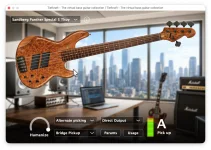
Tiefkraft contains eight sampled electric basses, including six conventional four- and five-string instruments and two octave-paired BassLine Buster Std8 models. The useful part is not simply having eight names in a dropdown. Each source instrument starts from a different combination of string count, scale length, construction, pickups, and electronics, so choosing the right one can save a lot of pointless EQ and patch-hopping once the arrangement gets busy.
The easiest way to pick from Tiefkraft’s eight sampled bass guitars is to decide what job the bass line needs to do first. A low, supportive five-string part has different demands from a tight four-string rock line, while the paired-string Std8 instruments are deliberately stranger. Treating all eight as cosmetic variations misses most of the point, especially when the source bass already solves a range or pickup problem before processing enters the picture.
The Sandberg Basic Ken Taylor RW goes the other direction. It is a four-string with a mahogany back, quilted maple top, Canadian hardrock maple neck and fingerboard, plus two Sandberg Powerhumbuckers that can operate as humbuckers or single coils. In practice, its appeal is flexibility inside a familiar four-string range rather than extra low notes, which makes it easier to slot into parts that should feel conventional without being locked to one pickup character.
Wood names are worth noticing, but they are easy to overread. A sampled electric bass arrives with the instrument, pickups, playing technique, and recording chain already baked into the captured sound, so “alder versus mahogany” is not a reliable shortcut for choosing a patch. Pickup position can alter the harmonic spectrum, which is a better reason to pay attention to pickup layout than to build a whole decision around body wood.
The ESP LTD B-404 is a different proposition even before you hear it. Its source instrument uses neck-through construction, a 34-inch scale, swamp ash body, spalted maple top, a five-piece maple and walnut neck, rosewood fingerboard, and active EMG electronics. Compared with the bolt-on instruments in the set, it gives you another construction style and another recorded pickup system rather than another minor flavor of the same bass.
Then come the E-II BTL-4 and BTL-5. Both source instruments were made in Japan with alder bodies, spalted maple tops, three-piece hard maple bolt-on necks, ebony fingerboards, 24 frets, and Seymour Duncan SSB pickups. The BTL-4 keeps things in four-string territory, while the BTL-5 adds the practical low-register advantage of a fifth string without changing the whole design language around it.
Mark II keeps the octave-paired idea but changes the hardware in a way that matters more than the wood swap. Its source instrument moves to a two-piece swamp ash body and combines an EMG 35DC bass pickup at the bridge with an EMG H4A guitar pickup at the neck. Those pickups can be controlled independently on the physical bass, which helps explain why this version is the more deliberately hybrid design and why its upper content can feel less like a normal doubled bass.
Neither Std8 should be your automatic choice just because eight strings sound bigger. Their octave courses add upper-register content at the source, which can crowd guitars, keys, or distorted mids if the arrangement is already packed. They make more sense when the bass itself is supposed to carry a noticeable melodic or textural role rather than disappear underneath everything else.
The easiest way to pick from Tiefkraft’s eight sampled bass guitars is to decide what job the bass line needs to do first. A low, supportive five-string part has different demands from a tight four-string rock line, while the paired-string Std8 instruments are deliberately stranger. Treating all eight as cosmetic variations misses most of the point, especially when the source bass already solves a range or pickup problem before processing enters the picture.
The source instruments set the useful context
The Sandberg Panther Special 5 Thuya is the obvious place to start when the part needs genuine five-string territory. Its original instrument uses a 35-inch scale, a mahogany body with a Thuya top, a maple neck, Pau Ferro fingerboard, and two Sandberg trapezoid pickups. Tiefkraft’s five-string instruments also supply the collection’s drop-A reach, so the Panther makes sense when the arrangement actually needs those notes instead of merely wanting a darker bass preset.The Sandberg Basic Ken Taylor RW goes the other direction. It is a four-string with a mahogany back, quilted maple top, Canadian hardrock maple neck and fingerboard, plus two Sandberg Powerhumbuckers that can operate as humbuckers or single coils. In practice, its appeal is flexibility inside a familiar four-string range rather than extra low notes, which makes it easier to slot into parts that should feel conventional without being locked to one pickup character.
Wood names are worth noticing, but they are easy to overread. A sampled electric bass arrives with the instrument, pickups, playing technique, and recording chain already baked into the captured sound, so “alder versus mahogany” is not a reliable shortcut for choosing a patch. Pickup position can alter the harmonic spectrum, which is a better reason to pay attention to pickup layout than to build a whole decision around body wood.
The four-string group covers very different ground
The BassLine Buster CW4 is the custom oddball among the conventional four-strings. The original uses a swamp ash back, black limba top, hard maple neck and fingerboard, a 34-inch scale, 24 frets, EMG pickups, and Noll TCM3 electronics. It also supports humbucker and single-coil options, so it is a sensible first audition when you want a modern four-string sound with more pickup variation than a simple one-voice bass patch.The ESP LTD B-404 is a different proposition even before you hear it. Its source instrument uses neck-through construction, a 34-inch scale, swamp ash body, spalted maple top, a five-piece maple and walnut neck, rosewood fingerboard, and active EMG electronics. Compared with the bolt-on instruments in the set, it gives you another construction style and another recorded pickup system rather than another minor flavor of the same bass.
Then come the E-II BTL-4 and BTL-5. Both source instruments were made in Japan with alder bodies, spalted maple tops, three-piece hard maple bolt-on necks, ebony fingerboards, 24 frets, and Seymour Duncan SSB pickups. The BTL-4 keeps things in four-string territory, while the BTL-5 adds the practical low-register advantage of a fifth string without changing the whole design language around it.
The Std8 pair is for parts that should sound unusual
The BassLine Buster Std8 Mark I is not an extended-range eight-string in the modern metal sense. Its eight strings are arranged as four paired courses, with each bass string joined by a higher octave string, so a single played note carries both registers. The original Mark I uses an alder body, a three-piece hard maple neck, EMG MM TW pickups, Noll TCM3 electronics, a 34-inch scale, and 24 frets.Mark II keeps the octave-paired idea but changes the hardware in a way that matters more than the wood swap. Its source instrument moves to a two-piece swamp ash body and combines an EMG 35DC bass pickup at the bridge with an EMG H4A guitar pickup at the neck. Those pickups can be controlled independently on the physical bass, which helps explain why this version is the more deliberately hybrid design and why its upper content can feel less like a normal doubled bass.
Neither Std8 should be your automatic choice just because eight strings sound bigger. Their octave courses add upper-register content at the source, which can crowd guitars, keys, or distorted mids if the arrangement is already packed. They make more sense when the bass itself is supposed to carry a noticeable melodic or textural role rather than disappear underneath everything else.