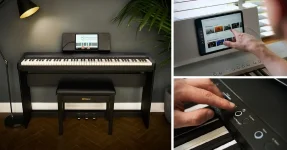
Roland’s KPD-70 three-pedal unit requires the KSF-40 stand when fitted to an FP-40, even though the pedal unit also supports other pianos. Buying the pedals alone leaves part of the setup missing.
The FP-40 already includes a DP-2 pedal switch, so you can use sustain without ordering anything else. An upgrade should solve a particular problem, whether you want finer control underfoot, a pedal that stays put, or access to three pedal functions.
For someone learning on Roland’s FP-40 and Piano Sphere combination, a full furniture setup is a separate decision from improving the sustain pedal. You can make one change without committing to the other.
The FP-40’s Pedal1 input supports continuous detection with a suitable optional pedal. Roland lists the DP-10 among its accessories, and that pedal supports half-damper operation on compatible keyboards.
If your aim is finer sustain control while keeping your existing stand, a standalone pedal with half-damper control addresses that need directly. A three-pedal board adds other functions, but you don’t have to buy three pedals simply to move beyond a basic switch.
Pedal shape alone tells you little about its sensing. A long, piano-style pedal can still work as an on-off switch. Read the control specification instead of treating a metal lever as evidence of half-pedaling support.
The DP-10 can also operate as a standard switch, so its operating mode deserves attention when setting it up. For half-damper use, check its Continuous setting rather than assuming the pedal arrives configured for your purpose.
A useful practice comparison is to play the same short passage with different amounts of pedal travel. Listen to the releases as carefully as the sustained notes. Keep the piano sound and your playing reasonably consistent so you can hear what your foot changes.
FP-30 and FP-30X owners use the KSC-70, while the FP-40 uses the KSF-40. If you’re moving from an older piano, a familiar pedal model number does not establish that your old furniture stand transfers with it.
This matters when shopping used. An advertisement describing a KPD-70 with a “matching Roland stand” is incomplete for your purposes. Get the stand’s actual model number before deciding that the pair will fit your FP-40.
The KSF-40 provides a fixed playing height and mounting for the optional pedal board. The stand and KPD-70 are separate products, so check the contents of a bundle rather than relying on its main photograph.
Pedal1 and Pedal2 also serve different purposes on the piano. Pedal1 handles the damper pedal, while Pedal2 supports damper, sostenuto, and soft functions through the dedicated board. Buying three individual pedals does not reproduce the specified KPD-70 connection.
If the music you’re studying needs those additional functions, the board gives you a reason to consider the furniture stand. If the immediate problem is simply limited sustain control, compare the single-pedal option before replacing a stand that already suits your room.
For a piano that stays in one place, the assembled dimensions are more useful than the bare keyboard’s measurements. The full setup is approximately 51.5 inches wide and 15.1 inches deep, but you still need space to sit and move your legs.
If you pack the piano away between sessions, consider where each accessory will go. A pedal upgrade that suits a permanent practice corner may be awkward in a room you clear every evening.
A loose pedal also needs a comfortable position under your foot. The DP-10 has a rubber plate that folds underneath for storage and extends for use, plus a 2.2-meter cable. Try its placement with your bench where you actually sit.
Leave enough cable slack that positioning the pedal does not pull against its connection. Play a passage that uses repeated pedal changes and notice whether you keep reaching forward or shifting your heel. Adjust the placement before practicing that movement for an hour.
The FP-40 already includes a DP-2 pedal switch, so you can use sustain without ordering anything else. An upgrade should solve a particular problem, whether you want finer control underfoot, a pedal that stays put, or access to three pedal functions.
For someone learning on Roland’s FP-40 and Piano Sphere combination, a full furniture setup is a separate decision from improving the sustain pedal. You can make one change without committing to the other.
A single pedal can give you more control
The included DP-2 is a momentary footswitch. It handles sustain as an on-or-off operation, which lets you practice pressing and releasing the pedal but does not provide continuous pedal-position control.The FP-40’s Pedal1 input supports continuous detection with a suitable optional pedal. Roland lists the DP-10 among its accessories, and that pedal supports half-damper operation on compatible keyboards.
If your aim is finer sustain control while keeping your existing stand, a standalone pedal with half-damper control addresses that need directly. A three-pedal board adds other functions, but you don’t have to buy three pedals simply to move beyond a basic switch.
Pedal shape alone tells you little about its sensing. A long, piano-style pedal can still work as an on-off switch. Read the control specification instead of treating a metal lever as evidence of half-pedaling support.
The DP-10 can also operate as a standard switch, so its operating mode deserves attention when setting it up. For half-damper use, check its Continuous setting rather than assuming the pedal arrives configured for your purpose.
A useful practice comparison is to play the same short passage with different amounts of pedal travel. Listen to the releases as carefully as the sustained notes. Keep the piano sound and your playing reasonably consistent so you can hear what your foot changes.
The same pedal board does not mean the same stand
The KPD-70 supports the FP-30, FP-30X, FP-40, and FP-E50. Its compatibility list names different stands for those instruments, rather than one stand that serves them all.FP-30 and FP-30X owners use the KSC-70, while the FP-40 uses the KSF-40. If you’re moving from an older piano, a familiar pedal model number does not establish that your old furniture stand transfers with it.
This matters when shopping used. An advertisement describing a KPD-70 with a “matching Roland stand” is incomplete for your purposes. Get the stand’s actual model number before deciding that the pair will fit your FP-40.
The KSF-40 provides a fixed playing height and mounting for the optional pedal board. The stand and KPD-70 are separate products, so check the contents of a bundle rather than relying on its main photograph.
Pedal1 and Pedal2 also serve different purposes on the piano. Pedal1 handles the damper pedal, while Pedal2 supports damper, sostenuto, and soft functions through the dedicated board. Buying three individual pedals does not reproduce the specified KPD-70 connection.
If the music you’re studying needs those additional functions, the board gives you a reason to consider the furniture stand. If the immediate problem is simply limited sustain control, compare the single-pedal option before replacing a stand that already suits your room.
Floor space and foot position belong in the decision
The FP-40 weighs 14 kilograms with its music rest attached. Add the KSF-40 and KPD-70, and the published combined weight becomes 24.1 kilograms. The difference is 10.1 kilograms before you add a bench or anything else.For a piano that stays in one place, the assembled dimensions are more useful than the bare keyboard’s measurements. The full setup is approximately 51.5 inches wide and 15.1 inches deep, but you still need space to sit and move your legs.
If you pack the piano away between sessions, consider where each accessory will go. A pedal upgrade that suits a permanent practice corner may be awkward in a room you clear every evening.
A loose pedal also needs a comfortable position under your foot. The DP-10 has a rubber plate that folds underneath for storage and extends for use, plus a 2.2-meter cable. Try its placement with your bench where you actually sit.
Leave enough cable slack that positioning the pedal does not pull against its connection. Play a passage that uses repeated pedal changes and notice whether you keep reaching forward or shifting your heel. Adjust the placement before practicing that movement for an hour.