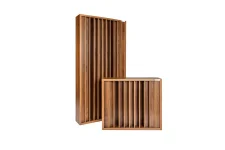
GIK Acoustics dropped a fresh pair of diffusers for sound nerds. Their new Q11D model evolves from the older Q7D design. It uses an eleven-root sequence to shift its effective range upward into the mid frequencies. This unit is slightly wider than its predecessor and features narrower wells. The different designs allow them to work together in modular arrays for broader coverage.
Construction relies on CNC-cut wood laminates. The diffuser comes in four finish options: beech, walnut, black, and white. Two sizes are available for different installation needs. The Standard version is the full-size unit. The Demi model offers a half-height profile for spaces with low ceilings.
This half-height design also works in interleaved two-dimensional scattering patterns. Recommended placements include the rear wall of mixing or listening rooms. It is also suggested for use behind dipole or open baffle speakers. Other applications cover the front or side walls in home theater systems.
The diffuser suits live rooms for recording percussion or acoustic instruments. The Standard size measures about two feet wide by four feet tall. The Demi version shares the width and depth but is half the height. The full-size unit weighs approximately seventy pounds.
A company's acoustic designer explained the product's purpose. He called quadratic diffusers the predictable standard for one-dimensional diffusion. He said they preserve mid and high frequency energy while controlling reflections. The Q11D operates at a higher frequency band than the seven-root model.
Its complex well structure provides scattering down to around five hundred seventy hertz. Even diffusion is maintained up to nearly four kilohertz. This type of diffusion excels in large spaces like auditoriums. It helps achieve a smooth midrange decay time.
Pricing for the Standard version is set under five hundred British pounds. The Demi model costs roughly half that amount. Both products are currently available for purchase directly.
Construction relies on CNC-cut wood laminates. The diffuser comes in four finish options: beech, walnut, black, and white. Two sizes are available for different installation needs. The Standard version is the full-size unit. The Demi model offers a half-height profile for spaces with low ceilings.
This half-height design also works in interleaved two-dimensional scattering patterns. Recommended placements include the rear wall of mixing or listening rooms. It is also suggested for use behind dipole or open baffle speakers. Other applications cover the front or side walls in home theater systems.
The diffuser suits live rooms for recording percussion or acoustic instruments. The Standard size measures about two feet wide by four feet tall. The Demi version shares the width and depth but is half the height. The full-size unit weighs approximately seventy pounds.
A company's acoustic designer explained the product's purpose. He called quadratic diffusers the predictable standard for one-dimensional diffusion. He said they preserve mid and high frequency energy while controlling reflections. The Q11D operates at a higher frequency band than the seven-root model.
Its complex well structure provides scattering down to around five hundred seventy hertz. Even diffusion is maintained up to nearly four kilohertz. This type of diffusion excels in large spaces like auditoriums. It helps achieve a smooth midrange decay time.
Pricing for the Standard version is set under five hundred British pounds. The Demi model costs roughly half that amount. Both products are currently available for purchase directly.