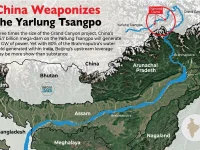
China advances construction plans for a $16.7 billion hydroelectric facility on the Yarlung Tsangpo River. The Medog Hydropower Project will generate 70 gigawatts of electricity, surpassing the Three Gorges Dam by more than triple capacity. Downstream nations India and Bangladesh express concerns about potential water manipulation and hydrological pressure tactics.
Geographic analysis reveals India contributes over 80 percent of the Brahmaputra River's total volume despite China controlling two-thirds of the river basin. Tibet receives minimal annual rainfall at 300 millimeters while Northeast India experiences over 2,300 millimeters yearly. Indian tributaries and monsoon patterns dominate water flow patterns.
The proposed dam operates as a run-of-the-river system without large-scale water storage capabilities. This design prevents sustained flow manipulation or seasonal water retention for geopolitical leverage. Assam Chief Minister Himanta Biswa Sarma suggests reduced upstream flow could actually benefit flood management efforts. Experts maintain India retains strategic advantages due to rainfall dominance and tributary contributions within its territory.
Geographic analysis reveals India contributes over 80 percent of the Brahmaputra River's total volume despite China controlling two-thirds of the river basin. Tibet receives minimal annual rainfall at 300 millimeters while Northeast India experiences over 2,300 millimeters yearly. Indian tributaries and monsoon patterns dominate water flow patterns.
The proposed dam operates as a run-of-the-river system without large-scale water storage capabilities. This design prevents sustained flow manipulation or seasonal water retention for geopolitical leverage. Assam Chief Minister Himanta Biswa Sarma suggests reduced upstream flow could actually benefit flood management efforts. Experts maintain India retains strategic advantages due to rainfall dominance and tributary contributions within its territory.