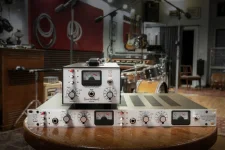
JUDE’s nine-position Z-Match control works across 60-ohm, 200-ohm, and 1.5-kilohm microphone input impedances, with gain varying by the selected setting. The control sits before a dual-discrete 3035 Class-A amplifier and works through a custom CineMag input transformer rather than behaving like an EQ knob bolted onto the end of the signal path.
The useful part starts with a distinction people often skip. A microphone has an output impedance, while the preamp presents an input impedance, and the relationship between the two affects how much signal reaches the preamp and how the microphone behaves across frequency. “Matching” the two numbers is not automatically the goal in modern recording.
JUDE makes that relationship deliberately adjustable. Its Sound Techniques A-Range preamp design uses a three-impedance input transformer, while the Z-Match selector provides nine operating positions and changes the available input gain along with the loading behavior. You are choosing an electrical condition at the front of the chain, not simply picking nine preset flavors.
The common shortcut says low impedance sounds darker and high impedance sounds more open. Treat that as a starting guess, not a law. Microphone transformers, resonances, active electronics, cable capacitance, and the preamp input stage all influence what happens, so two microphones with similar published output-impedance numbers can react differently when you turn the same selector.
Published research on condenser microphones also makes the broader point. Load impedance can alter microphone performance across sensitivity, frequency response, self-noise, dynamic range, and other measured parameters, which is a better reason to experiment than assuming impedance only matters with old ribbon microphones. The audible size of the change still depends on the microphone and the operating level.
Gain moves with the setting too. JUDE is specified for 65 to 76 dB of preamp gain with a 40-ohm source, so flipping Z-Match positions can change level enough to skew a casual comparison. A louder setting can seem clearer, punchier, or more detailed even when some of the preference comes from level alone.
Level matching makes the control far more useful. Record a short passage, change one Z-Match position, then trim the resulting level closely before comparing playback while keeping microphone position, performer distance, downstream gain, and monitoring volume fixed. Small differences become easier to judge once loudness is controlled.
The same discipline helps with vocals and acoustic instruments. Listen for changes in consonant edge, low-mid weight, pick attack, room pickup, and the way a sustained note decays instead of hunting for a vague “vintage” effect. Sometimes the right setting will be the one that changes the least.
Active condenser microphones can react less dramatically because their output electronics isolate the capsule from the preamp more effectively, yet “less dramatic” is not the same as inert. Load-dependent changes have been measured in modern condenser designs, so it is worth checking all sensible positions when the source is exposed enough for small differences to matter.
One boundary is easy to miss. JUDE also provides a 10-kilohm condition for line-level use, intended to better accommodate outputs from modern audio interfaces when sending recorded material through the hardware. It should not be treated as merely another microphone-loading stop when you are comparing the three documented mic impedances.
On the JUDE-MP2, each channel carries its own preamp path, so stereo work rewards consistency. Start matched microphones on the same Z-Match position and gain structure, then change one variable at a time if the stereo image needs adjustment. Otherwise, level and loading differences can become part of the left-right balance before the signal reaches your converter.
The useful part starts with a distinction people often skip. A microphone has an output impedance, while the preamp presents an input impedance, and the relationship between the two affects how much signal reaches the preamp and how the microphone behaves across frequency. “Matching” the two numbers is not automatically the goal in modern recording.
JUDE makes that relationship deliberately adjustable. Its Sound Techniques A-Range preamp design uses a three-impedance input transformer, while the Z-Match selector provides nine operating positions and changes the available input gain along with the loading behavior. You are choosing an electrical condition at the front of the chain, not simply picking nine preset flavors.
Lower impedance can change level before it changes tone
A lower preamp input impedance places a heavier load on the microphone. Depending on the microphone’s own output circuit, the immediate result can be less output level, followed by changes in frequency response or transient behavior. Passive transformer-coupled microphones tend to make those interactions easier to hear because their source impedance can vary substantially with frequency.The common shortcut says low impedance sounds darker and high impedance sounds more open. Treat that as a starting guess, not a law. Microphone transformers, resonances, active electronics, cable capacitance, and the preamp input stage all influence what happens, so two microphones with similar published output-impedance numbers can react differently when you turn the same selector.
Published research on condenser microphones also makes the broader point. Load impedance can alter microphone performance across sensitivity, frequency response, self-noise, dynamic range, and other measured parameters, which is a better reason to experiment than assuming impedance only matters with old ribbon microphones. The audible size of the change still depends on the microphone and the operating level.
Z-Match changes the transformer relationship as well
JUDE is unusual because its input transformer is not presented as one fixed transformer followed by a generic loading switch. Sound Techniques specifies a custom CineMag input transformer wired for three distinct impedances and says the component’s operating characteristics change with the selected Z-Match setting. The transformer is part of the interaction you are auditioning.Gain moves with the setting too. JUDE is specified for 65 to 76 dB of preamp gain with a 40-ohm source, so flipping Z-Match positions can change level enough to skew a casual comparison. A louder setting can seem clearer, punchier, or more detailed even when some of the preference comes from level alone.
Level matching makes the control far more useful. Record a short passage, change one Z-Match position, then trim the resulting level closely before comparing playback while keeping microphone position, performer distance, downstream gain, and monitoring volume fixed. Small differences become easier to judge once loudness is controlled.
The same discipline helps with vocals and acoustic instruments. Listen for changes in consonant edge, low-mid weight, pick attack, room pickup, and the way a sustained note decays instead of hunting for a vague “vintage” effect. Sometimes the right setting will be the one that changes the least.
Microphone type should guide where you start
With a passive ribbon or transformer-coupled dynamic microphone, starting at the higher 1.5-kilohm setting gives the microphone a lighter load and establishes a useful reference. Move downward only after you know what the more lightly loaded version sounds like. A lower setting may be musically useful, but reduced output can require more gain and may change the microphone’s response at the same time.Active condenser microphones can react less dramatically because their output electronics isolate the capsule from the preamp more effectively, yet “less dramatic” is not the same as inert. Load-dependent changes have been measured in modern condenser designs, so it is worth checking all sensible positions when the source is exposed enough for small differences to matter.
One boundary is easy to miss. JUDE also provides a 10-kilohm condition for line-level use, intended to better accommodate outputs from modern audio interfaces when sending recorded material through the hardware. It should not be treated as merely another microphone-loading stop when you are comparing the three documented mic impedances.
On the JUDE-MP2, each channel carries its own preamp path, so stereo work rewards consistency. Start matched microphones on the same Z-Match position and gain structure, then change one variable at a time if the stereo image needs adjustment. Otherwise, level and loading differences can become part of the left-right balance before the signal reaches your converter.