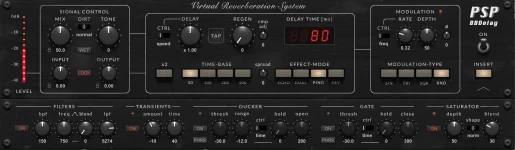
PSP BBDelay doubles its available delay length in x2 mode, and PSP explicitly warns that the processed signal loses bandwidth when you engage it. You are not just getting more milliseconds for free. The longer setting changes what the wet signal can carry.
The useful detail is buried inside PSP BBDelay's analog delay design rather than sitting in the usual feature-list language about warm repeats and vintage color. PSP ties the Delay control to the modeled BBD clock rate, with slower clocking producing longer delays and faster clocking producing shorter ones. Once you look at it that way, the darker long-delay sound stops being a vague analog vibe and becomes a timing trade-off.
High-frequency loss is part of the bargain. A BBD handles audio as sampled analog charge passed through a fixed chain of storage stages, so stretching the same chain over a longer period means moving those samples through it more slowly.
The important bit is what happens to the usable frequency range as the clock slows. A sampled system cannot accept unlimited high-frequency content without aliasing, so BBD circuits normally filter the signal before it enters the delay line and smooth it again after it comes out. Lower clock rates pull the safe audio range downward, which forces more of the top end out of the delayed signal.
It is why a long analog delay can lose cymbal fizz, pick attack, breath, and bright synth harmonics before the repeat has even had a chance to fade. People often describe the result as warm or rounded, which is fair enough as a listening description. Electrically, though, the useful point is narrower bandwidth.
A detailed model of variable-rate BBD behavior with surrounding filters treats those filters as part of the system rather than decoration added afterward. Input filtering suppresses frequencies that would fold back as aliases, while output filtering deals with image spectra created by the sampled output. Those jobs become more demanding as the modeled clock rate falls.
A producer can use that on purpose instead of treating it as damage. Longer settings can push repeats behind a lead vocal or guitar without reaching for another EQ, while short settings preserve more edge and make rhythmic echoes poke forward. The same patch can therefore feel cleaner or murkier before you touch feedback, dirt, saturation, or the dedicated tone controls.
Tempo sync does not cancel the trade-off either. Asking for a longer synchronized value still asks the underlying delay model to cover more time, and PSP can flag combinations that fall outside the chosen time base. The musical grid changes how you select the timing, not the basic relationship between delay length and the modeled BBD clock.
The distinction matters when you are dialing a sound by ear. If the very first delayed tap already feels softer on top at a long setting, shortening the delay or leaving x2 mode can restore more upper detail before you start adjusting the feedback filters. If later repeats get progressively duller while the first one is fine, the feedback path deserves more attention.
Bright material makes the difference easiest to hear. Feed the plug-in percussion, picked guitar, plucks, or a synth patch with obvious upper harmonics, then compare a short delay against a much longer one at similar wet level and low regeneration. Listen to the first repeat rather than the whole tail, because it tells you what the delay line itself is doing before repeated feedback processing piles on.
Long BBD delay times are useful precisely because the compromise is audible. More time gives you a wider rhythmic canvas, while the reduced bandwidth can keep those echoes from fighting the dry sound. Push it far enough, and the limitation becomes part of the arrangement, not just a spec-sheet footnote.
The useful detail is buried inside PSP BBDelay's analog delay design rather than sitting in the usual feature-list language about warm repeats and vintage color. PSP ties the Delay control to the modeled BBD clock rate, with slower clocking producing longer delays and faster clocking producing shorter ones. Once you look at it that way, the darker long-delay sound stops being a vague analog vibe and becomes a timing trade-off.
High-frequency loss is part of the bargain. A BBD handles audio as sampled analog charge passed through a fixed chain of storage stages, so stretching the same chain over a longer period means moving those samples through it more slowly.
BBD delay time begins with the clock
A bucket brigade device has a fixed number of stages, while the clock decides how quickly charge moves from one stage to the next. Slow the clock and the trip takes longer. Speed it up, and the delay gets shorter.The important bit is what happens to the usable frequency range as the clock slows. A sampled system cannot accept unlimited high-frequency content without aliasing, so BBD circuits normally filter the signal before it enters the delay line and smooth it again after it comes out. Lower clock rates pull the safe audio range downward, which forces more of the top end out of the delayed signal.
It is why a long analog delay can lose cymbal fizz, pick attack, breath, and bright synth harmonics before the repeat has even had a chance to fade. People often describe the result as warm or rounded, which is fair enough as a listening description. Electrically, though, the useful point is narrower bandwidth.
A detailed model of variable-rate BBD behavior with surrounding filters treats those filters as part of the system rather than decoration added afterward. Input filtering suppresses frequencies that would fold back as aliases, while output filtering deals with image spectra created by the sampled output. Those jobs become more demanding as the modeled clock rate falls.
Longer settings change more than the delay number
PSP's x2 switch makes this especially easy to miss because the control looks simple. Engage it and the available delay length doubles, but PSP also states that processed bandwidth drops. You gain time by accepting a darker wet path.A producer can use that on purpose instead of treating it as damage. Longer settings can push repeats behind a lead vocal or guitar without reaching for another EQ, while short settings preserve more edge and make rhythmic echoes poke forward. The same patch can therefore feel cleaner or murkier before you touch feedback, dirt, saturation, or the dedicated tone controls.
Tempo sync does not cancel the trade-off either. Asking for a longer synchronized value still asks the underlying delay model to cover more time, and PSP can flag combinations that fall outside the chosen time base. The musical grid changes how you select the timing, not the basic relationship between delay length and the modeled BBD clock.
Dark repeats are not the same as feedback filtering
One easy mistake is hearing a darker tail and assuming the feedback filter caused all of it. BBDelay also has high-pass, low-pass, and resonant shaping inside the feedback path, so each regenerated pass can lose or emphasize different frequencies. Both processes stack on top of the bandwidth limits created by the delay engine itself.The distinction matters when you are dialing a sound by ear. If the very first delayed tap already feels softer on top at a long setting, shortening the delay or leaving x2 mode can restore more upper detail before you start adjusting the feedback filters. If later repeats get progressively duller while the first one is fine, the feedback path deserves more attention.
Bright material makes the difference easiest to hear. Feed the plug-in percussion, picked guitar, plucks, or a synth patch with obvious upper harmonics, then compare a short delay against a much longer one at similar wet level and low regeneration. Listen to the first repeat rather than the whole tail, because it tells you what the delay line itself is doing before repeated feedback processing piles on.
Long BBD delay times are useful precisely because the compromise is audible. More time gives you a wider rhythmic canvas, while the reduced bandwidth can keep those echoes from fighting the dry sound. Push it far enough, and the limitation becomes part of the arrangement, not just a spec-sheet footnote.