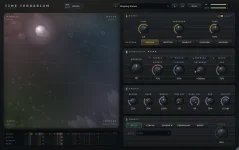
Seal stops new input while the echoes already inside Time Terrarium keep circulating and migrating at a steady level. This behavior is more useful than the name makes it sound.
In Time Terrarium’s four-zone delay design, Seal is basically the line between feeding the effect and letting the existing tail live on by itself. You can play into the plug-in, close the glass, and keep the captured repeats moving without piling fresh notes into the same loop.
Migrate is what keeps the sealed tail from being a frozen copy. It passes each repeat to a neighboring habitat, clockwise or counter-clockwise, so later passes can pick up a different delay character. The combination gives you a practical way to separate the moment you create a tail from the way that tail develops afterward.
This matters on busy material. A vocal phrase, drum fill, chord, or single synth hit can enter first, then Seal can close before the next phrase arrives. The delayed material keeps going, but the following dry performance does not keep loading more audio into the same circulating texture.
The distinction also gives you a cleaner way to hear what Migrate is doing. The orb handles where fresh audio enters the habitats, while Migrate works on repeats already moving through the system. Once Seal blocks new input, the second job becomes much easier to hear because the tail is no longer being refreshed by new notes.
Feedback systems can get dense and colored quickly once audio keeps recirculating. Work on feedback delay networks deals directly with spectral coloration and temporal density in recursive audio structures. 23DSP has not published Time Terrarium’s internal DSP topology, so the paper is useful context rather than a description of how this plug-in is coded.
Replanting or swapping habitats changes that journey without changing the source material. Put two strongly contrasting species next to each other and the tail can shift character quickly. Put related treatments beside one another, and the change can be subtler, which is handy when you want movement without every repeat announcing a completely different effect.
Direction matters for the same reason. Clockwise and counter-clockwise migration visit the neighboring habitats in opposite orders, so the same four species can produce a different progression depending on which way repeats travel. This is one of those controls that is easier to understand by listening to one sustained sound than by throwing a whole arrangement through it.
Pattern can make the result more complex because each habitat may also run at a different multiple of the main delay time. If the timing starts becoming harder to follow, the separate Pattern mode breakdown is the better place to sort out Dotted, Triplet, Cascade, and Golden before adding migration on top.
Tone, Low Cut, and High Cut become practical cleanup tools once a sealed tail hangs around for a while. The filters affect the echoes and Bloom reverb rather than the dry signal, so you can trim low-end buildup or shave off a bright tail without changing the original sound outside the effect.
Bloom can push the circulating material farther into ambience because it is fed by the echoes, while Width can narrow the result toward mono or spread it beyond normal stereo width. Neither control needs to be cranked. A tail that already changes species on every pass can get crowded fast if migration, reverb, stereo spread, and a busy Pattern all fight for attention.
For performance use, the clean move is to capture first and reshape second. Open Seal for the phrase you want, close it once the useful material is inside, then adjust Migrate or the surrounding tone controls while the tail continues. Reopen Seal when you actually want new material joining the loop again.
In Time Terrarium’s four-zone delay design, Seal is basically the line between feeding the effect and letting the existing tail live on by itself. You can play into the plug-in, close the glass, and keep the captured repeats moving without piling fresh notes into the same loop.
Migrate is what keeps the sealed tail from being a frozen copy. It passes each repeat to a neighboring habitat, clockwise or counter-clockwise, so later passes can pick up a different delay character. The combination gives you a practical way to separate the moment you create a tail from the way that tail develops afterward.
Seal turns a live delay into a contained tail
With Seal open, new input can keep entering the four habitats according to the orb position. Close it and fresh input stops entering, while the echoes already inside stay circulating at a steady level until Seal is opened again. It is closer to holding the contents of the effect than simply raising Feedback and hoping the tail lasts long enough.This matters on busy material. A vocal phrase, drum fill, chord, or single synth hit can enter first, then Seal can close before the next phrase arrives. The delayed material keeps going, but the following dry performance does not keep loading more audio into the same circulating texture.
The distinction also gives you a cleaner way to hear what Migrate is doing. The orb handles where fresh audio enters the habitats, while Migrate works on repeats already moving through the system. Once Seal blocks new input, the second job becomes much easier to hear because the tail is no longer being refreshed by new notes.
Feedback systems can get dense and colored quickly once audio keeps recirculating. Work on feedback delay networks deals directly with spectral coloration and temporal density in recursive audio structures. 23DSP has not published Time Terrarium’s internal DSP topology, so the paper is useful context rather than a description of how this plug-in is coded.
Habitat order decides how the tail changes
Migrate always passes repeats toward a neighboring habitat, which makes the physical order of the four corners part of the sound. With the default Moss, Water, Crystal, and Ash planting, a migrating repeat can move through tape, ping-pong, shimmer, and reverse characters instead of returning with the same treatment every time.Replanting or swapping habitats changes that journey without changing the source material. Put two strongly contrasting species next to each other and the tail can shift character quickly. Put related treatments beside one another, and the change can be subtler, which is handy when you want movement without every repeat announcing a completely different effect.
Direction matters for the same reason. Clockwise and counter-clockwise migration visit the neighboring habitats in opposite orders, so the same four species can produce a different progression depending on which way repeats travel. This is one of those controls that is easier to understand by listening to one sustained sound than by throwing a whole arrangement through it.
Pattern can make the result more complex because each habitat may also run at a different multiple of the main delay time. If the timing starts becoming harder to follow, the separate Pattern mode breakdown is the better place to sort out Dotted, Triplet, Cascade, and Golden before adding migration on top.
Small moves keep a sealed tail usable
A useful starting patch is deliberately boring. Feed one short sound into a couple of contrasting habitats, use moderate Migrate, then close Seal and listen to how the repeats change over several passes. Moving one control at a time makes it obvious whether the interesting bit comes from migration, the species Character control, filtering, or the timing pattern.Tone, Low Cut, and High Cut become practical cleanup tools once a sealed tail hangs around for a while. The filters affect the echoes and Bloom reverb rather than the dry signal, so you can trim low-end buildup or shave off a bright tail without changing the original sound outside the effect.
Bloom can push the circulating material farther into ambience because it is fed by the echoes, while Width can narrow the result toward mono or spread it beyond normal stereo width. Neither control needs to be cranked. A tail that already changes species on every pass can get crowded fast if migration, reverb, stereo spread, and a busy Pattern all fight for attention.
For performance use, the clean move is to capture first and reshape second. Open Seal for the phrase you want, close it once the useful material is inside, then adjust Migrate or the surrounding tone controls while the tail continues. Reopen Seal when you actually want new material joining the loop again.