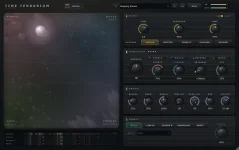
23DSP sells Time Terrarium for €19 and 23ArpDelay for €15, but the two plug-ins approach delay from very different directions. One is built around changing echo character across four habitats, while the other turns repeats into pitched, scale-aware tap patterns.
The Time Terrarium’s moving-habitat delay gives you four echo species at once: a movable orb, Migrate, Pattern, Seal, Bloom, Duck, and shared tone controls. 23ArpDelay instead gives you up to 16 taps with individual pitch, timing, level, pan, filtering, mute, and reverse controls.
So the useful comparison is not which one has more features. It is whether you want the delay itself to keep changing texture, or whether you want to compose the repeats almost like another melodic part.
Its four-habitat layout is also deliberately broad rather than microscopic. You are not editing 16 separate taps one by one. You are placing or moving the orb, choosing species, setting a Pattern relationship, and deciding how much the repeats should migrate, bloom, duck, spread, or filter.
The difference gets obvious on pads, vocals, drums, and one-shot effects. A single hit can start as tape, move into ping-pong, pick up shimmer, then return as reverse material with the default planting, while the orb controls where fresh audio enters.
Seal pushes it further into performance territory. You can stop new audio from entering while the existing repeats keep circulating, then let Migrate and the habitat order reshape what is already trapped inside. The separate Seal and Migrate workflow matters if you want evolving tails without constantly feeding more notes into them.
The big practical difference is control density. A tap can have its own delay time, level, stereo position, filter, mute state, reverse state, and pitch, so you can build a repeat line that behaves more like a programmed sequence than a conventional echo tail. MIDI can also set the reference note or send the generated arpeggio to another instrument.
Its pitch engine uses a phase vocoder for every pitched tap and channel. Laroche and Dolson’s phase-vocoder paper describes the frequency-domain approach behind this family of pitch-shifting techniques, while 23ArpDelay adds latency compensation, level matching, and optional formant preservation around its own implementation.
Pitched taps carry a practical cost. They need roughly 46 ms at 44.1 kHz or 43 ms at 48 kHz because the shifter works in analysis frames, while an unshifted tap bypasses that stage and can go down to a single sample. Version 0.9.0-rc6 also reduced pitched-tap CPU use on Windows in 23DSP’s own benchmark, which matters more as you stack many shifted taps.
Pick 23ArpDelay when the repeat pitches themselves need to be written with intent. It is the stronger fit for scale-locked echoes, harmonized tap lines, octave patterns, MIDI-driven arpeggio ideas, or detailed per-tap timing where each repeat needs its own job.
There is some overlap. Both can make rhythmic delays, both can work in sync or free time, and both can turn a plain source into something much busier. The split appears once you start editing because Time Terrarium asks where the echo should travel and what it should become, while 23ArpDelay asks which pitched tap should happen next and exactly how that tap should behave.
For a melodic synth line, 23ArpDelay can build harmony into the repeats without changing the played part. For a vocal throw, drum fill, texture, or long transition, Time Terrarium can keep the original pitch relationship mostly intact while the echo character changes around it. Those are different jobs, even if both plug-ins sit in the same delay folder.
The Time Terrarium’s moving-habitat delay gives you four echo species at once: a movable orb, Migrate, Pattern, Seal, Bloom, Duck, and shared tone controls. 23ArpDelay instead gives you up to 16 taps with individual pitch, timing, level, pan, filtering, mute, and reverse controls.
So the useful comparison is not which one has more features. It is whether you want the delay itself to keep changing texture, or whether you want to compose the repeats almost like another melodic part.
Time Terrarium changes character as repeats move
Time Terrarium makes the most sense when the sound of the repeats matters as much as their notes. Each habitat can hold Moss, Water, Crystal, Ash, Frost, Dust, Pebble, or Wind, and Migrate can pass repeats to the neighboring habitat so later echoes pick up a different treatment.Its four-habitat layout is also deliberately broad rather than microscopic. You are not editing 16 separate taps one by one. You are placing or moving the orb, choosing species, setting a Pattern relationship, and deciding how much the repeats should migrate, bloom, duck, spread, or filter.
The difference gets obvious on pads, vocals, drums, and one-shot effects. A single hit can start as tape, move into ping-pong, pick up shimmer, then return as reverse material with the default planting, while the orb controls where fresh audio enters.
Seal pushes it further into performance territory. You can stop new audio from entering while the existing repeats keep circulating, then let Migrate and the habitat order reshape what is already trapped inside. The separate Seal and Migrate workflow matters if you want evolving tails without constantly feeding more notes into them.
23ArpDelay writes pitched patterns into the repeats
23ArpDelay is much more deliberate about pitch. Every tap can carry its own interval, and the pattern builder can generate shapes from scale choice, motion, spacing, and contour across as many as 16 taps and four octaves.The big practical difference is control density. A tap can have its own delay time, level, stereo position, filter, mute state, reverse state, and pitch, so you can build a repeat line that behaves more like a programmed sequence than a conventional echo tail. MIDI can also set the reference note or send the generated arpeggio to another instrument.
Its pitch engine uses a phase vocoder for every pitched tap and channel. Laroche and Dolson’s phase-vocoder paper describes the frequency-domain approach behind this family of pitch-shifting techniques, while 23ArpDelay adds latency compensation, level matching, and optional formant preservation around its own implementation.
Pitched taps carry a practical cost. They need roughly 46 ms at 44.1 kHz or 43 ms at 48 kHz because the shifter works in analysis frames, while an unshifted tap bypasses that stage and can go down to a single sample. Version 0.9.0-rc6 also reduced pitched-tap CPU use on Windows in 23DSP’s own benchmark, which matters more as you stack many shifted taps.
The better fit depends on what the repeats should do
Pick Time Terrarium when you want one delay to behave like a changing environment. The interesting movement comes from routing, species changes, migration, orbiting, Seal, and the way Pattern modes spread the four habitats in time.Pick 23ArpDelay when the repeat pitches themselves need to be written with intent. It is the stronger fit for scale-locked echoes, harmonized tap lines, octave patterns, MIDI-driven arpeggio ideas, or detailed per-tap timing where each repeat needs its own job.
There is some overlap. Both can make rhythmic delays, both can work in sync or free time, and both can turn a plain source into something much busier. The split appears once you start editing because Time Terrarium asks where the echo should travel and what it should become, while 23ArpDelay asks which pitched tap should happen next and exactly how that tap should behave.
For a melodic synth line, 23ArpDelay can build harmony into the repeats without changing the played part. For a vocal throw, drum fill, texture, or long transition, Time Terrarium can keep the original pitch relationship mostly intact while the echo character changes around it. Those are different jobs, even if both plug-ins sit in the same delay folder.