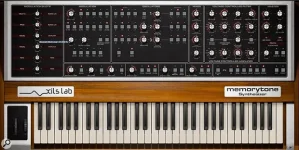
The original 1982 Memorymoog already stored 100 patches and gave each of its six voices three oscillators, two envelopes and a 24 dB low-pass filter. MemoryTone raises the voice count and adds modern control, but much of the instrument’s apparent complexity has roots in the hardware.
Looking at the old front panel changes the story quickly. Oscillator 3 was not merely another source for thick chords, and the arpeggiator was not a token up-and-down pattern generator. Moog had already built several ideas into the Memorymoog that now get described as advanced software-synth behavior.
The dedicated LFO handled a different job. It ran from 0.1 to 100 Hz and offered triangle, rising saw, falling saw, square, and sample-and-hold shapes, with destinations including all three oscillator frequencies, their pulse widths, and the filter. Oscillator 3 could also drop into a low-frequency range, so the hardware was already comfortable letting an audio oscillator become a modulation source.
MemoryTone keeps this family resemblance rather than replacing it with a completely different synthesis model. Three oscillators per voice, two ADSR envelopes and a self-oscillating 24 dB ladder filter remain central. The filter lineage itself reaches further back through Robert Moog's voltage-controlled filter patent, filed in 1966 and published in 1969.
Where the plugin moves forward is routing freedom. Six assignable modulation slots let you choose sources and destinations without being restricted to the hardware’s fixed switch layout, while velocity, aftertouch and MPE bring note-by-note performance information into the instrument. More options, but not a rejection of the old modulation logic.
Its LFO doubled as the arpeggiator clock, which tied rhythmic motion directly to the synth’s modulation system. Modern plugins make tempo sync and pattern editing easier to see, but the original design already treated arpeggiation as a performance feature rather than a decorative extra.
Program Sequences are another easily misunderstood part of the hardware. The Memorymoog stored ten sequences, each containing as many as 20 programs, and let players step forward or backward through them from the panel or optional footswitches. These were chains of presets, not a modern note sequencer, which makes the name sound more elaborate than the underlying function.
MemoryTone’s advanced arpeggiator therefore extends an existing strength instead of bolting rhythm onto a synth that never had it. The MemoryTone's expanded performance architecture adds mono and poly operation, swing, gate control, octave expansion, broken chords and random patterns, moving the idea closer to contemporary production without erasing its origin.
Patch storage changes just as dramatically. The original machine held 100 patches internally and used cassette tape to move larger libraries in and out of memory. MemoryTone instead works with a software preset manager inside a resizable interface, where a large library no longer depends on recording data as audio to external media.
Effects mark an even cleaner break from the hardware. MemoryTone includes chorus, phaser, delay, reverb, EQ, and a three-band resonator with independent routing, so a patch can carry much of its production treatment inside the instrument. The 1982 machine supplied the synthesis voice and left those jobs to external gear.
MPE is the most obvious generational divide. The original keyboard could not deliver modern multidimensional note expression, while MemoryTone can respond to MPE alongside velocity and aftertouch. You can keep the old three-oscillator architecture while controlling individual notes with information the hardware was never designed to receive.
Calling MemoryTone a modern Memorymoog is therefore accurate, but “modern” belongs mostly to control, capacity, and integration. The six-voice original already had independent voice modulation, oscillator-driven modulation, multiple arpeggiator behaviors, patch memory, and programmable preset chains. MemoryTone’s job is less about inventing those ideas than removing the boundaries around them.
Looking at the old front panel changes the story quickly. Oscillator 3 was not merely another source for thick chords, and the arpeggiator was not a token up-and-down pattern generator. Moog had already built several ideas into the Memorymoog that now get described as advanced software-synth behavior.
The original Memorymoog already moved sounds per voice
Each hardware voice had its own oscillator 3 and filter contour available for voice modulation. Those sources could affect oscillator 1 and 2 frequency, pulse width, and filter cutoff independently on every active voice. Hold a chord, and the movement did not have to behave like one global LFO pasted across all six notes.The dedicated LFO handled a different job. It ran from 0.1 to 100 Hz and offered triangle, rising saw, falling saw, square, and sample-and-hold shapes, with destinations including all three oscillator frequencies, their pulse widths, and the filter. Oscillator 3 could also drop into a low-frequency range, so the hardware was already comfortable letting an audio oscillator become a modulation source.
MemoryTone keeps this family resemblance rather than replacing it with a completely different synthesis model. Three oscillators per voice, two ADSR envelopes and a self-oscillating 24 dB ladder filter remain central. The filter lineage itself reaches further back through Robert Moog's voltage-controlled filter patent, filed in 1966 and published in 1969.
Where the plugin moves forward is routing freedom. Six assignable modulation slots let you choose sources and destinations without being restricted to the hardware’s fixed switch layout, while velocity, aftertouch and MPE bring note-by-note performance information into the instrument. More options, but not a rejection of the old modulation logic.
The 1982 arpeggiator was hardly primitive
The Memorymoog offered up, down, and up-down arpeggiation, plus latched versions of those patterns. It could also trigger all voices together and play notes in the order they were entered, with a latched first-to-last mode available as well. Players could replace notes in a running pattern and transpose the result from the keyboard.Its LFO doubled as the arpeggiator clock, which tied rhythmic motion directly to the synth’s modulation system. Modern plugins make tempo sync and pattern editing easier to see, but the original design already treated arpeggiation as a performance feature rather than a decorative extra.
Program Sequences are another easily misunderstood part of the hardware. The Memorymoog stored ten sequences, each containing as many as 20 programs, and let players step forward or backward through them from the panel or optional footswitches. These were chains of presets, not a modern note sequencer, which makes the name sound more elaborate than the underlying function.
MemoryTone’s advanced arpeggiator therefore extends an existing strength instead of bolting rhythm onto a synth that never had it. The MemoryTone's expanded performance architecture adds mono and poly operation, swing, gate control, octave expansion, broken chords and random patterns, moving the idea closer to contemporary production without erasing its origin.
The useful upgrades solve hardware-era limits
Six voices were substantial in 1982, but dense modern arrangements can exhaust them quickly. MemoryTone expands the engine to 16 voices, giving sustained chords, long releases and stacked passages more room before voice allocation becomes audible. Software also removes the need to auto-tune 18 physical oscillators after warm-up.Patch storage changes just as dramatically. The original machine held 100 patches internally and used cassette tape to move larger libraries in and out of memory. MemoryTone instead works with a software preset manager inside a resizable interface, where a large library no longer depends on recording data as audio to external media.
Effects mark an even cleaner break from the hardware. MemoryTone includes chorus, phaser, delay, reverb, EQ, and a three-band resonator with independent routing, so a patch can carry much of its production treatment inside the instrument. The 1982 machine supplied the synthesis voice and left those jobs to external gear.
MPE is the most obvious generational divide. The original keyboard could not deliver modern multidimensional note expression, while MemoryTone can respond to MPE alongside velocity and aftertouch. You can keep the old three-oscillator architecture while controlling individual notes with information the hardware was never designed to receive.
Calling MemoryTone a modern Memorymoog is therefore accurate, but “modern” belongs mostly to control, capacity, and integration. The six-voice original already had independent voice modulation, oscillator-driven modulation, multiple arpeggiator behaviors, patch memory, and programmable preset chains. MemoryTone’s job is less about inventing those ideas than removing the boundaries around them.