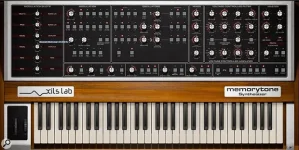
XILS-Lab MemoryTone offers up to 16 voices, while Arturia Memory V provides dedicated six-voice and 12-voice polyphonic modes. Both start from three oscillators per voice and a resonant ladder filter, so the useful comparison begins after those basics. The real split is how quickly each instrument turns that vintage structure into something more elaborate.
MemoryTone keeps its main identity fairly compact, with six assignable modulation slots, MPE, an advanced arpeggiator, onboard effects, and an extra sub oscillator. Memory V takes a more visibly expanded route through drag-and-drop modulation, advanced modulators, keyboard control, four macros, four arpeggiator layers and four effect slots.
The advanced panel pushes well beyond a basic vintage-synth workflow, with envelopes, function generators, random modulation, voice modulation, and a modulation sequencer available in three modulator slots. Four assignable macros and a four-layer Multi-Arp give you separate ways to turn one patch into something performable or rhythmically busy. The arpeggiator can stack independent patterns, which matters if one-note movement feels too rigid for the part.
Memory V also gives you explicit control over the filter model. Alongside its 24 dB ladder response, Arturia includes a 12 dB mode and Emphasis Bass Compensation for retaining more low-end weight as resonance rises. The historical design behind this filter family can be traced to the original Moog ladder filter patent, while Arturia treats the filter as something you can deliberately reshape.
Arturia applies the same practical thinking elsewhere. Memory V ships with more than 300 presets, in-app tutorials, controller integration, NKS support and MTS-ESP microtuning compatibility, useful when you are browsing quickly or mapping hardware. Its oscilloscope can also display output, LFO or voice-modulation activity while you edit.
Its effects section deserves more attention than a feature count suggests, with chorus, phaser, delay, reverb, EQ and resonator processing inside the instrument. The resonator is especially useful for pads, drones and animated keys because it opens timbres you would not expect from the vintage-style panel alone. MemoryTone also keeps those effects inside the same instrument rather than making you build the chain elsewhere.
The trade-off is interface philosophy. Arturia exposes modern functions through a large, advanced workspace with visual modulation gestures and macros, while MemoryTone leans on a smaller matrix and older-school preset handling. Early user reports mention preset-navigation trouble in Cubase on Windows and a resizing crash in Nuendo on macOS, while another user reported normal operation in Cakewalk Sonar.
For producers who spend most sessions designing motion, sequencing modulation and mapping expressive controllers, Memory V has the clearer workflow advantage. Its Multi-Arp, macros, and drag-and-drop routing get dedicated visual tools, while MemoryTone’s modern Memorymoog workflow keeps more of the expansion inside a six-slot matrix and single-engine layout.
A from-scratch sound designer may read the comparison differently. Six modulation slots, 16 voices, several potential LFO sources, and the resonator give MemoryTone enough room for detailed movement without making every patch a multi-panel programming job. The higher voice ceiling also gives dense chords more room before note stealing becomes part of the sound.
MPE support does not decide the contest because both instruments provide it. Memory V goes further in documenting how expressive controls can be assigned, including slide, aftertouch, and release velocity, while MemoryTone's published material confirms MPE and broad MIDI control. If expressive controller mapping sits at the center of your playing, documentation and assignment speed become practical advantages rather than brochure trivia.
MemoryTone keeps its main identity fairly compact, with six assignable modulation slots, MPE, an advanced arpeggiator, onboard effects, and an extra sub oscillator. Memory V takes a more visibly expanded route through drag-and-drop modulation, advanced modulators, keyboard control, four macros, four arpeggiator layers and four effect slots.
Memory V puts workflow tools right in front of you
Arturia has made modulation unusually easy to read. Sources can be dragged onto destinations, while dedicated controls expose velocity, release velocity, keyboard tracking, aftertouch, MPE slide and the mod wheel. If you build patches by trying a route, hearing it, then binning it seconds later, Memory V suits that pace.The advanced panel pushes well beyond a basic vintage-synth workflow, with envelopes, function generators, random modulation, voice modulation, and a modulation sequencer available in three modulator slots. Four assignable macros and a four-layer Multi-Arp give you separate ways to turn one patch into something performable or rhythmically busy. The arpeggiator can stack independent patterns, which matters if one-note movement feels too rigid for the part.
Memory V also gives you explicit control over the filter model. Alongside its 24 dB ladder response, Arturia includes a 12 dB mode and Emphasis Bass Compensation for retaining more low-end weight as resonance rises. The historical design behind this filter family can be traced to the original Moog ladder filter patent, while Arturia treats the filter as something you can deliberately reshape.
Arturia applies the same practical thinking elsewhere. Memory V ships with more than 300 presets, in-app tutorials, controller integration, NKS support and MTS-ESP microtuning compatibility, useful when you are browsing quickly or mapping hardware. Its oscilloscope can also display output, LFO or voice-modulation activity while you edit.
MemoryTone gives one engine more breathing room
MemoryTone answers with a different kind of depth. Its engine reaches 16 voices and keeps six assignable modulation slots close to a traditional Memorymoog-style panel, while oscillator 3, the main LFO, and the sub oscillator can handle modulation duties. You can build plenty of movement without leaving the central character of the synth behind.Its effects section deserves more attention than a feature count suggests, with chorus, phaser, delay, reverb, EQ and resonator processing inside the instrument. The resonator is especially useful for pads, drones and animated keys because it opens timbres you would not expect from the vintage-style panel alone. MemoryTone also keeps those effects inside the same instrument rather than making you build the chain elsewhere.
The trade-off is interface philosophy. Arturia exposes modern functions through a large, advanced workspace with visual modulation gestures and macros, while MemoryTone leans on a smaller matrix and older-school preset handling. Early user reports mention preset-navigation trouble in Cubase on Windows and a resizing crash in Nuendo on macOS, while another user reported normal operation in Cakewalk Sonar.
For producers who spend most sessions designing motion, sequencing modulation and mapping expressive controllers, Memory V has the clearer workflow advantage. Its Multi-Arp, macros, and drag-and-drop routing get dedicated visual tools, while MemoryTone’s modern Memorymoog workflow keeps more of the expansion inside a six-slot matrix and single-engine layout.
The better choice depends on how you build patches
A preset-first producer will probably feel the difference before hearing every technical distinction. Memory V gives you a larger factory library, tutorials, and a browser ecosystem tied into Arturia's wider software platform. If you usually start by finding a nearly finished sound and adjusting it, Arturia removes more friction.A from-scratch sound designer may read the comparison differently. Six modulation slots, 16 voices, several potential LFO sources, and the resonator give MemoryTone enough room for detailed movement without making every patch a multi-panel programming job. The higher voice ceiling also gives dense chords more room before note stealing becomes part of the sound.
MPE support does not decide the contest because both instruments provide it. Memory V goes further in documenting how expressive controls can be assigned, including slide, aftertouch, and release velocity, while MemoryTone's published material confirms MPE and broad MIDI control. If expressive controller mapping sits at the center of your playing, documentation and assignment speed become practical advantages rather than brochure trivia.