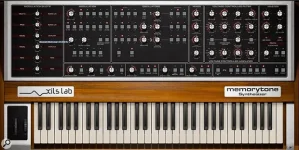
Memorymode 2 can import original Memorymoog cassette backups saved as WAV files, giving old hardware patches a direct route into a modern plugin. MemoryTone’s published feature set, by contrast, focuses on recreating the synth architecture and does not document a comparable hardware-patch import system.
For anyone sitting on old MemoryMoog data, this difference matters more than another effect or modulation slot. A patch archive can represent years of custom sounds, studio recalls, and backups made when cassette storage was a perfectly ordinary part of owning a programmable synthesizer.
Old tapes are not automatically clean data. A recording can be incomplete, damaged, or simply fail to decode, and Memorymode 2 reports an error instead of filling the library with questionable conversions. Keeping the original WAV therefore matters, especially when the only surviving copy came from aging media.
Memorymode 2 also handles compatible Memorymoog SysEx files, but there is an important catch. The standard factory Memorymoog did not provide this form of SysEx transfer, so the feature applies to instruments fitted with the Lintronics Advanced Memorymoog upgrade. Compatible .syx files can be dragged directly onto the interface and converted into software presets.
The route only runs one way. Memorymode 2 does not export those edited presets back to a LAMM-equipped Memorymoog because its extra layers, modulation, sequencing, and effects contain information the hardware format cannot represent. Around the same era, programmable synthesizer memory systems were already treating stored parameter values and live panel control as a serious engineering problem rather than a convenience.
Cherry Audio goes further with the factory library. MemoryMode 2 includes the original 100 Memorymoog factory programs imported from a cassette backup, so those sounds are based on recovered program data rather than somebody rebuilding each patch from screenshots or memory. For vintage patch users, provenance is a practical feature.
You can still rebuild an old sound by matching controls and listening carefully. What you do not get, based on the currently documented feature set, is an automated bridge from an archived Memorymoog bank into the plugin. Anyone with dozens of personal hardware patches would feel the difference quickly.
The MemoryTone Memorymoog-style synthesis engine makes more sense when your starting point is a new patch rather than an old data file. Its modulation matrix, extra sub oscillator, expressive control, and effects let you push the familiar architecture into current production work without pretending every modern parameter has a vintage equivalent.
Patch continuity and sonic emulation are separate jobs. A plugin can model the behavior of old circuitry closely while offering no route for reading the old instrument’s saved program data, just as a converter can preserve parameter values without guaranteeing identical sound. Memorymode 2 happens to address both sides more directly for archive owners.
Exact recall still needs care. Cherry Audio says revisions to the filter, envelopes, and other analog modeling can make an imported version 1 preset sound slightly different, with manual adjustment sometimes required. Memorymode 2 installs separately from version 1, so an old project does not have to surrender its original instrument merely because the newer one exists.
Once an imported patch is inside Memorymode 2, it can use dual layers, expanded modulation, Motion Controls, the Touch Animator, and newer effects. Those additions are useful, but they also move the sound farther from anything an original Memorymoog could store. Saving the untouched WAV or SysEx source alongside the converted preset keeps the historical data separate from whatever the modern plugin becomes.
For anyone sitting on old MemoryMoog data, this difference matters more than another effect or modulation slot. A patch archive can represent years of custom sounds, studio recalls, and backups made when cassette storage was a perfectly ordinary part of owning a programmable synthesizer.
Memorymode 2 treats old patch data as something worth rescuing
The original Memorymoog could hold 100 patches in its internal memory and move those programs to cassette tape for longer-term storage. Memorymode 2 can read a complete cassette backup after it has been transferred to an uncompressed WAV file, with mono and stereo recordings supported. Drop the file onto the plugin, and it attempts to decode the stored programs.Old tapes are not automatically clean data. A recording can be incomplete, damaged, or simply fail to decode, and Memorymode 2 reports an error instead of filling the library with questionable conversions. Keeping the original WAV therefore matters, especially when the only surviving copy came from aging media.
Memorymode 2 also handles compatible Memorymoog SysEx files, but there is an important catch. The standard factory Memorymoog did not provide this form of SysEx transfer, so the feature applies to instruments fitted with the Lintronics Advanced Memorymoog upgrade. Compatible .syx files can be dragged directly onto the interface and converted into software presets.
The route only runs one way. Memorymode 2 does not export those edited presets back to a LAMM-equipped Memorymoog because its extra layers, modulation, sequencing, and effects contain information the hardware format cannot represent. Around the same era, programmable synthesizer memory systems were already treating stored parameter values and live panel control as a serious engineering problem rather than a convenience.
Cherry Audio goes further with the factory library. MemoryMode 2 includes the original 100 Memorymoog factory programs imported from a cassette backup, so those sounds are based on recovered program data rather than somebody rebuilding each patch from screenshots or memory. For vintage patch users, provenance is a practical feature.
MemoryTone is better treated as a fresh instrument
MemoryTone approaches the same heritage from another direction. It gives you a 16-voice, three-oscillator architecture, a self-oscillating ladder filter, six flexible modulation slots, an advanced arpeggiator, MPE, and a substantial factory library, but its current published feature material does not advertise Memorymoog cassette or SysEx import.You can still rebuild an old sound by matching controls and listening carefully. What you do not get, based on the currently documented feature set, is an automated bridge from an archived Memorymoog bank into the plugin. Anyone with dozens of personal hardware patches would feel the difference quickly.
The MemoryTone Memorymoog-style synthesis engine makes more sense when your starting point is a new patch rather than an old data file. Its modulation matrix, extra sub oscillator, expressive control, and effects let you push the familiar architecture into current production work without pretending every modern parameter has a vintage equivalent.
Patch continuity and sonic emulation are separate jobs. A plugin can model the behavior of old circuitry closely while offering no route for reading the old instrument’s saved program data, just as a converter can preserve parameter values without guaranteeing identical sound. Memorymode 2 happens to address both sides more directly for archive owners.
Old software presets create another migration problem
Memorymode 2 also imports user and third-party presets from the first Memorymode. Those files are translated into the new format as single-layer presets, while compatible older effects are reassigned to newer equivalents in the updated effects system. MIDI mappings attached to version 1 presets do not carry over.Exact recall still needs care. Cherry Audio says revisions to the filter, envelopes, and other analog modeling can make an imported version 1 preset sound slightly different, with manual adjustment sometimes required. Memorymode 2 installs separately from version 1, so an old project does not have to surrender its original instrument merely because the newer one exists.
Once an imported patch is inside Memorymode 2, it can use dual layers, expanded modulation, Motion Controls, the Touch Animator, and newer effects. Those additions are useful, but they also move the sound farther from anything an original Memorymoog could store. Saving the untouched WAV or SysEx source alongside the converted preset keeps the historical data separate from whatever the modern plugin becomes.