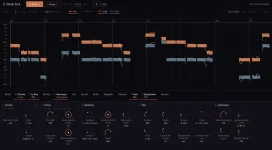
Melody Rack processes fourteen MIDI effects in sequence, and moving one slot can change the notes, timing, harmony, or expression produced downstream. Reordering is not housekeeping. Each processor receives whatever the processor before it has already changed.
Two chains can contain the same effects with the same knob settings and still produce different music. Harmony after an arpeggiator works on the arpeggiated notes, while an arpeggiator placed later receives the harmony notes as part of its input. Both orders are valid, but they are solving different jobs.
The useful way to read the rack is from left to right as a stream of changing MIDI evidence. Symbolic music transformation research describes musical transformations as operations on symbolic structures, and serial processing makes the consequence concrete. Change an earlier structure, and every later processor is handed a different phrase.
Motif belongs on the other side for a different reason. Inversion, retrograde, sequencing, or other phrase-level changes can alter the melody Chords is supposed to analyze. Put Motif after Chords, and the progression may describe the phrase that existed before the transformation rather than the notes now passing through the rack.
A sequence appended after Chords creates an even clearer failure. Chords fits its progression to the phrase it receives and stops at the end of that material, so notes added later can extend beyond the harmonic map. The MIDI still plays, yet downstream processors no longer have chord information underneath every new note.
This is where Melody Rack’s reorderable MIDI effect chain differs from an ordinary row of unrelated MIDI utilities. Chord context is produced inside the chain and consumed later in the same chain. Moving the producer changes what the consumers know.
The difference is easy to test with an uneven phrase. Push Feel toward the grid, place it before a rhythm-generating effect, and the generator works from already tightened onsets. Move Feel behind the generator, and the generated material can inherit more of the original push and drag before final timing correction happens.
Order also changes what a processor is allowed to multiply. Euclid can turn one sustained note into several rhythmic events, while Arp can turn chord material into an ordered stream. A processor placed after either one sees many events where an earlier position may have seen only one note or one chord.
Generic MIDI chain advice usually stops at saying order matters. The more useful rule is to name the intermediate MIDI after every slot. If a stage changes note count, onset time, pitch, duration, or harmonic context, the next stage is not processing the original melody anymore.
Time movement creates a related problem. When a note shifts later in the phrase, its pitch curve has to travel with it rather than remain at the old beat. Melody Rack keeps those two pieces together, which means timing transformations can happen without leaving the expressive bend stranded behind.
The chain is also deterministic enough for controlled comparisons. Its effects act on incoming notes without mutating the original take, and random behavior is seeded per run. Moving one slot therefore does not automatically reroll Chance or invent a fresh humanization pass, so you can hear the consequence of order rather than a different random result.
A good test uses one short take and changes only one pair of neighboring slots. Listen for what changed in note count, chord fit, timing, or expression before touching another control. Once two processors move at the same time, it becomes much harder to tell which intermediate MIDI state actually caused the new result.
Two chains can contain the same effects with the same knob settings and still produce different music. Harmony after an arpeggiator works on the arpeggiated notes, while an arpeggiator placed later receives the harmony notes as part of its input. Both orders are valid, but they are solving different jobs.
The useful way to read the rack is from left to right as a stream of changing MIDI evidence. Symbolic music transformation research describes musical transformations as operations on symbolic structures, and serial processing makes the consequence concrete. Change an earlier structure, and every later processor is handed a different phrase.
Chord placement creates the chain’s hard boundary
Chords are the dividing line in Melody Rack’s default order because it writes the progression that harmony-aware processors later read. Move a chord-following effect ahead of Chords, and it loses that progression as context. In Key, Harmony, and Echo can still work there, but their chord-following behavior falls back to scale-only processing.Motif belongs on the other side for a different reason. Inversion, retrograde, sequencing, or other phrase-level changes can alter the melody Chords is supposed to analyze. Put Motif after Chords, and the progression may describe the phrase that existed before the transformation rather than the notes now passing through the rack.
A sequence appended after Chords creates an even clearer failure. Chords fits its progression to the phrase it receives and stops at the end of that material, so notes added later can extend beyond the harmonic map. The MIDI still plays, yet downstream processors no longer have chord information underneath every new note.
This is where Melody Rack’s reorderable MIDI effect chain differs from an ordinary row of unrelated MIDI utilities. Chord context is produced inside the chain and consumed later in the same chain. Moving the producer changes what the consumers know.
Timing effects can erase detail before generators read it
Feel sitting late in the default chain looks like a cosmetic choice until another effect tries to copy your performance timing. Quantize the source heavily before Arp or Euclid reads it, and those generators receive a cleaner grid, but less of the timing you actually played or sang. Moving Feel later lets them react to the looser source first.The difference is easy to test with an uneven phrase. Push Feel toward the grid, place it before a rhythm-generating effect, and the generator works from already tightened onsets. Move Feel behind the generator, and the generated material can inherit more of the original push and drag before final timing correction happens.
Order also changes what a processor is allowed to multiply. Euclid can turn one sustained note into several rhythmic events, while Arp can turn chord material into an ordered stream. A processor placed after either one sees many events where an earlier position may have seen only one note or one chord.
Generic MIDI chain advice usually stops at saying order matters. The more useful rule is to name the intermediate MIDI after every slot. If a stage changes note count, onset time, pitch, duration, or harmonic context, the next stage is not processing the original melody anymore.
Expression belongs after note structure is settled
Expression is late because sung pitch curves need to follow the notes they belong to after structural transformations finish. A retrograde can reverse a note, and Euclid can split one note into several pieces. Applying expressive pitch data too early risks attaching performance movement to note structures that are about to be replaced.Time movement creates a related problem. When a note shifts later in the phrase, its pitch curve has to travel with it rather than remain at the old beat. Melody Rack keeps those two pieces together, which means timing transformations can happen without leaving the expressive bend stranded behind.
The chain is also deterministic enough for controlled comparisons. Its effects act on incoming notes without mutating the original take, and random behavior is seeded per run. Moving one slot therefore does not automatically reroll Chance or invent a fresh humanization pass, so you can hear the consequence of order rather than a different random result.
A good test uses one short take and changes only one pair of neighboring slots. Listen for what changed in note count, chord fit, timing, or expression before touching another control. Once two processors move at the same time, it becomes much harder to tell which intermediate MIDI state actually caused the new result.