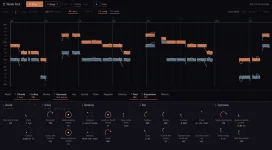
Melody Rack can export a sung pitch curve as a per-note MPE bend, while plain MIDI export carries notes without that continuous expression. The note survives either way, but the movement around it does not.
A singer rarely travels from one pitch to the next in ruler-straight steps. Scoops, falls, drift, vibrato, and small corrections happen inside the note, and continuous vocal pitch movement is part of what separates a performed line from a row of fixed pitch centers.
Melody Rack keeps frame-level pitch information from the sung take instead of throwing it away after transcription. Its Expression stage can decide how much of that movement reaches the synth, with the flat-note end of the control removing the contour and the expressive end retaining the scoop, drift, and fall.
Plain drag-out deliberately chooses compatibility over those details. Song Cage documents the plain file as notes only, which means it can play on ordinary MIDI destinations without requiring an MPE-aware instrument. You get a clean symbolic melody that is easy to edit, transpose, quantize, or hand to a synth with no special expression setup.
The compromise becomes audible on exposed lead lines. A clean note sequence can reproduce the melody accurately while still sounding oddly stiff because the original singer did not perform a sequence of perfectly centered blocks. The missing information lives inside each note rather than between the notes.
Melody Rack uses that per-note path for the pitch curve it retained from the voice. Drag the result as MPE and the curve rides with the relevant note as bend data, which lets one note scoop upward while another note can remain steady. Melody Rack’s expressive MIDI export therefore preserves a different layer of the performance than a plain note-only clip.
The distinction gets more useful after editing. Transpose a note inside Melody Rack and its curve moves with it rather than staying behind at the old pitch. Reverse a phrase and the associated curves reverse with their notes, so structural MIDI changes do not automatically detach the vocal movement that made those notes feel performed.
MPE also declares a bend range for the receiving instrument. Melody Rack uses the MPE convention of a wide per-note range, while its plain output uses a much smaller ordinary bend range. A receiving synth still needs to understand MPE correctly, because a disagreement about bend range can turn a subtle scoop into a wildly wrong pitch.
This is why the safest comparison uses the same take in two exports. Put the plain clip and the MPE clip on separate tracks with the same MPE-capable instrument, then solo them alternately. The pitches and rhythm should tell the same basic melodic story, while the MPE version reveals the motion inside held notes.
Dense generated parts need a little more care than a monophonic sung lead. MPE has a finite pool of member channels, and each active note needs independent channel space while it is sounding if you want separate control. Long releases and overlapping notes can consume those channels faster than a short vocal phrase.
Expression is also not automatically better at full strength. A pitch curve captured from a loose demo may contain useful character, uncertain intonation, or both. Reducing the Expression amount can keep enough movement to stop the line feeling rigid without forcing every wobble in the scratch vocal onto the finished synth part.
Plain MIDI still has a strong job. Use it when the exact notes matter more than the route your voice took through them, when the destination instrument lacks MPE, or when you want a neutral line for heavy editing. Use MPE when the bend into a note, the drift across it, or the fall at its edge is part of the phrase you actually meant to keep.
A singer rarely travels from one pitch to the next in ruler-straight steps. Scoops, falls, drift, vibrato, and small corrections happen inside the note, and continuous vocal pitch movement is part of what separates a performed line from a row of fixed pitch centers.
Plain MIDI keeps the note and drops the journey
Standard note data is very good at saying which note starts, when it starts, and when it ends. A sung C can therefore become a C in the piano roll even if the voice approached it from below, hovered slightly sharp, then fell away at the release. The note identity remains useful, but much of the performance between those points has disappeared.Melody Rack keeps frame-level pitch information from the sung take instead of throwing it away after transcription. Its Expression stage can decide how much of that movement reaches the synth, with the flat-note end of the control removing the contour and the expressive end retaining the scoop, drift, and fall.
Plain drag-out deliberately chooses compatibility over those details. Song Cage documents the plain file as notes only, which means it can play on ordinary MIDI destinations without requiring an MPE-aware instrument. You get a clean symbolic melody that is easy to edit, transpose, quantize, or hand to a synth with no special expression setup.
The compromise becomes audible on exposed lead lines. A clean note sequence can reproduce the melody accurately while still sounding oddly stiff because the original singer did not perform a sequence of perfectly centered blocks. The missing information lives inside each note rather than between the notes.
MPE gives each note its own pitch movement
Traditional MIDI pitch bend is channel-wide, so every sounding note on the same channel responds to the same bend message. MPE works around that limitation by assigning active notes to separate member channels, allowing pitch bend and other expression messages to address notes independently.Melody Rack uses that per-note path for the pitch curve it retained from the voice. Drag the result as MPE and the curve rides with the relevant note as bend data, which lets one note scoop upward while another note can remain steady. Melody Rack’s expressive MIDI export therefore preserves a different layer of the performance than a plain note-only clip.
The distinction gets more useful after editing. Transpose a note inside Melody Rack and its curve moves with it rather than staying behind at the old pitch. Reverse a phrase and the associated curves reverse with their notes, so structural MIDI changes do not automatically detach the vocal movement that made those notes feel performed.
MPE also declares a bend range for the receiving instrument. Melody Rack uses the MPE convention of a wide per-note range, while its plain output uses a much smaller ordinary bend range. A receiving synth still needs to understand MPE correctly, because a disagreement about bend range can turn a subtle scoop into a wildly wrong pitch.
The destination synth decides whether expression survives
Exporting MPE does not guarantee expressive playback by itself. The instrument receiving the clip has to support per-note expression and interpret the bend data on the member channels. A synth that ignores MPE may play the underlying notes while discarding or mishandling the movement you expected to hear.This is why the safest comparison uses the same take in two exports. Put the plain clip and the MPE clip on separate tracks with the same MPE-capable instrument, then solo them alternately. The pitches and rhythm should tell the same basic melodic story, while the MPE version reveals the motion inside held notes.
Dense generated parts need a little more care than a monophonic sung lead. MPE has a finite pool of member channels, and each active note needs independent channel space while it is sounding if you want separate control. Long releases and overlapping notes can consume those channels faster than a short vocal phrase.
Expression is also not automatically better at full strength. A pitch curve captured from a loose demo may contain useful character, uncertain intonation, or both. Reducing the Expression amount can keep enough movement to stop the line feeling rigid without forcing every wobble in the scratch vocal onto the finished synth part.
Plain MIDI still has a strong job. Use it when the exact notes matter more than the route your voice took through them, when the destination instrument lacks MPE, or when you want a neutral line for heavy editing. Use MPE when the bend into a note, the drift across it, or the fall at its edge is part of the phrase you actually meant to keep.