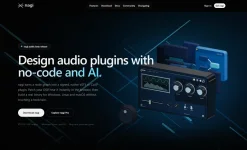
Nagi builds VST3 and CLAP plugins inside one desktop app, while Audio Plugin Coder 1.5.0 orchestrates AI agents around JUCE 9 and CMake. Both are trying to remove the blank-project pain from plugin development, but they remove different parts of it.
Nagi puts the signal graph, Faust editor, interface designer, preview, local AI helper, and build step in the same application. Audio Plugin Coder, or APC, gives an AI coding agent a structured development system for planning, generating, testing, debugging, and packaging a conventional plugin codebase.
The difference gets obvious once something breaks. With Nagi, you are mainly debugging the patch, Faust DSP, parameter mapping, or export. With APC, you can end up debugging generated C++, JUCE behavior, CMake, the compiler, WebView code, platform SDKs, or the agent's implementation choices.
Projects stay as ordinary files on disk, and the AI helper runs locally. Building does not require an account. The current output is VST3 and CLAP across Windows, macOS, and Linux, with either local builds or an isolated container available.
You can still get technical. The Faust DSP route inside Nagi gives you main.dsp, the Faust standard library, parameter paths, and custom signal processing without turning the whole project into a JUCE application.
APC exposes much more of the machinery. Version 1.5.0 expects a coding agent plus Git, Node.js, Python, CMake, JUCE 9, pluginval, and a platform compiler stack. Windows adds Visual Studio C++, macOS uses Xcode, and Linux needs a proper C++ toolchain plus audio and WebView dependencies.
Its setup scripts check much of this for you, but the dependencies still exist. The Audio Plugin Coder local setup becomes useful precisely because an agent cannot compile around a missing SDK or a broken compiler path.
The framework currently supports VST3 and standalone builds across its three desktop platforms, AU on macOS, and LV2 on Linux. CLAP is still on its roadmap. Nagi goes the other direction by shipping VST3 and CLAP now, while AU and LV2 are not part of its stated output.
UI work also splits sharply. Nagi gives you a visual interface builder with parameter-bound controls, while APC can use WebView interfaces or an experimental native Visage route. Complex custom application behavior is therefore more accessible in APC, but you are also taking responsibility for more moving parts.
Generated code still needs normal software testing. The Codex code-generation evaluation treated executable tests as the judge of whether generated programs actually worked, which is a useful rule here too. A convincing agent response is not the same thing as a plugin surviving validation, automation, state recall, and a long DAW session.
Licensing also deserves attention before shipping. APC itself uses the MIT licence, but its current documentation notes that plugins built on JUCE remain subject to JUCE's licensing terms. Closed-source distribution can therefore introduce a JUCE licensing decision that does not come from APC's own MIT licence.
APC fits better when the plugin is supposed to become a software project you can keep extending at source level. Its agent workflow can maintain project state, generate implementation code, run validation steps, patch released plugins, and evolve features later instead of treating the first successful binary as the end of the job.
The trade is control for responsibility. Nagi hides more infrastructure and narrows the development model around its graph, Faust, GUI system, and supported formats. APC opens the JUCE stack and gives the agent room to change far more, but compiler failures, framework behavior, dependencies, licensing, and generated-code quality become part of your problem too.
For a small custom effect, the extra APC machinery can be unnecessary overhead. For a plugin that needs unusual host behavior, a heavily custom interface, AU or LV2 output, or long-term source-level development, the machinery may be exactly the part you need.
Nagi puts the signal graph, Faust editor, interface designer, preview, local AI helper, and build step in the same application. Audio Plugin Coder, or APC, gives an AI coding agent a structured development system for planning, generating, testing, debugging, and packaging a conventional plugin codebase.
The difference gets obvious once something breaks. With Nagi, you are mainly debugging the patch, Faust DSP, parameter mapping, or export. With APC, you can end up debugging generated C++, JUCE behavior, CMake, the compiler, WebView code, platform SDKs, or the agent's implementation choices.
Nagi keeps the toolchain behind the canvas
Nagi is the lighter route when the main job is sound design rather than software engineering. The Nagi no-code plugin workflow starts with nodes, lets you audition the patch immediately, and only asks for Faust when the stock blocks stop being enough.Projects stay as ordinary files on disk, and the AI helper runs locally. Building does not require an account. The current output is VST3 and CLAP across Windows, macOS, and Linux, with either local builds or an isolated container available.
You can still get technical. The Faust DSP route inside Nagi gives you main.dsp, the Faust standard library, parameter paths, and custom signal processing without turning the whole project into a JUCE application.
APC exposes much more of the machinery. Version 1.5.0 expects a coding agent plus Git, Node.js, Python, CMake, JUCE 9, pluginval, and a platform compiler stack. Windows adds Visual Studio C++, macOS uses Xcode, and Linux needs a proper C++ toolchain plus audio and WebView dependencies.
Its setup scripts check much of this for you, but the dependencies still exist. The Audio Plugin Coder local setup becomes useful precisely because an agent cannot compile around a missing SDK or a broken compiler path.
Audio Plugin Coder gives you more code to own
APC's main advantage is not simply that an AI writes code. It produces a JUCE-based project that can move through architecture, interface design, implementation, testing, debugging, packaging, later bug fixes, and feature upgrades. Version 1.5.0 also adds the APC Hub, a local dashboard for project state, documentation, tools, and settings.The framework currently supports VST3 and standalone builds across its three desktop platforms, AU on macOS, and LV2 on Linux. CLAP is still on its roadmap. Nagi goes the other direction by shipping VST3 and CLAP now, while AU and LV2 are not part of its stated output.
UI work also splits sharply. Nagi gives you a visual interface builder with parameter-bound controls, while APC can use WebView interfaces or an experimental native Visage route. Complex custom application behavior is therefore more accessible in APC, but you are also taking responsibility for more moving parts.
Generated code still needs normal software testing. The Codex code-generation evaluation treated executable tests as the judge of whether generated programs actually worked, which is a useful rule here too. A convincing agent response is not the same thing as a plugin surviving validation, automation, state recall, and a long DAW session.
Licensing also deserves attention before shipping. APC itself uses the MIT licence, but its current documentation notes that plugins built on JUCE remain subject to JUCE's licensing terms. Closed-source distribution can therefore introduce a JUCE licensing decision that does not come from APC's own MIT licence.
The real choice is where you want the complexity
Nagi makes more sense when you want to think in signal flow first. You can sketch a processor visually, move into Faust for custom DSP, build the panel, and export without personally managing a full C++ application stack. Its platform limits still matter at release time, especially around host formats and architecture.APC fits better when the plugin is supposed to become a software project you can keep extending at source level. Its agent workflow can maintain project state, generate implementation code, run validation steps, patch released plugins, and evolve features later instead of treating the first successful binary as the end of the job.
The trade is control for responsibility. Nagi hides more infrastructure and narrows the development model around its graph, Faust, GUI system, and supported formats. APC opens the JUCE stack and gives the agent room to change far more, but compiler failures, framework behavior, dependencies, licensing, and generated-code quality become part of your problem too.
For a small custom effect, the extra APC machinery can be unnecessary overhead. For a plugin that needs unusual host behavior, a heavily custom interface, AU or LV2 output, or long-term source-level development, the machinery may be exactly the part you need.