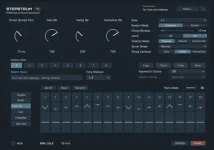
Notewerks has released StepStrum 1.2, giving music producers more ways to shape MIDI strums and rhythms. The update adds shorter patterns, new note speeds, and a way to change the pace of a whole pattern bank at once.
StepStrum takes chords from a MIDI keyboard and plays them back as strums, picked notes, or timed riffs. It works with virtual guitars, synths, and samplers, keeping each part in sync with the song's beat.
One big change is the freedom to choose how long a pattern runs. StepStrum Pro users can pick anywhere from 4 to 16 steps, rather than being stuck with the old 16-step limit.
And those odd step counts could be fun to mess with. A loop with 5, 7, or 11 steps can shift against a regular beat, giving a track a less rigid groove. Short loops also work for bass riffs and quick ideas that don't need a long sequence.
Each of the eight slots can have a different step count. That means a producer can jump between short and long loops without having to rebuild them. Lite users still get the fixed 16-step setup, though.
Timing gets a nice upgrade as well. Before this release, every slot had to share one Time Division value. With 1.2, each pattern can run at its own note speed.
For instance, one slot might play eighth notes, while another runs a fast sixteenth-note riff. A third could move at a much slower pace. When a producer swaps slots, the timing changes with the pattern.
Notewerks has also added 1/2, 1/1, and 2/1 note divisions. These longer values give users room to make slow bass parts, drawn-out notes, and ambient sounds. The old quarter-note, triplet, eighth-note, and sixteenth-note choices remain part of the mix.
Then there's the new Rate knob for the full bank. It has three settings: ½×, 1×, and 2×. One slows every pattern, another keeps the usual speed, and the last doubles it. Each slot keeps its saved timing value even as the bank speed changes.
The cool bit is how these controls work together. Producers can mix short and long loops, set a different beat value for each, and change the pace of all eight without editing them one by one.
As for the price, anyone who already has StepStrum can get version 1.2 at no extra cost. The Lite edition remains free, while Pro costs $39.